
The Space Elevator
A 22,000-Mile Journey to the Stars

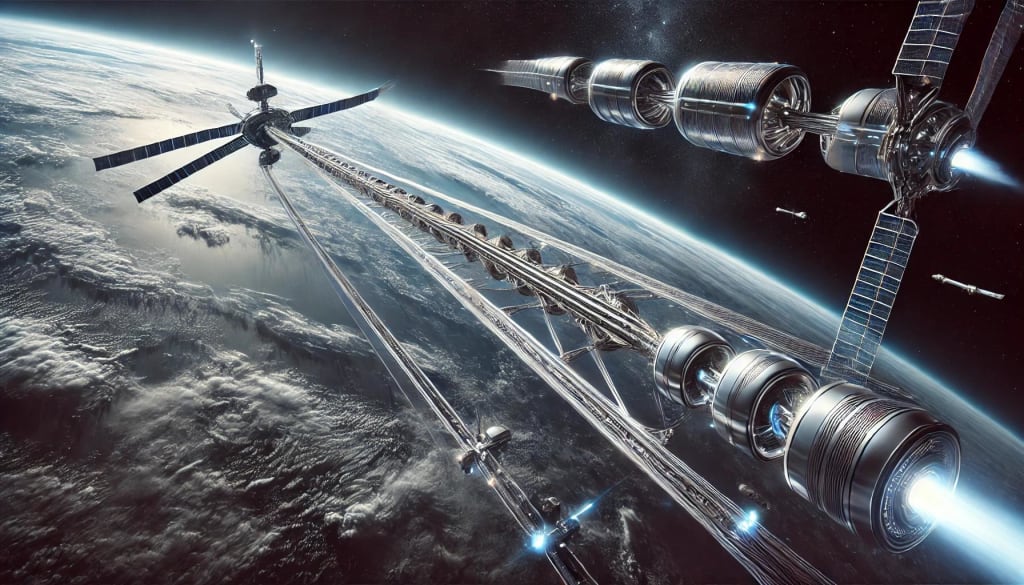
Imagine stepping into an elevator that doesn’t just take you up a few floors but lifts you all the way to space! With advancements in space technology moving at an astounding pace, experts believe that by the mid-21st century, humans might be able to travel to space as easily as hopping on a plane. One of the most groundbreaking ideas in this new frontier is the Space Elevator, a revolutionary structure that could redefine interstellar travel.
Japan’s Bold Vision: The Space Elevator Project
In Japan, a visionary group of engineers has unveiled an ambitious plan to construct a space elevator that spans roughly 22,000 miles (35,000 kilometers), bridging Earth and outer space. Designed by the masterminds behind Tokyo's iconic Skytree Tower, this project comes with a hefty $100 billion price tag, and if all goes according to plan, it could be ready to welcome passengers by 2050.
This isn’t just science fiction; it’s a feasible feat. Reports confirm that this "technically possible" project would cut travel time to Mars drastically. Instead of the typical multi-month journey, experts estimate that passengers could reach the Red Planet in just 40 days, thanks to advances in propulsion and orbital mechanics.
Engineering Marvel: The Elevator’s Design and Spaceport Concept
The elevator is expected to transport travelers to a spaceport stationed about 36,000 kilometers above Earth. This port will serve as a hub for further exploration into space. To begin the journey, passengers will check in at "Earth Port," a floating terminal on the equator accessible via an underwater tunnel. Engineered to withstand extreme weather conditions, the elevator’s design ensures that reaching space could soon be as simple as boarding a train.
Radian One: The Future of Reusable Spaceplanes
Another monumental advancement comes from Radian Aerospace, with its state-of-the-art spaceplane, Radian One. Set to take flight in 2028, Radian One is a rocket-powered spaceplane designed for horizontal takeoff, capable of traveling at a blistering 500 mph. This marvel of engineering can stay in orbit for up to five days and is reusable up to 100 times. With a crew capacity of two to five astronauts and a rapid 48-hour turnaround time, this aircraft could revolutionize the speed and efficiency of space travel.
As of 2024, a prototype is already in development, with a full-scale model anticipated to launch by the end of the decade. Radian One aims to reduce space travel costs and increase frequency, making it one of the most exciting projects on the aerospace horizon.
Space Balloon Neptune: A Journey to the Edge of Earth
For those looking for a more leisurely approach to the cosmos, Space Perspective has introduced a unique way to experience the final frontier. The company's flagship craft, the Neptune Space Balloon, can ascend to an astonishing altitude of 100,000 feet, offering passengers breathtaking views of Earth from the edge of space. Neptune offers the added comforts of Wi-Fi, allowing passengers to share their experiences live, along with an exclusive drink service.
Unlike conventional spacecraft, Neptune’s luxurious capsule includes a panoramic 360-degree window, lush seating, and even a bathroom designed with stylish decor and real plants. With the ability to accommodate up to eight guests, Neptune provides a rare and stunning way to experience space. The journey, which takes about six hours, includes four hours of serene floating above the Earth. Space Perspective plans to launch human flights by 2025, with commercial operations set to begin in 2026.
Further Insights and Reports
Recent studies and industry reports provide deeper insights into these innovative projects:
NASA’s 2023 Report: Details on the materials and structural challenges of building a space elevator.
Kyoto University Research: Examines the environmental impact of Earth Port, particularly on marine ecosystems near the equator.
Japanese Space Agency Findings: Exploration into ultra-strong materials for the space elevator’s cables to ensure resilience under extreme conditions.
Virgin Galactic’s Collaborations: Investment in reusable space technologies, with partnerships to support Radian One’s development.
These visionary projects represent a massive leap toward transforming space into a new frontier for tourism, science, and exploration. With rapid advancements in aerospace technology, the dream of accessible space travel is moving closer to reality, promising a future where visiting space may one day be as simple as booking a vacation.
This captivating journey to the stars is closer than ever, and with projects like the Space Elevator, Radian One, and Neptune Balloon, the next few decades holds limitless potential for human exploration beyond Earth.
About the Creator
Ahmed Wagih
I have been working in the field of writing for 10 years and have gained great experience in this field.
I am currently studying in workshops on how to summon inspiration to start writing.
I write short stories and articles in most fields
Keep reading
More stories from Ahmed Wagih and writers in Futurism and other communities.
Amazon’s AI Competitor to ChatGPT and Gemini Faces Delays Amid High Expectations
As artificial intelligence races forward with giants like OpenAI's ChatGPT and Google’s Gemini leading the way, Amazon's efforts to introduce a groundbreaking AI experience are facing delays. Initially previewed last year, Amazon’s AI-enhanced Alexa was envisioned as a revolutionary voice assistant that could reshape home automation and digital interactions. However, the release has now been postponed multiple times, pushing the anticipated launch to early 2025, as the company refines its approach to create a truly compelling AI product.
By Ahmed Wagihabout a year ago in Futurism
About Binding Prometheus
I want to start actively advocating on behalf of my own work, and the most valuable part of my canon is, without a doubt, Binding Prometheus, the play I have been working on since 2019 and only finished in 2023 as part of my MA. The play itself is an amalgamation of a million different inspirations. On one end, it evokes the Ancient Greek myth-play, deriving its own title from the earliest extant work of Western drama we have, Aeschylus’s Prometheus Bound. On the other end, it borrows significantly from the sci-fi bulwarks from over the years, namely Mary Shelley’s Frankenstein and Karel Capek’s Rossum’s Universal Robots. The play could be an episode of Black Mirror, I fear. I don’t know. I’ve only ever seen one episode of Black Mirror.
By Steven Christopher McKnight15 days ago in Futurism
United States Cannabis Market Size & Forecast 2026–2034
Introduction The United States cannabis industry is entering a defining decade. What was once a tightly regulated and socially controversial product category has evolved into a structured, multi-billion-dollar commercial ecosystem spanning agriculture, pharmaceuticals, wellness, retail, and consumer packaged goods. According to Renub Research, the United States Cannabis Market is projected to grow from USD 11.73 billion in 2025 to USD 40.41 billion by 2034, registering a robust compound annual growth rate (CAGR) of 14.73% from 2026 to 2034.
By Marthan Sir7 days ago in Futurism


Comments
There are no comments for this story
Be the first to respond and start the conversation.