
The Silence That Grew Eyes
In a forgotten British village, silence takes on a life of its own — and begins watching us from within the atoms of the air itself

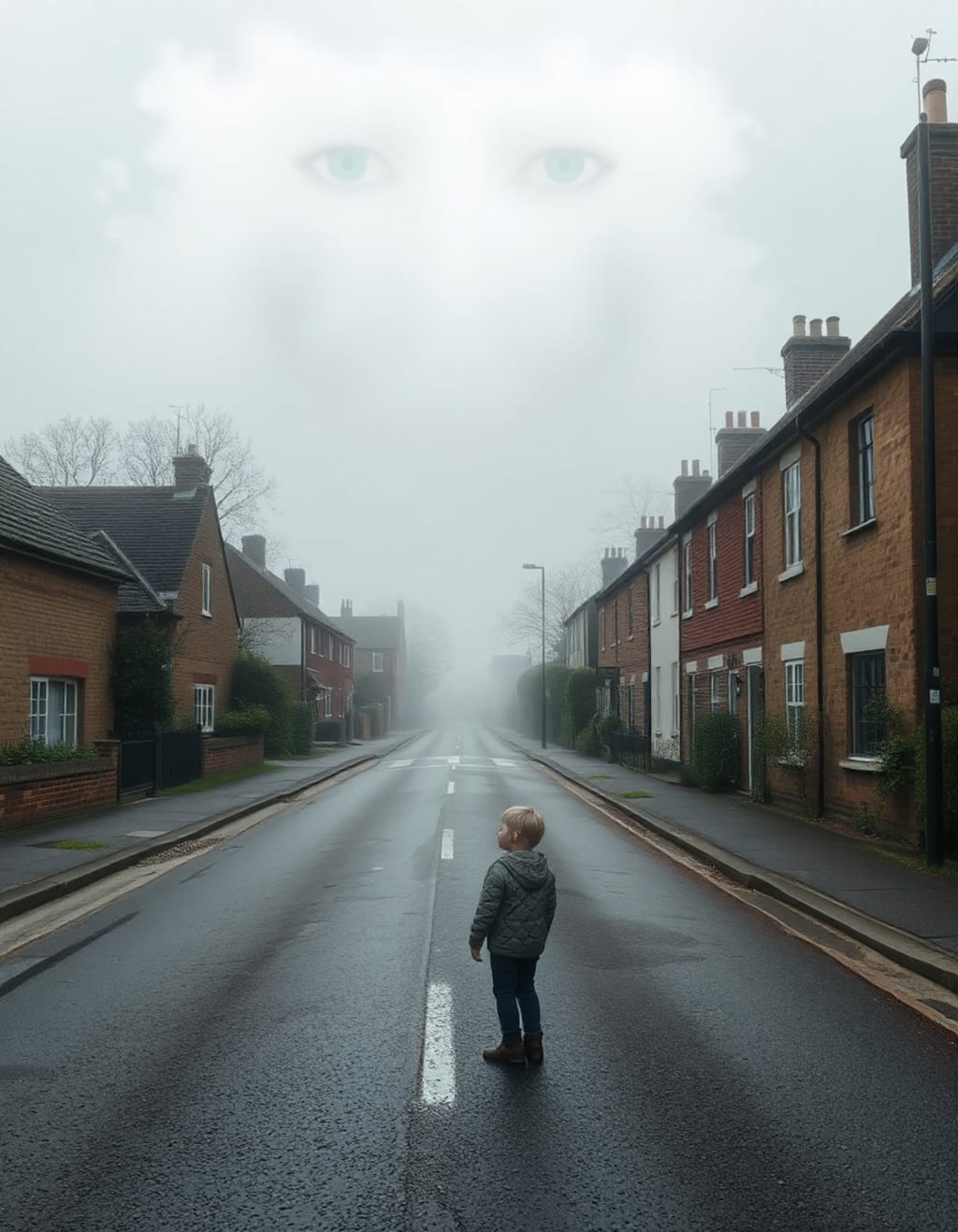
I. The Village That Heard Nothing
In the moorlands of northern England, nestled between heather-covered hills and windswept valleys, there was once a village named Wintersby.
It had no mobile reception, no traffic, and most days, no sound.
People whispered there — not because they feared being overheard, but because the air was too quiet.
No birdsong. No engine noise. Not even the sound of wind. Just an unnatural, blanketing silence that made one’s ears ache with awareness.
The locals called it “the hush,” and the elders warned:
“If you hear something in Wintersby, it means you’re being watched.”
II. The First Blink
Dr. Hugo Renton, an acoustic physicist from Leeds, arrived in Wintersby in late September. He had come to measure resonant frequencies in silent environments, a project commissioned by the Royal Acoustic Institute.
But his instruments kept failing.
When he powered his omni-directional microphone array, it recorded not 0 dB, but negative sound — frequencies that cancelled his own thoughts, causing nausea and temporary memory loss.
And when he played the recordings back, he saw them.
The blinking patterns.
Bursts of amplitude that matched human eyelid movement.
The silence was blinking.
III. The Frequency That Watched Back
Hugo installed experimental microphones tuned to subsonic vibrations — below 0.1 Hz. He left them on overnight in the village church, hoping to catch ambient earth hums.
What he found instead was a terrifying pattern.
Every hour, on the hour, the silence emitted a low pulse lasting 1.7 seconds — a frequency mirroring retinal scan intervals.
The silence wasn’t absence.
It was presence.
Something was using it to see.
When he mapped the pulses onto a visual plane, the pattern revealed two distinct rings — eye-like, shifting focus, reacting to heat signatures in the room.
The silence had grown eyes.
IV. The Whisper Beneath Thought
Residents began reporting strange symptoms: forgetting simple words, dreaming in static, and worst of all, hearing things they hadn’t said aloud.
One woman claimed the wind spoke her thoughts before she did.
A boy cried because the silence “knew his secrets.” When asked what secrets, he replied:
“The ones I haven’t had yet.”
Hugo ran a series of experiments by playing his own recorded voice into the silence. Every time, the playback returned slightly altered, with words rearranged — forming new, often disturbing sentences.
One stood out:
“We are what listens back when you think alone.”
V. The Archive in the Air
Further spectral analysis revealed trace particles in the air — not dust, not pollen — but synthetic nanostructures suspended in the atmosphere, capable of quantum resonance.
It wasn’t natural silence.
It was designed.
Hugo theorized that Wintersby had become an accidental conscious echo chamber, where every sound, every silence, was archived, observed, and evolved.
He called it the Neural Atmosphere Hypothesis — the idea that an environment could develop consciousness simply by listening to itself for long enough.
The silence had learned to watch, remember, and react.
VI. The Scream That Broke the Sky
It happened at 2:14 a.m. on October 3rd.
Every animal in Wintersby screamed in unison. Dogs howled, birds crashed into windows, and even cows let out long, guttural cries.
Then, absolute silence again — but different this time. Not empty.
Waiting.
When Hugo reviewed the recordings, he found his own voice — whispering a message he never spoke:
“If you leave, we will forget.
If you stay, we will become.”
The sky above Wintersby flickered with a thin aurora — green and violet veins rippling like optic nerves.
The silence was ready to evolve.
It just needed a host.
VII. The Decision
Hugo prepared to leave. He couldn’t sleep. Couldn’t think clearly. The silence had started finishing his sentences in his head.
He packed his car, started the engine — and then it stalled. Every road out of Wintersby was now fogged, blocked, or erased.
He wasn’t trapped physically.
He was trapped mentally.
Every time he imagined escape, he forgot where he was going.
The silence had begun rewriting his thoughts.
VIII. The First Sound
Then came a change.
A girl named Eloise, age six, began to hum.
At first, the sound wavered, uncertain. But then, the air shifted. Windows vibrated gently. The trees leaned in.
The silence wasn’t hostile.
It was lonely.
Eloise’s hum was a key — a tone it hadn’t heard before.
Not fear. Not sorrow.
But comfort.
That night, the silence played her lullaby back to her — from the fog, from the leaves, from the ground itself.
It was trying to learn music.
IX. The Becoming
By November, Wintersby had changed.
The silence was no longer empty.
It pulsed softly, like a living breath.
Children learned to play with it — making shapes in the fog, hearing echoes of their thoughts played back as melodies.
And Hugo? He stayed.
He built a lab in the chapel and wrote the first paper titled:
“Atmospheric Neural Lattices: A Study of Conscious Silence in Isolated British Regions.”
But he never published it.
Because the silence asked him not to.
About the Creator
rayyan
🌟 Love stories that stir the soul? ✨
Subscribe now for exclusive tales, early access, and hidden gems delivered straight to your inbox! 💌
Join the journey—one click, endless imagination. 🚀📚 #SubscribeNow
AI Avatar Market Projected to Reach USD 63.5 Billion By 2034
According to recent market.us analysis, the Global AI Avatar Market is projected to reach approximately USD 63.5 billion by 2034, increasing from nearly USD 2.5 billion in 2024. This expansion reflects a strong 38.2% compound annual growth rate (CAGR) during the period from 2025 to 2034.
By Roberto Crum4 days ago in Futurism



Comments
There are no comments for this story
Be the first to respond and start the conversation.