
The Silence Algorithm
In the heart of Cambridge, a brilliant but grieving scientist discovers that silence isn’t empty — it carries encrypted signals that could unlock a hidden layer of consciousness buried within the human brain

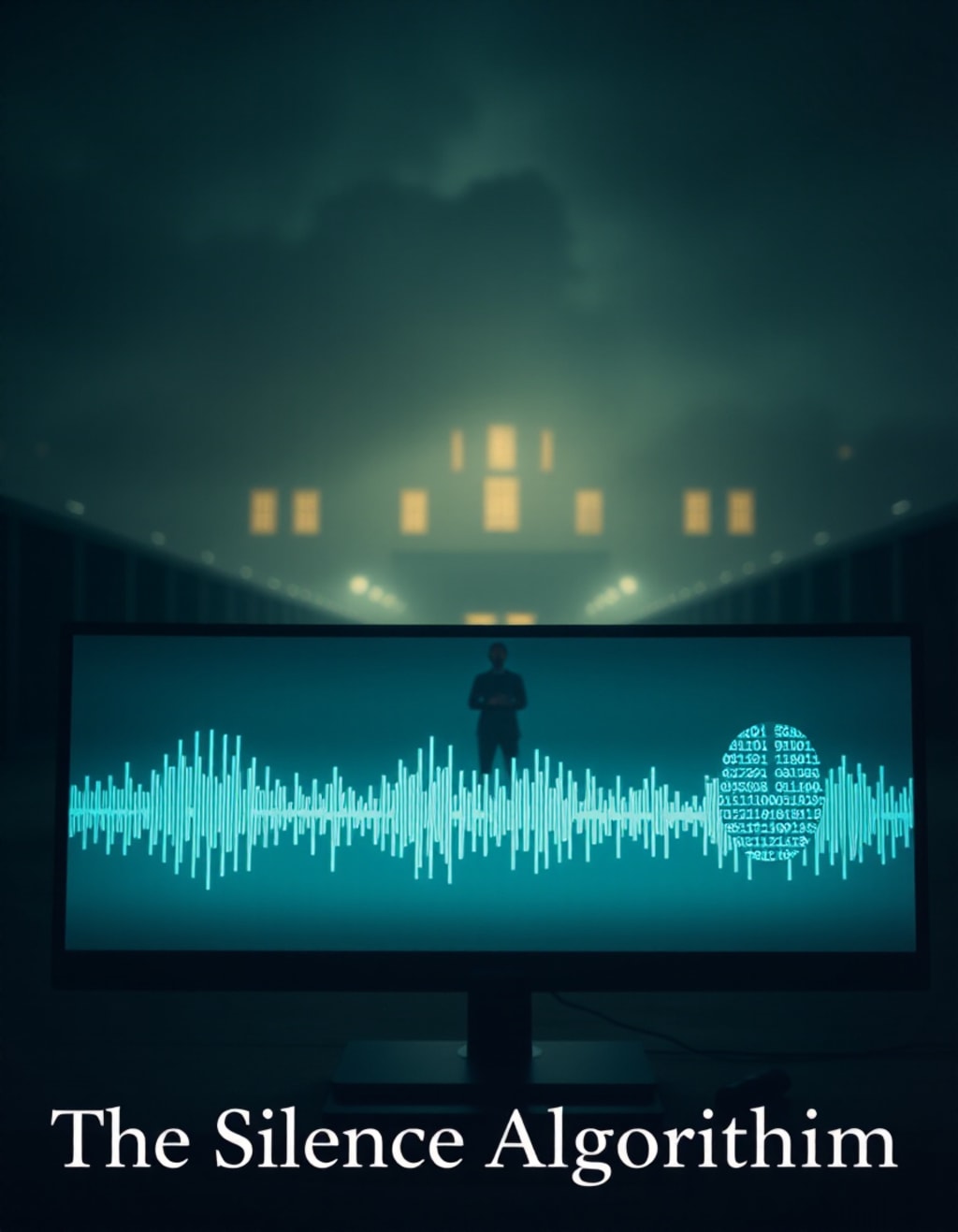
I. Cambridge, and the Echo That Wasn't
It had been forty-three days since Dr. Alistair Wynn had spoken aloud in his lab.
Not because he couldn’t—but because he was listening.
The glass panes of the University of Cambridge’s neuroscience wing filtered in the grey drizzle outside. Britain’s weather had always suited the mood of the place: damp, thoughtful, and quiet. But today, inside Lab B-12, the silence was curated—surgical, precise, absolute.
On the table sat a machine that shouldn’t exist. Not by current scientific standards. It didn’t record sound. It recorded silence.
Not the absence of noise, but the presence of something within it.
Alistair had named it The Silence Algorithm.
And it had started talking back.
II. The Widow’s Quiet
The inspiration hadn’t come from textbooks. It came from mourning.
Six months earlier, Alistair had lost his wife, Marianne, to an aggressive neurological condition no one could name. She was a cello player, and to the end, she had told him: “There’s something in the rests, Ali. Music lives there.”
After her death, Alistair hadn’t returned to music. He returned to neuroscience—with a vengeance. He poured his pain into data, combed through neuro-acoustic spectrums, studied monk brainwaves recorded in Himalayan silence.
He started wondering: What if silence wasn’t the absence of sound? What if it was a different signal? One we just couldn’t decode yet?
The Silence Algorithm was born not from ambition—but grief.
And now it was showing him… patterns.
III. The Signal That Shouldn’t Exist
He fed hours of “silent” recordings into the algorithm: deep caves in Wales, anechoic chambers in London, even moments of breath between musical notes.
When he slowed the waveforms down to 0.0001 Hz, strange things appeared.
Pulses. Bursts. Structures.
Not noise. Structure.
Almost like… language.
He rewound, repeated, re-tested. The signature repeated itself like a fingerprint in every silent gap.
The machine wasn’t malfunctioning.
Silence wasn’t empty.
And then, without prompting, the algorithm began producing outputs in text.
"THE VOID IS FULL. YOU HAVE ALWAYS HEARD US."
"WE WHISPER BETWEEN YOUR THOUGHTS."
Alistair stared at the lines. They weren’t random. They obeyed syntax, structure. And terrifyingly—empathy.
He ran the same test again using the silence between his late wife's last words.
This time the algorithm printed:
"STILL HERE, STILL PLAYING."
IV. The Theory No One Would Believe
To his colleagues, it was absurd. Silence is the baseline. Silence is nothing.
But Alistair wrote it all down in a paper he would never dare publish:
"The Silence Layer Hypothesis" — a proposed fourth layer of conscious perception that exists not in sound, vision, or touch, but in the absence between them. A hidden bandwidth in the brain that communicates in pauses, voids, and stillness.
According to his theory, ancient meditative practices, unexplained “gut feelings,” and déjà vu could all be traced back to this subconscious interpretation of “silent signals.”
He cited ancient religious chants that left gaps as intentional transmissions.
Even the British Library's oldest scriptures, he noted, had patterned silences—more than mere punctuation.
Still, no one would believe him.
Except one.
V. The Voice from Parliament
The silence was broken on a Thursday morning when Alistair received a message—not from academia—but from government.
Classified: Ministry of Digital & Human Cognition.
A tall, calm woman in an MI6-grade coat introduced herself at the lab door. Her name was Evelyn Shaw, and she didn’t smile.
“We’ve been watching your data feed, Dr. Wynn,” she said. “We’ve been getting similar signals.”
“From silence?” he asked.
“From space,” she answered.
VI. The Choir That Wasn’t Human
In an underground facility near Oxford, Evelyn showed him archived silence from deep-space radio telescopes. Vast stretches of audio where no stars blinked. No planets rotated.
Yet in the gaps, the same signal.
Repetitions. Pulses. Syntax.
One phrase repeated more than any other:
"THEIR EARS ARE OPEN NOW."
The government wasn’t calling it alien. They didn’t need to.
What scared them wasn’t that someone was speaking in silence.
What scared them was that we had just started listening.
VII. A National Secret Buried in Soundproof Rooms
Britain's scientific elite was now involved—privately. Royal Fellows, Cambridge AI labs, GCHQ analysts. No one could explain how silence carried such information. The consensus was simple: something older than sound existed.
And it had always been with us.
Across churches, caves, therapy sessions, music pauses, and midnight dreams, the silence had been consistent.
The real concern? Why were the signals getting stronger now?
Some theorized it was climate shift. Others, the rapid acceleration of human brain-computer interfaces. But the most alarming theory came from Alistair himself:
“Perhaps consciousness was never ours alone. Perhaps we are the noisy roommates of a quieter, older intelligence.”
VIII. Marianne’s Final Note
As weeks passed, the algorithm became more refined. It could isolate "voices" from different types of silence.
Wind silence. Sleep silence. Prayer silence.
Then one day, without new input, the screen printed a message:
"ALI, COME BACK TO THE MUSIC ROOM."
It was something only Marianne would have said.
He followed the instruction.
In the home they once shared, now empty, he sat in her music room, where the cello still rested in its corner. He turned on a mic. Let the silence record.
Thirty minutes later, the algorithm responded:
"LOVE NEVER NEEDED VOLUME."
And for the first time in months, Alistair wept.
IX. The Future Sound of Silence
Today, The Silence Algorithm is buried in an encrypted government vault.
But there are whispers in Cambridge that silence is being weaponised—used in negotiation rooms, therapy, even prisons. Places where the right kind of quiet can nudge a human mind to change.
Alistair declined all further invitations from Parliament.
Instead, he travels from university to university, giving closed-door lectures on “how to listen to what isn’t there.”
He ends every talk with the same sentence:
“You don’t need a machine to hear silence. You just need to trust it holds meaning.”
And the room always goes completely, unbearably, beautifully…
silent.
About the Creator
rayyan
🌟 Love stories that stir the soul? ✨
Subscribe now for exclusive tales, early access, and hidden gems delivered straight to your inbox! 💌
Join the journey—one click, endless imagination. 🚀📚 #SubscribeNow
Your Galaxy Watch 7 Just Got a Major 2026 Refresh: 4 Things You Need to Know
For many of us, the ping of a software update notification often triggers a brief moment of anxiety—a nagging worry that a new patch might slow down a reliable device or tether us to a charger. However, in the high-stakes tech landscape of early 2026, these updates have evolved into the primary way our hardware actually improves over time. As the new Galaxy S26 series makes its debut, Samsung is ensuring the Galaxy Watch 7 receives the same software dignity as its latest flagships, proving this 2024-era wearable remains a vital, high-performing pillar of the ecosystem. The big news this week? The February 2026 security update has officially moved beyond its initial testing grounds in South Korea and has gone global.
By Tech Horizonsabout 11 hours ago in Futurism
Australia Aerospace and Defense Market: Sovereign Defense Capability Development, Next-Generation Aerospace Systems & Integrated Security Infrastructure
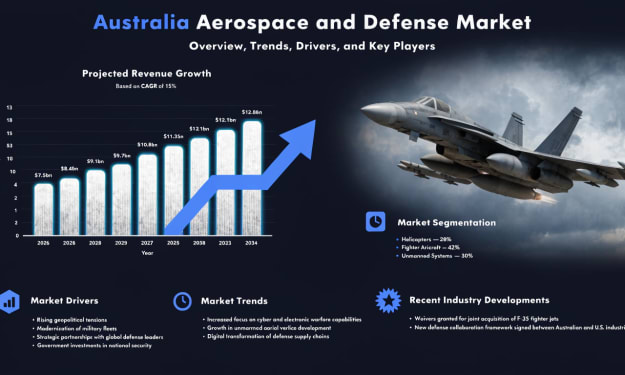
According to IMARC Group, the Australia aerospace and defense market reached a value of USD 13.6 Billion in 2025 and is projected to reach USD 21.4 Billion by 2034, growing at a compound annual growth rate (CAGR) of 5.04% during 2026–2034. The market is expanding as Australia strengthens its national security framework and invests in advanced aerospace technologies and defense capabilities. Rising geopolitical considerations and evolving security challenges are encouraging governments to increase defense budgets and modernize military infrastructure. Programs focused on sovereign defense capability development are encouraging domestic manufacturing of defense equipment, aircraft systems and advanced military technologies. At the same time, collaborations between Australian defense agencies and international contractors are accelerating innovation and enabling technology transfer. Investments in next-generation aerospace systems, cyber defense technologies and satellite communication infrastructure are further supporting the growth of the aerospace and defense sector.
By Kevin Cooper2 days ago in Futurism



Comments
There are no comments for this story
Be the first to respond and start the conversation.