
The Secret Language of Numbers: A Journey Through Numerology
“From Pythagoras to Tesla, the hidden story of how numbers became the secret language of the universe.”

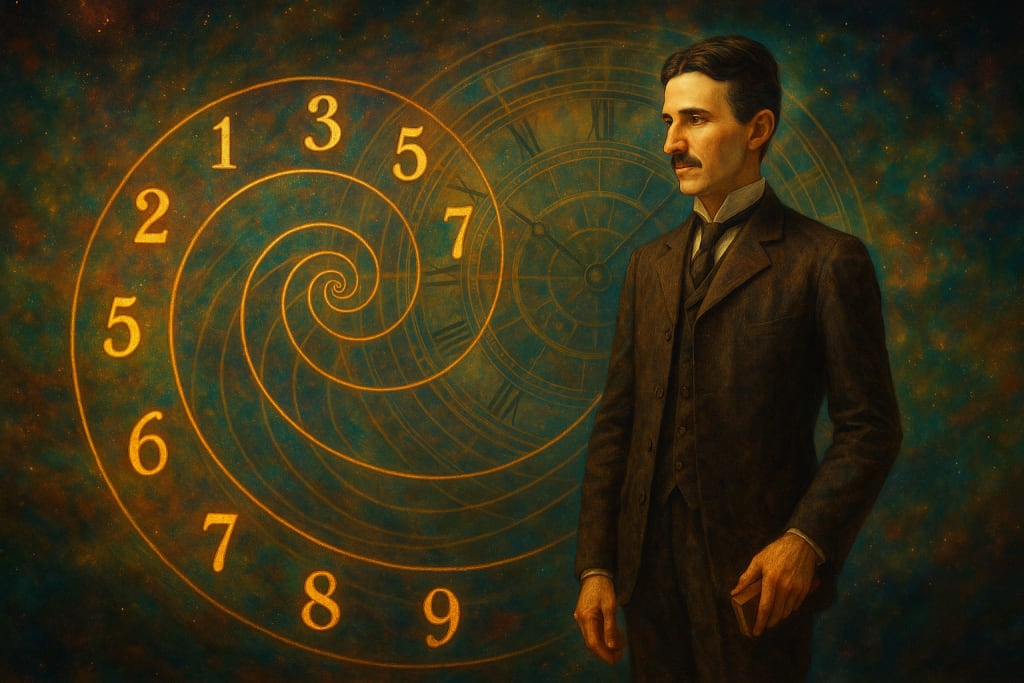
The Secret Language of Numbers
For as long as humans have looked up at the stars and wondered why we are here, numbers have been part of that search. They are everywhere, in the movements of planets, in the architecture of temples, in the codes of language, in the rhythms of music. To most people, numbers are simple tools: ways to count, to measure, to calculate. But throughout history there have always been those who believed numbers carry something far deeper, a hidden meaning that connects us to the universe itself. This is the essence of numerology: the idea that numbers are not lifeless symbols, but living archetypes with vibration and power.
The story of numerology begins in the earliest civilizations. In Babylon, priests believed that numbers held magical significance, woven into rituals and the design of calendars. In Egypt, the builders of temples worked with proportions that reflected divine order, believing the sacred was expressed in measurement itself. Numbers were never neutral; they were a language spoken by the gods. Across the Mediterranean, the Hebrews developed gematria, a mystical system in which every letter carried a numerical value. By adding up the letters of a word, mystics found hidden links between passages of scripture, convinced that the divine message was encoded in mathematics. The Greeks developed their own version, called isopsephy, and in their philosophy numbers were often seen as the skeleton of reality. No figure embodies this belief more than Pythagoras, the sixth-century philosopher whose name today is associated with geometry and schoolbook theorems. But for Pythagoras and his followers, numbers were more than equations. They were sacred principles. The number one symbolized unity, the beginning of all things. Two represented duality and conflict. Three expressed balance and harmony. Four was stability, five freedom, seven inner wisdom. To the Pythagorean mind, “number rules the universe.” Music, astronomy, ethics, the proportions of the human body, all could be explained by numerical harmony. For them, mathematics was not cold or abstract. It was mystical, the key to unlocking the divine order of the cosmos. This way of thinking never truly disappeared. Through the Middle Ages and Renaissance, Christian mystics, alchemists, and esoteric philosophers continued to search for hidden meanings in numbers. Heinrich Cornelius Agrippa wrote of the spiritual power of numbers, linking them to angels and planetary forces. Secret societies in Europe built rituals and initiations around numerical symbolism, convinced that by understanding numbers one could unlock the mysteries of nature and spirit alike.
In the early twentieth century, numerology resurfaced in a new way. Writers like Sarah Joanna Balliett, often called the mother of modern numerology, published books about the “philosophy of numbers” and the vibrations they carried. She was part of a wave of spiritual teachers who believed the universe itself was a vibrational field, and that numbers were a direct key to that frequency. Her ideas shaped the modern forms of numerology we still see today: life path numbers, destiny numbers, angel numbers. Though mainstream science dismissed it, numerology flourished in spiritual movements, gaining a place alongside astrology and other mystical practices. But perhaps no modern figure embodies the mystery of numbers more than Nikola Tesla. Tesla’s genius was unquestionable, an inventor far ahead of his time, whose vision of energy, technology, and the future still feels futuristic even today. Yet Tesla was also deeply eccentric, and one of his obsessions was numbers, especially the sequence 3, 6, and 9. Stories claim that Tesla would circle buildings three times before entering, that he would only stay in hotels with room numbers divisible by three, that he believed these numbers contained the secret patterns of the universe. There is a famous quote often attributed to him: “If you only knew the magnificence of the 3, 6 and 9, you would have a key to the universe.” Whether or not he actually said it in that form, it captures the essence of how Tesla viewed the world, not as random, but as ordered by invisible forces, patterns waiting to be discovered. For Tesla, numbers were not just symbols; they were cosmic keys.
He was not alone. The Nobel Prize–winning physicist Wolfgang Pauli was haunted by the number 137, which appears in the equations of quantum physics. He was convinced it contained a hidden message about reality itself. Johannes Kepler, the great astronomer, believed the planets moved in orbits that reflected musical harmony, linking celestial mechanics with number and sound. Even today, artists, musicians, and thinkers weave hidden numerical patterns into their work, drawn to the idea that numbers are a universal language that transcends culture and time. What makes this so compelling is that modern science, in its own way, agrees. The universe really does seem to be written in the language of numbers. The spiral of galaxies mirrors the spiral of seashells, both following the Fibonacci sequence. The golden ratio, phi, appears in sunflowers, hurricanes, even in the proportions of the human face. Music is nothing but numbers made audible, vibrations arranged into harmony. Physics depends on constants, precise numbers that, if changed by the smallest fraction, would make life impossible. The deeper scientists peer into the fabric of reality, the more they find mathematics at its core. For the mystics of old, this was never a surprise. Numbers have always been seen as the bridge between the visible and the invisible.
And that may be why numerology continues to captivate people today. It is not just about fortune-telling or personality types, though many enjoy it for those reasons. It is about the sense that life itself is patterned, that synchronicities are not accidents but signposts, that when numbers repeat in your life they carry meaning. When someone notices 11:11 on the clock day after day, they feel the universe tapping them on the shoulder. When certain numbers show up in dreams, in names, in addresses, people interpret them as guidance. Skeptics call it coincidence. Believers call it connection. But either way, it inspires people to pause, to reflect, to wonder. And perhaps that is the real power of numerology. Whether or not one believes in the literal interpretations, it offers a way to tune in, to see life not as chaos but as an unfolding design. It teaches us to look for patterns, to be attentive to synchronicities, to feel connected to something larger than ourselves. Even if we strip away the mystical layers, we are still left with a profound truth: numbers really do shape everything. They are the invisible architecture of existence. They structure time, measure space, create harmony in sound, symmetry in form. They are the bones of the cosmos.
It is no wonder that visionaries like Tesla felt they were keys to the universe. Because in a sense, they are. Whether through science, mysticism, or both, numbers point us toward something greater, a hidden harmony that underlies all things. They remind us that the universe is not mute, but speaks to us in the most subtle and universal language of all. So the next time you see a number repeat itself in your life, take it as an invitation. Maybe it is coincidence, maybe it is the universe sending a quiet message. Either way, it is a reminder that we are not separate from the world around us. We are woven into it, part of its design, as much a pattern as the stars, the seashells, or the spirals of galaxies. Numbers are not just mathematics. They are mystery. They are magic. And perhaps, if we pay close enough attention, they are also a doorway into understanding the infinite.
About the Creator
The Secret History Of The World
I have spent the last twenty years studying and learning about ancient history, religion, and mythology. I have a huge interest in this field and the paranormal. I do run a YouTube channel
Keep reading
More stories from The Secret History Of The World and writers in Futurism and other communities.
Volume 7: After the Sky Opens: Life in the First Days of Disclosure
Life in the First Days of Disclosure The moment humanity has waited for will not arrive with fanfare or fireworks. It will come with silence broken by a collective gasp, a shockwave of realization that spreads not from governments or generals, but from the people who look to the sky and understand that everything has changed. Disclosure will not be the end of a mystery; it will be the beginning of a reckoning. And what follows in the days, weeks, and months after will test the very soul of humanity.
By The Secret History Of The WorldExclusive • 7 months ago
APAC Creator Economy Market to hit USD 390.7 Billion By 2034
APAC Creator Economy Market Overview The Asia Pacific Creator Economy Market is projected to reach approximately USD 390.7 Billion by 2034, increasing from USD 41.6 Billion in 2024, reflecting a strong CAGR of 25.1% during the forecast period from 2025 to 2034.
By Roberto Crum5 days ago in Futurism


Comments
There are no comments for this story
Be the first to respond and start the conversation.