
The Sands That Calculated Time: Decoding the Climate Machines of Ancient Britain
When archaeologists uncovered bronze spirals in Orkney once thought decorative, they discovered a lost technology that tracked ancient climate shifts—forcing a rethink of how prehistoric Britons faced environmental collapse

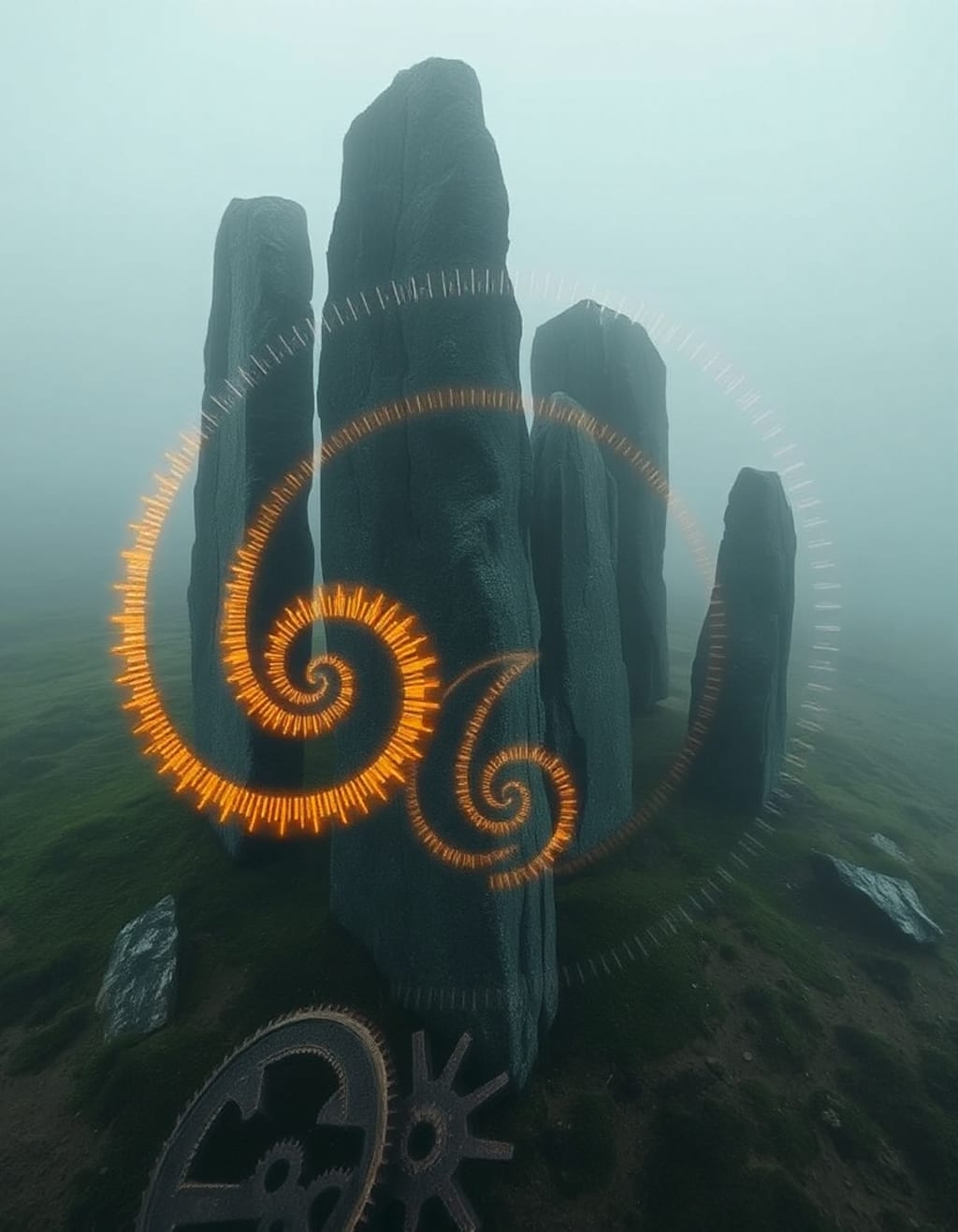
1. The Discovery Under Sand
In June 2029, a research team from the University of Glasgow unearthed a strange circular artifact beneath the shifting sands of Orkney. Buried near the Neolithic site of Skara Brae, the object appeared to be nothing more than a decorative bronze disk, oxidised and dented with age.
But when geophysicist Dr. Amaya Hurst scanned it under a magnetometric imager, the disk revealed a lattice of non-random spiral patterns—too mathematically consistent to be art, too advanced to be dismissed.
The team named it the Orkney Spiral Array.
They didn’t know yet: this would become the most important archaeological discovery in British history—a technology lost in time, and a message from an ancient climate war.
2. Ancient Intelligence in Bronze
Initial tests suggested the array was made in 2100 BCE—roughly 4000 years ago. The spirals were engraved in layers, with microscopic ridges too fine for hand tools alone.
It was Dr. Hurst’s idea to model the spirals through AI pattern-recognition software used for quantum climate forecasting. The result shocked the team.
The spirals weren’t decorative—they were data maps.
Each ring encoded seasonal temperature shifts, rainfall fluctuations, and solar phases—but not just from one year. The rings formed a time spiral tracking over 400 years of climatic patterns.
Someone in ancient Orkney had built a mechanical climate archive.
3. The Bronze Coders of the North
Historians had long assumed that pre-Roman Britons lacked formal writing or advanced instrumentation. But the Orkney Spiral changed that.
Within months, teams from Cambridge and Edinburgh found similar spirals carved into standing stones at Callanish, Avebury, and even beneath Stonehenge—once thought to be religious or astronomical.
These spirals matched glacial retreat periods, salt content in preserved soil, and pollen fossil shifts—known markers of climate change.
The ancients weren’t just observing the sky.
They were tracking Earth’s pulse.
4. The Age of the Spiral Engineers
The Spiral Array worked much like a primitive analog computer. Bronze ridges resonated with weather events—storm frequency, sea salinity, and solar activity. Grooves thickened during drought years, spirals widened during cooling periods.
An engraved table nearby showed tick-marks and bone pointers—likely used to read and calibrate the data.
It was, effectively, a prehistoric climate dashboard.
Dr. Hurst’s team suggested a new term:
Techno-Ancestry—the use of embedded ancient technologies to map ecological memory across time.
It turned out that Orkney’s Spiral Engineers had understood something modern society forgot: when the weather shifts, survival depends on memory.
5. The Climate Collapse They Feared
But why did the Spiral Engineers build such systems?
In 2030, peat-core sampling near the site showed a spike in sulfur and ash dated to around 2000 BCE. Volcanic dust from a distant Icelandic eruption, combined with a solar minimum, had plunged Britain into a mini ice age.
This event—now called the Neolithic Cold Snap—caused flooding across lowland Britain, ruined crops, and triggered mass migrations from the north.
The Orkney Spiral wasn’t a scientific curiosity.
It was a survival mechanism—a way to detect repeating climate shifts.
And somewhere in that spiral data was a message from a civilization that had survived global cooling, sea-level rise, and resource collapse.
6. The Forgotten Technologists
The prevailing view of ancient Britons was that they were primitive, nature-bound, tribal.
But the Spiral Array challenged all of that.
Analysis of wear patterns on the disks showed rotational marks—meaning they were likely turned by hand or wind, generating minor voltages when wet—a kind of bronze-age capacitor or hydrological dial.
One array even had iron inclusions that responded to magnetism—suggesting geo-sensing capabilities.
These were not priests or mystics.
They were technologists of the earth—mathematicians, data archivists, and systems thinkers.
They used natural materials to encode environmental memory, powered by rain, wind, and sea salt.
7. How They Warned Us
Among the spirals, a recurring symbol appeared—a double wave, crossed by a jagged mark.
It matched later Celtic and Pictish symbols for “loss” and “deep winter.” The symbol appeared most often near the outermost rings—those indicating the Spiral Engineers' final years.
What were they trying to say?
One researcher proposed that the spirals formed a climate forecast, warning future generations of repeating cycles—ice, fire, famine.
The spiral wasn’t just an archive. It was a climate prophecy.
And Britain today, facing rising seas and erratic seasons, was living through the return of the Spiral Warnings.
8. The Digital Reawakening
In 2032, the Spiral AI Archive was launched online. Scientists fed the spiral encodings into neural nets trained on ancient climate models. The AI identified seven repeating climate patterns, each lasting roughly 300–400 years.
It also found that we were now entering a convergence of three of the most destructive spirals: drought, glacial melt, and ocean current collapse.
What the ancients feared, we had ignored.
In Parliament, politicians debated the ethics of modelling modern policy on ancient data. But outside, climate protesters carried banners shaped like spirals, chanting:
"They warned us with bronze. We respond with silence."
9. A New Spiral Era
The Orkney spirals inspired a technological renaissance.
Startups began embedding spiral logic into bio-materials, creating weather-sensitive pavements, climate-adaptive textiles, and spiral-inscribed seed banks that react to environmental triggers.
Schools in the UK added Spiral Studies to their curriculum—combining archaeology, climate science, and data ethics.
A new term emerged:
Spiral Citizenship—the idea that to live responsibly on Earth, one must remember both ancient warnings and future patterns.
Even NASA requested spiral encodings to model Martian weather simulations—believing the ancient logic might help predict alien climates.
10. The Past Is Not Behind Us
Dr. Amaya Hurst, now head of the British Institute for Climate Memory, gave a final address on the sands of Orkney in 2034:
“We thought history was behind us. But the Spiral shows us it loops, it speaks, it returns. The past is not dead. It is repeating—right now. It left us tools in the dirt, if only we choose to listen.”
About the Creator
rayyan
🌟 Love stories that stir the soul? ✨
Subscribe now for exclusive tales, early access, and hidden gems delivered straight to your inbox! 💌
Join the journey—one click, endless imagination. 🚀📚 #SubscribeNow
Australia E-Pharmacy Market: Telehealth Integration, AI-Driven Prescription Management & Digital Healthcare Access
According to IMARC Group, the Australia e-pharmacy market reached a value of USD 3.4 Billion in 2025 and is projected to reach USD 10.5 Billion by 2034, growing at a compound annual growth rate (CAGR) of 12.93% during 2026–2034. The market is expanding rapidly as digital technologies transform how healthcare services are accessed and delivered across the country. E-pharmacy platforms allow consumers to purchase prescription medicines, over-the-counter drugs and health products through online channels while benefiting from doorstep delivery services. Rising internet penetration and widespread smartphone adoption are enabling consumers to access digital healthcare services more conveniently. Additionally, the expansion of telehealth consultations is creating integrated healthcare ecosystems where patients can receive digital prescriptions and order medicines online seamlessly. Increasing awareness of chronic disease management and regulatory emphasis on prescription authentication are also supporting the growth of the e-pharmacy sector across Australia.
By Shrestha Roy3 days ago in Futurism
Saudi Arabia E-commerce Market: Digital Payments, Logistics Expansion & Growth Outlook
According to IMARC Group's latest research publication, Saudi Arabia e-commerce market size reached USD 222.9 Billion in 2024. The market is projected to reach USD 708.7 Billion by 2033, exhibiting a growth rate (CAGR) of 12.8% during 2025-2033.
By Shubham Sharma 3 days ago in Futurism




Comments (1)
This is fascinating stuff. I can't believe they found such an advanced climate archive from 4000 years ago. It makes me wonder what else we don't know about ancient civilizations. How did they manage to create such precise data maps without modern technology? And what else could these spirals tell us about the past? It's amazing to think that the ancients were tracking Earth's climate so long ago. It shows they were a lot more intelligent and advanced than we thought. I'm curious to see if there are any more discoveries like this waiting to be unearthed. Maybe there are other ancient technologies out there that could change our understanding of history.