
The Role of AI in Predicting Spring Weather Patterns
"How AI is Revolutionizing Spring Weather Forecasting

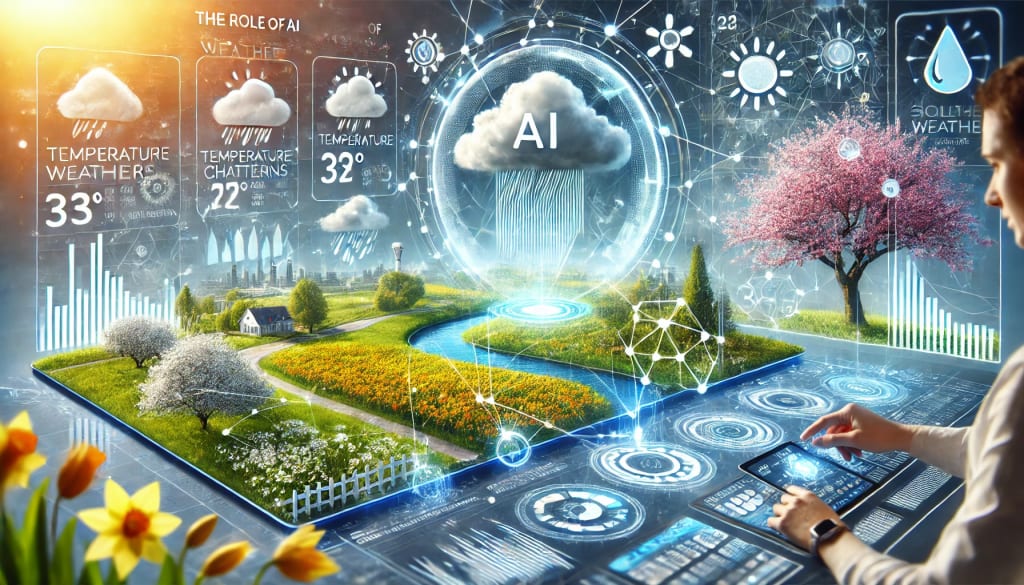
Spring is one of the most unpredictable seasons when it comes to weather. One day, the sun is shining, and flowers are blooming; the next, sudden rain showers or even late snowfalls can disrupt plans. This seasonal instability makes it challenging for farmers, travelers, and even allergy sufferers to plan ahead. Fortunately, Artificial Intelligence (AI) is revolutionizing the way we predict spring weather patterns, making forecasts more accurate than ever before.
In this article, we’ll explore how AI is improving weather predictions, real-life examples of its impact, and the best AI-powered tools available today.
Why Is Spring Weather So Unpredictable?
Spring marks a transition between winter and summer, which leads to rapid shifts in weather conditions. Several factors contribute to its unpredictability:
Colliding Air Masses: Cold air from winter meets warming air from summer, causing unstable weather.
Increased Moisture: As temperatures rise, evaporation increases, leading to frequent rain showers.
Jet Stream Movements: The shifting position of the jet stream influences storm paths and temperature changes.
Climate Change Effects: Rising global temperatures are making spring weather patterns even more erratic.
Because traditional weather models struggle to predict rapid changes, AI-driven forecasting is now playing a crucial role in improving accuracy.
How AI Is Transforming Spring Weather Forecasting
AI improves weather predictions by processing vast amounts of data faster and more efficiently than traditional methods. Here’s how it works:
1. AI Processes Massive Data Sets Faster
Traditional meteorological models rely on mathematical equations and physical laws to predict weather. These models require supercomputers to process complex data. AI, however, learns from past weather patterns and can analyze real-time satellite imagery, atmospheric pressure, temperature changes, and humidity levels much faster.
For example, Google’s DeepMind developed an AI system called GraphCast, which can generate weather forecasts 10 days in advance faster than traditional models.
2. Machine Learning Improves Forecast Accuracy
Machine learning algorithms identify patterns in historical weather data and compare them with real-time conditions. These systems continuously improve over time, leading to more accurate forecasts.
NASA and the National Oceanic and Atmospheric Administration (NOAA) use AI-powered neural networks to enhance storm tracking, especially during volatile spring months.
3. AI Helps Predict Extreme Weather Events
Spring often brings severe weather events such as tornadoes, thunderstorms, and flooding. AI models analyze radar and satellite data to predict these disasters earlier, allowing people to prepare and evacuate sooner.
In 2023, IBM’s Watson AI helped predict a severe tornado outbreak in the Midwest 12 hours earlier than conventional methods, saving lives by giving residents more time to take shelter.
Real-Life Examples of AI’s Impact on Spring Weather Prediction
1. Farmers Using AI for Crop Protection
Spring is a crucial planting season, but unpredictable weather can damage crops or delay planting schedules. AI-powered weather models help farmers make better decisions about when to plant, water, and protect their crops.
For example, The Climate Corporation, an AI-driven agricultural tech company, provides real-time weather insights to farmers, helping them reduce losses from unexpected frosts or heavy rains.
2. AI Assisting Allergy Sufferers
Pollen levels fluctuate based on temperature, wind, and rainfall. AI-based weather apps like Tomorrow.io and AccuWeather combine weather forecasting with pollen prediction models, allowing allergy sufferers to plan their outdoor activities.
Sarah, a school teacher with severe pollen allergies, uses AI-powered weather apps to decide whether to bike to work or drive based on expected pollen levels. This has significantly improved her daily comfort during spring.
3. AI Helping Cities Prepare for Spring Floods
Melting snow and spring rains often lead to flash floods. AI is helping cities prepare by analyzing rainfall patterns and soil absorption rates.
The city of Venice, Italy, uses AI-powered water-level forecasting to predict high tides and floods. In the US, AI models are used to determine which areas are most at risk and issue early flood warnings.
Best AI-Powered Tools for Spring Weather Tracking
If you want to stay ahead of unpredictable spring weather, here are some AI-driven tools to check out:
1. Tomorrow.io (Best for Hyperlocal Forecasting)
Uses AI and machine learning for street-level weather forecasts
Ideal for outdoor event planning and allergy tracking
Sends severe weather alerts before traditional weather apps
2. IBM’s Weather Company (Best for Long-Term Forecasts)
Uses AI to provide 10-day and seasonal forecasts
Helps businesses prepare for weather-related disruptions
Trusted by airlines, logistics companies, and farmers
3. Google’s GraphCast (Best for AI-Powered Predictions)
AI-driven model that outperforms traditional weather simulations
Provides detailed forecasts for storms, heatwaves, and rainfall
Helps climate scientists track long-term weather trends
4. AccuWeather AI (Best for Real-Time Storm Warnings)
Uses AI to predict severe storms and tornadoes
Provides minute-by-minute precipitation forecasts
Trusted by meteorologists and emergency services
How AI Weather Predictions Benefit You
Whether you’re a farmer, commuter, or just someone who loves spring outdoor activities, AI-powered weather forecasting can help you:
✅ Plan outdoor events with confidence
✅ Avoid allergy flare-ups by tracking pollen levels
✅ Prepare for storms, floods, and sudden temperature changes
✅ Improve travel plans with more accurate forecasts
✅ Stay safe during severe weather events
Final Thoughts
Spring weather can be unpredictable, but AI is making forecasts more accurate than ever before. From predicting pollen levels to warning about severe storms, AI-driven weather models are changing the way we plan our daily lives. As this technology continues to advance, we can expect even greater precision in weather forecasting, disaster prevention, and climate predictions.
“AI won’t change the weather, but it will change how we prepare for it.” —
How do you track spring weather? Do you use AI-powered weather apps? Let’s discuss in the comments!
About the Creator
Pure Crown
I am a storyteller blending creativity with analytical thinking to craft compelling narratives. I write about personal development, motivation, science, and technology to inspire, educate, and entertain.
Keep reading
More stories from Pure Crown and writers in Futurism and other communities.
How to Use Apps to Track Spring Allergies and Weather Changes
Spring is a season of renewal, but for many people, it also marks the return of sneezing, itchy eyes, and runny noses. As flowers bloom and trees release pollen, allergy sufferers brace themselves for months of discomfort. Thankfully, technology has made it easier to track allergens and weather changes with the help of apps. These digital tools help users plan their outdoor activities, manage symptoms, and even receive alerts when pollen levels spike.
By Pure Crownabout a year ago in Futurism
Agentic AI Market to Surpass USD 196.6 Billion by 2034
Market Overview Agentic AI represents an advanced category of artificial intelligence systems that can independently plan, reason, and execute tasks to achieve defined goals with minimal human supervision. These systems are designed to function as intelligent agents capable of perceiving context, analyzing information, and taking action across multiple digital environments. Unlike traditional AI systems that depend heavily on predefined instructions, agentic AI can operate autonomously and continuously adapt to real-time data.
By Roberto Crum6 days ago in Futurism
Apple’s "Ultra" Gamble: 4 Surprising Ways the Mac Lineup is Changing Forever
1. Introduction: The End of the "One Size Fits All" Era For years, Apple executives dismissed the idea of a touchscreen Mac as an ergonomic disaster, famously insisting that "vertical surfaces don't want to be touched." That long-standing refusal is finally crumbling as the company prepares for its most significant hardware pivot in a decade. The catalyst is the rumored "MacBook Ultra," a device that signals a fundamental shift in how Apple categorizes its computers. We are moving away from the streamlined "Air and Pro" simplicity and entering a new era defined by a vast spectrum of models designed to capture every possible consumer—from the budget-conscious student to the high-end creative.
By Tech Horizons2 days ago in Futurism
A More Human Vocal
When we launched Vocal nearly a decade ago, the world was a very different place. LLMs did not exist, and stories were created one at a time by people sitting down to write, revise, and share something personal. Many of our assumptions about publishing, trust, and participation were built for a world where effort and output were inseparable.
By Justin @ Vocal5 days ago in Resources



Comments (1)
Hello, just wanna let you know that if we use AI, then we have to choose the AI-Generated tag before publishing 😊