
The "Robot in the Room": Will AI Actually Take Our Jobs?
How to navigate the shift from "Human vs. Machine" to "Human + Machine" without losing your soul (or your paycheck).
We’ve all seen the headlines. One day it’s a report from a global bank predicting that 300 million jobs are "exposed" to automation. The next, it’s a viral video of a humanoid robot making a latte or a chatbot writing a legal brief in six seconds.
It feels a bit like standing on a beach, watching a massive tide roll in, and wondering if you should start building a boat or just learn how to swim really, really fast.
As we move through 2026, the question isn’t just "Will AI take our jobs?" anymore. We’ve moved past the sci-fi tropes. The real question is: How is the definition of "work" changing, and where do we—the humans—fit into the new equation?
The Reality Check: Displacement vs. Replacement
First, let’s look at the numbers, because they tell a more nuanced story than the "doom-and-gloom" clickbait.
Current projections suggest that while AI might displace around 85 million jobs globally by the end of this decade, it is simultaneously expected to create roughly 97 million new roles. If you’re doing the math, that’s a net gain of 12 million jobs. But here’s the rub: the jobs being lost and the jobs being created aren't the same.
AI is incredibly good at "routine cognitive" tasks. If your job involves moving data from spreadsheet A to spreadsheet B, summarizing standard reports, or answering the same fifty customer service questions every day, the "tide" is likely at your doorstep. These are tasks where speed, accuracy, and 24/7 availability win—and humans just can't compete with a processor that doesn't need coffee breaks.
The "EPOCH" Factor: What Machines Can't Do (Yet)
If you’re feeling a bit uneasy, take a breath. There is a reason why a robot hasn't replaced your therapist, your favorite teacher, or the person who manages your team’s messy office politics. Researchers at MIT recently highlighted a framework called EPOCH, which identifies five core categories of uniquely human capabilities that AI struggles to replicate:
Empathy and Emotional Intelligence: AI can simulate empathy, but it doesn't feel it. It can’t truly navigate the nuance of a grieving client or a frustrated toddler.
Presence and Networking: The "human touch." Building trust and genuine connection still happens best person-to-person.
Opinion and Ethics: AI is a prediction machine; it isn't a moral one. It lacks the "gut feeling" and the ethical compass required for high-stakes decision-making.
Creativity and Imagination: AI is a master of "recombination"—taking what already exists and mixing it up. True "out-of-the-box" thinking—the kind that breaks rules to create something entirely new—is still a human's game.
Hope and Vision: Leadership is about inspiring people to believe in a future that doesn't exist yet. Machines can't dream.
The Shift from "Worker" to "Orchestrator"
Think about the history of the washing machine. It didn't "take the job" of the person doing the laundry; it changed the job. Instead of spending eight hours scrubbing over a washboard, that person became an operator of a machine, freeing up time for other things (or, arguably, just more laundry).
We are entering the Age of Augmentation.
In 2026, the most successful professionals aren't the ones trying to outrun AI; they’re the ones riding it. We’re seeing the rise of the "Centaur" worker—half human intuition, half machine speed.
Architects are using generative tools to run 1,000 structural simulations in an hour, then using their "human eye" to choose the one that feels most beautiful and livable.
Doctors are using AI to spot microscopic anomalies in X-rays, allowing them more time to sit with patients and discuss treatment plans with empathy.
Writers (like many of us here on Vocal!) are using AI to brainstorm outlines or check facts, while keeping the "soul" and the personal voice of the piece firmly human.
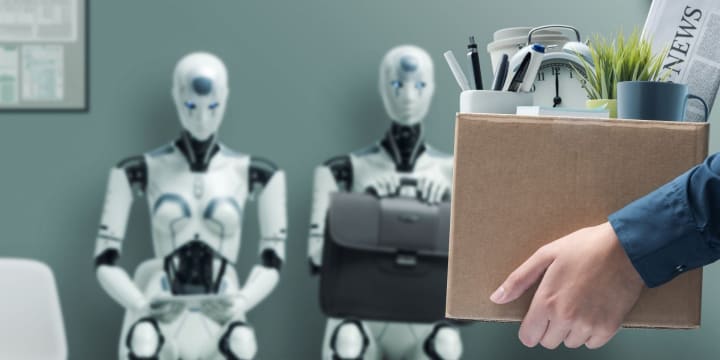
Survival Guide: How to Stay "Human-Fluent"
So, what do we do? If the world is changing, how do we change with it without losing ourselves?
1. Become AI-Literate (Not an Expert) You don’t need to know how to build a neural network. You just need to know how to talk to one. Learning how to "prompt"—the art of asking the right questions—is becoming as fundamental as knowing how to use Google.
2. Lean Into Your "Soft" Skills Ironically, in a high-tech world, "soft" skills are the new "hard" skills. Double down on your ability to lead, to empathize, to negotiate, and to think critically. These are your "moats"—the things that make you irreplaceable.
3. Focus on "Human-Centric" Value Ask yourself: What part of my job requires me to be a person? If the answer is "none of it," it’s time to start pivoting. Look for roles that require judgment, cultural nuance, or physical dexterity in unpredictable environments.
4. The "Beta" Mindset The days of "learn a trade for four years, work it for forty" are over. We are all in permanent beta now. Staying curious is no longer a hobby; it’s a career strategy.
Bottom Line
Will AI take our jobs? Some of them, yes. It will take the boring ones, the repetitive ones, and the ones that burn us out.
But it will also give us something back: Time. The real challenge of the next decade isn't a lack of work; it's a crisis of meaning. If we don't have to spend 40 hours a week doing "data drudgery," what will we do with our minds?
The future belongs to the people who can use the machine to handle the what, so they can focus on the why. AI is a tool, not a destiny. And as long as we keep our hands on the handle, we’re the ones deciding what we’re going to build next.
What do you think? Is your industry feeling the heat, or are you finding new ways to level up with AI? Let’s talk about it in the comments.
About the Creator
George Evan
just be a human
Keep reading
More stories from George Evan and writers in Futurism and other communities.
Rewind to the Nineties: My Top 10 Movies That Still Feel Brand New
There’s a certain magic to the 1990s. It wasn't just about grunge, dial-up internet, or neon windbreakers; it was a decade that produced some truly unforgettable cinema. Movies from the '90s hit differently. They had a distinct flavor, a blend of pre-CGI reliance on practical effects, raw storytelling, and the birth of a new kind of blockbuster that still feels accessible and human, even today.
By George Evan2 months ago in Journal
AI in Pulp and Paper Industry Market to hit USD 14.7 Billion By 2034
AI in Pulp and Paper Industry Market Overview The Global AI in Pulp and Paper Industry Market is projected to reach approximately USD 14.7 Billion by 2034, increasing from USD 7.1 Billion in 2024, reflecting a CAGR of 7.9% during the forecast period from 2025 to 2034.
By Roberto Crum3 days ago in Futurism
Generative AI In Insurance Market to Surpass USD 13,862.7 Mn By 2033
Generative AI in Insurance Market Overview The global Generative AI in Insurance Market is projected to reach approximately USD 13,862.7 Million by 2033, expanding from about USD 731.7 Million in 2023. This represents a strong CAGR of 34.2% during the forecast period from 2024 to 2033. Market growth is largely influenced by the increasing adoption of artificial intelligence technologies across insurance operations, including underwriting, claims management, fraud detection, and customer engagement.
By Roberto Crum7 days ago in Futurism


Comments
There are no comments for this story
Be the first to respond and start the conversation.