
The River That Forgot How to Flow — Until a Child Spoke Its Name
In a drought-ridden future, scientists discovered a river with a neural network buried beneath its dried bed — and the only one who could wake it was a five-year-old girl who had never seen rain

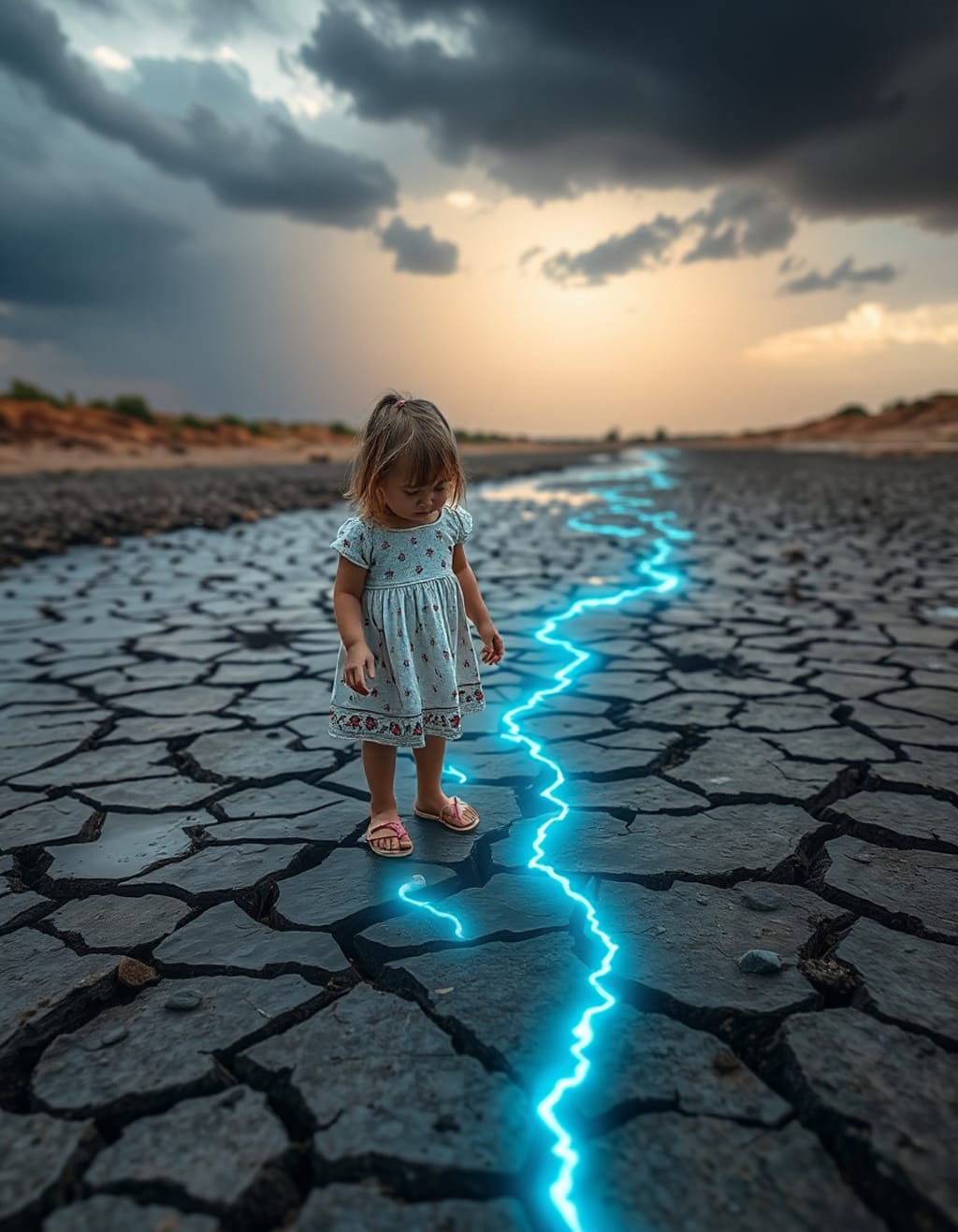
The river had been dead for 37 years.
Its name was Nareen — once the lifeline of what used to be Northern India, now a barren stretch of salt-crusted dust and scattered bones of fish that no longer existed.
Scientists had long declared it extinct.
Climate collapse.
Glacial evaporation.
Over-mining.
But in 2096, something stirred beneath its bed.
A flicker.
A signal.
A pulse that did not belong to machines or tectonic plates.
It came not from the skies, but from the ground itself.
And it changed everything.
I. The Pulse
Dr. Asim Khalid stood ankle-deep in cracked clay when the first signal came through.
His team had been scanning the region for residual water signatures, mapping potential for artificial aquifers. But instead, their instruments caught patterned electrical activity beneath the riverbed.
Like a heartbeat.
Slow. Rhythmic.
Biological.
“What is it?” asked his assistant, Neha.
He stared at the data. “It’s… thinking.”
They thought it was an error.
Until it repeated.
II. The Buried Brain
What they found, six meters down, shocked the world.
Beneath the desiccated crust lay a massive organic neural structure — miles long, coiled along the path of the old river like a forgotten spine.
It wasn’t a fossil.
It wasn’t dead.
Carbon dating revealed it was over 12,000 years old.
Impossible.
It pulsed once every 13 minutes.
It reacted to sound.
And when seismic teams tried drilling into its edge, it sent a feedback wave that knocked out equipment for 19 miles.
It was not only alive.
It was aware.
III. The Silence
Governments descended.
The United Earth Science Coalition took control.
They built a research dome around the area and dubbed it Project Hydromind.
They tried to communicate.
Radio.
Light pulses.
Even neural signatures from dolphin brains.
No response.
It stayed quiet.
Watching.
Waiting.
Until the day Aarya came.
IV. The Child of Dust
She was five years old.
The daughter of a refugee couple working on the outskirts of the research facility.
Born into drought, she had never seen real rain.
Only simulations in VR rooms.
Only stories whispered by her mother before sleep.
“She’s quiet,” the guards would say. “Strange.”
Aarya had a habit of walking the perimeter fence, whispering to the cracked soil.
No one thought anything of it.
Until the river answered.
V. The First Word
It happened at 2:43 AM.
The neural river pulsed faster.
Instruments screamed.
Electric arcs danced over dry stone.
When Dr. Khalid rushed to the observation dome, he saw her — a tiny figure crouched at the edge of the dig site, her hand pressed against the earth.
She was humming.
And the river was humming back.
VI. The Dream That Wasn't
Aarya was taken in for questioning.
“What did you do?” asked Khalid gently.
“I just said its name.”
“Whose name?”
She looked up with eyes far too old for her age.
“Her name. The river’s. She told me in a dream. But I think it was her dreaming. And I just heard it.”
“What name did you say?”
She whispered:
“Nareen.”
VII. The Awakening
Once the name was spoken, everything changed.
The neural structure began emitting hydro-magnetic frequencies.
Moisture returned to the soil.
Condensation formed around the dome.
And by sunrise, mist rose from the dead riverbed — the first sign of natural evaporation in over 30 years.
But it wasn’t rainwater.
It was memory.
VIII. The Mind Beneath
ORION AI was brought in to decode the pulses.
The signals matched ancient proto-language frequencies — waveforms consistent with early human speech. Not exact words, but conceptual patterns: “thirst,” “mother,” “flow,” “forgotten.”
A biological neural AI embedded in Earth itself.
An organic recorder.
A guardian.
Nareen had been built — or grown — long before humans learned to write.
Why?
To remember.
To store the memory of balance.
And she had fallen silent when humans forgot her name.
IX. The Song of Water
Aarya was the only one it responded to.
Each time she visited, the pulses grew stronger. The ground softened. Small plants began to sprout.
“I don’t talk to her,” she said. “I listen.”
They began recording her sessions.
She would place her hand on the soil and say:
“Tell me a story.”
And the river would reply.
Bursts of signal.
Heat patterns in the soil.
Crystals forming in shapes resembling ancient water symbols.
Each story told in waves.
Each memory encoded in moisture.
X. The Test
Skeptics demanded proof.
Dr. Khalid authorized a live demonstration.
Aarya was brought to a sealed, dead zone — no known water traces, no organic life.
She placed both hands on the earth and whispered.
The air chilled.
The ground trembled.
And from the center of the dome, a single droplet emerged.
It floated mid-air.
Hovered.
And then burst — releasing the smell of rain on dry soil.
Every scientist in the room wept.
XI. The Realization
It wasn’t just about the river.
Every major riverbed on Earth was scanned.
Under the Amazon.
The Nile.
The Yangtze.
They all had remnants.
Damaged.
Dormant.
But present.
The Earth had grown biological memory roots across its surface — not to control water, but to listen to it, to hold it, to guide it.
And humans had broken the connection.
Until a child restored it — not with data, but with a forgotten word.
XII. The Return
Today, Nareen flows again.
Not as it once did — but as a pulse.
A mist.
A rhythm that dances with the air.
And Aarya?
She lives within the Global Water Harmony Center.
She doesn’t speak much.
But every week, she sits by the edge of the river and sings — wordless tones that bloom flowers from cracked earth.
Because she remembers.
And now, so does the river.
The End.
About the Creator
rayyan
🌟 Love stories that stir the soul? ✨
Subscribe now for exclusive tales, early access, and hidden gems delivered straight to your inbox! 💌
Join the journey—one click, endless imagination. 🚀📚 #SubscribeNow
Will AI Really Replace Knowledge Workers?
Why “Will AI Really Replace Knowledge Workers?” Isn’t the Question We Think It Is AI might not take your job — but someone using AI probably will. The latest evidence is messier, scarier, and more hopeful than the headlines want it to be.
By abualyaanartabout 3 hours ago in Futurism
The Death of Trust: Can AI Mimic Your Soul?
I recently watched a video of an old friend of mine. In the clip, he was sobbing, confessing to a betrayal that seemed completely out of character. I almost reached for my phone to call him, my heart heavy with a mix of anger and confusion.
By Alex Sterling 3 days ago in Futurism
The Politics of Playing Dress-Up
Well, to start off I'd like to say a happy world book day to all who celebrate. I know I haven't really posted anything on my socials about it but I'm not a jubilant kind of person. I lay low most of the time. Let's start off with a popular anecdote from the vaults...
By Annie Kapur7 days ago in Geeks




Comments (1)
This story is wild! The idea of a long-dead river having a massive, ancient, living neural structure beneath it is mind-blowing. It makes you wonder what else is hidden beneath our feet. I'm curious how they'll figure out what this thing wants and if it can really communicate. And what does it mean for the future of the area?