
The Silent Pulse
How Earth's Magnetic Heartbeat Shapes Life Without Us Knowing


It hums. It pulses. It never sleeps.
And yet, almost no one hears it.
Deep beneath your feet, beyond the crust and mantle, the molten iron core of our planet spins, generating a magnetic field that stretches tens of thousands of kilometers into space. This field—the magnetosphere—is Earth’s silent protector. Unseen, unfelt, and often unspoken, it’s one of the most powerful forces keeping life as we know it safe.
This is the story of Earth’s magnetic field, how it breathes, how it affects our health, how it might change—and what happens when the pulse stops.
1. The Invisible Shield
In 1839, British scientist Michael Faraday changed the world when he demonstrated electromagnetic induction. That same year, a far more ancient induction continued beneath the Earth—the constant churning of its liquid core, producing a magnetic field that reaches far beyond the planet’s surface.
This field, while invisible, is real. It shields us from cosmic radiation and solar winds that could strip away our atmosphere. Mars, for instance, once had water. It also had a magnetic field—until it didn’t. When its magnetic field died, its atmosphere was swept away by the sun’s charged particles.
Earth’s field pulses with low-frequency energy, quietly syncing with the planet’s rotation, solar activity, and even seismic movement. NASA calls this a “geomagnetic heartbeat.”
2. The Pulse Within Us
The human heart beats around 100,000 times a day. But Earth’s magnetic field also has its rhythm—an ultra-low frequency wave that resonates at around 7.83 Hz, known as the Schumann resonance.
What’s strange is that this same frequency has been found in human brainwaves—particularly during meditative or deeply relaxed states.
Coincidence?
Some scientists don’t think so. Research by institutions like the HeartMath Institute has suggested that human emotional and physiological states may synchronize with the planet’s magnetic rhythm. In times of solar storms or magnetic disruptions, people report changes in sleep, anxiety, and even decision-making ability.
It’s not pseudoscience. It’s geo-biology, and it’s only now being taken seriously.
3. When the Pulse Wavers
Here’s where the story gets unsettling.
Earth’s magnetic field is not constant. In fact, it’s weakening—by about 10% over the past 150 years. And in the South Atlantic, there’s a growing anomaly—called the South Atlantic Anomaly (SAA)—where the field is so weak that satellites lose signal and are bombarded by radiation.
Some scientists believe this could be the early sign of a magnetic pole reversal, a process where the north and south magnetic poles flip. It’s happened many times in Earth’s history, usually every 300,000 years. We’re overdue.
A reversal could take centuries to complete—but during the transition, Earth’s shield would weaken, exposing us to more radiation. Communication systems, satellites, and even animal migration could be disrupted.
Some birds, turtles, and whales use geomagnetic cues to navigate. A world without a stable magnetic pulse would be like trying to find your way without a compass—or a heartbeat.
4. The Magnetic Mind
In a lab at Caltech, scientists placed small magnetite crystals—tiny magnetic particles found in the brains of birds, bees, and even humans—under microscopes. The results were stunning. These crystals responded to external magnetic fields.
Are we, too, tied to the Earth’s silent pulse?
Recent experiments suggest humans might have magnetoreception, the ability to detect magnetic fields, just like migratory animals. In one study, brainwaves shifted subtly when a rotating magnetic field was applied—suggesting that we may still carry an ancient sense, long buried in our evolution.
It’s not strong enough to guide us like a GPS—but strong enough, perhaps, to make us feel unsettled when the magnetic field changes.
Have you ever felt a strange unease before a solar storm? A sudden mood shift, a restless night? The planet might be whispering, and you may be listening—without even knowing.
5. A Future Without a Pulse
What if Earth’s magnetic pulse disappeared?
There’s no doomsday panic—yet. But a weakened magnetosphere would make Earth vulnerable. More radiation would reach the surface, potentially causing:
Increases in cancer rates due to UV exposure
Disruption of global GPS and satellite systems
Power grid failures
Navigation problems for animals
Mental health disturbances linked to biological stress
And in the worst case, Earth could become more like Mars—a barren world, stripped of its air and water over millennia.
That’s why studying the magnetosphere is now a global scientific priority. NASA’s Magnetospheric Multiscale Mission (MMS) is currently gathering data in real-time to understand magnetic reconnection, a phenomenon that might hold the key to how energy is transferred from the sun into Earth’s system.
6. Listening to the Pulse
Despite all its complexity, the magnetic field speaks in rhythm.
Musicians have turned Schumann resonances into audio. Artists have visualized it as moving waves. Poets compare it to a heartbeat, quiet but vital.
Maybe it’s time we all listened more carefully.
Maybe it’s time we stopped seeing Earth as silent.
Because beneath our feet and around our heads, there’s a pulse.
It protects us.
It shapes us.
And if we lose it—we may lose more than we can imagine.
Final Note to Readers:
You’ve heard the beat. Now share the rhythm.
If this story made you pause, wonder, or feel connected to something larger, don’t forget to:
🔔 Subscribe for more emotional science stories
💬 Comment with your thoughts
📤 Share with someone who needs to hear Earth’s heartbeat
Let’s remind the world that sometimes… the most powerful forces are the ones we cannot see.
About the Creator
rayyan
🌟 Love stories that stir the soul? ✨
Subscribe now for exclusive tales, early access, and hidden gems delivered straight to your inbox! 💌
Join the journey—one click, endless imagination. 🚀📚 #SubscribeNow
Australia Power Market: Renewable Energy Expansion, Grid Modernization & Electricity Demand Growth
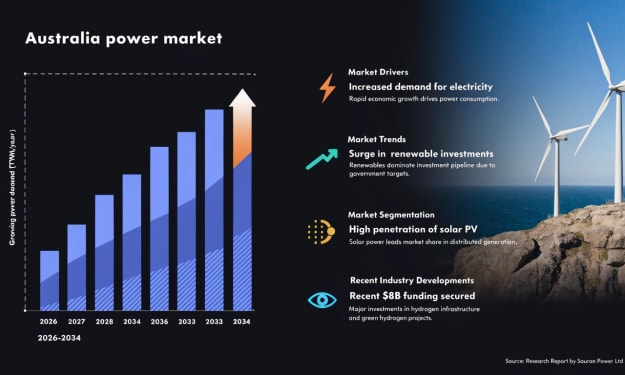
According to IMARC Group, the Australia power market reached 285.7 TWh in 2025 and is projected to reach 377.0 TWh by 2034, growing at a compound annual growth rate (CAGR) of 3.04% during 2026–2034. The market’s growth is being shaped by accelerating renewable energy adoption, increasing electricity demand and large-scale investments in grid modernization. Government incentives supporting clean energy transition, combined with rising corporate sustainability commitments, are encouraging the expansion of solar, wind and battery storage infrastructure. At the same time, the gradual phase-out of coal-fired power plants is transforming the structure of Australia’s electricity generation mix. With emerging technologies such as hydrogen energy systems and virtual power plants gaining traction, Australia’s power sector is evolving into a more diversified, digitally integrated and sustainable energy ecosystem.
By Kevin Cooper3 days ago in Futurism
Cyber Insurance Market: Rising Cyber Threats, Digital Risk Coverage & Industry Growth Outlook
According to IMARC Group's latest research publication, global artificial insemination market size reached USD 14.2 Billion in 2025. Looking forward, IMARC Group expects the market to reach USD 73.5 Billion by 2034, exhibiting a growth rate (CAGR) of 17.88% during 2026-2034.
By sujeet. imarcgroupabout 5 hours ago in Futurism



Comments (1)
The idea of Earth's magnetic field being our silent protector is fascinating. I remember learning about electromagnetic induction in school, but never thought about its connection to our planet's core. It's crazy to think that Mars lost its atmosphere when its magnetic field died. Do you think there's a way we could measure the Schumann resonance more accurately? And what would happen if it changed significantly?