
The Rise of Satellite Internet: Is it the Future of Connectivity?
How Innovations in Satellite Technology Are Redefining Global Internet Access.


The world of internet connectivity is on the brink of a revolution. For decades, DSL (Digital Subscriber Line) and cable internet have been the go-to options for most households and businesses, thanks to their relatively reliable service and affordability. However, a new player is rapidly gaining momentum and reshaping the connectivity landscape: satellite internet. With significant technological advancements and ambitious projects spearheaded by companies like SpaceX, Amazon, and OneWeb, satellite internet is no longer a niche solution but a formidable competitor that may soon replace traditional internet services in many areas.
What Is Satellite Internet?
Satellite internet provides access to the web by transmitting data to and from satellites orbiting the Earth. Unlike DSL and cable, which depend on extensive ground-based infrastructure such as telephone lines or fiber-optic cables, satellite internet operates largely in space. This unique infrastructure enables it to cover areas that traditional systems cannot reach, offering a lifeline to those in remote or underserved regions.
In its early days, satellite internet had a reputation for being slow, expensive, and plagued by high latency. These limitations made it unsuitable for tasks requiring real-time interaction, such as video conferencing or online gaming. However, in recent years, satellite internet has undergone a significant transformation, overcoming many of its previous drawbacks.
The Evolution of Satellite Internet
The modern era of satellite internet is defined by groundbreaking innovations that are enhancing its performance, reliability, and accessibility:
Low Earth Orbit (LEO) Satellites: Traditional satellite internet relied on geostationary satellites orbiting at an altitude of about 35,000 kilometers. While these satellites provided broad coverage, they introduced significant latency due to their distance from Earth. In contrast, LEO satellites orbit much closer, at altitudes between 500 and 2,000 kilometers, reducing latency to levels comparable to terrestrial networks.
Satellite Constellations: Companies like SpaceX (with its Starlink project) and OneWeb are deploying massive constellations of LEO satellites. These networks consist of thousands of interconnected satellites working together to provide seamless global coverage. The result is a service that can deliver high-speed internet to even the most isolated locations.
Advanced Ground Equipment: One of the key improvements in modern satellite internet is the development of user-friendly ground terminals. These compact devices automatically track satellites in orbit, ensuring a stable connection without requiring complex setup or maintenance.
Reduced Costs: The cost of launching satellites has plummeted thanks to advancements in reusable rocket technology. Companies like SpaceX have pioneered this approach, making satellite internet more economically viable and accessible to a broader audience.
Advantages Over DSL and Cable
Satellite internet offers several key advantages that position it as a strong contender to replace DSL and cable:
Global Coverage: One of the most significant benefits of satellite internet is its ability to provide connectivity anywhere on the planet. Unlike DSL and cable, which require extensive ground infrastructure, satellite internet can reach rural and remote areas where traditional providers have little incentive to invest.
Faster Deployment: Installing fiber-optic or cable networks is time-consuming and expensive, particularly in sparsely populated regions. In contrast, satellite networks can be rapidly deployed, offering a quicker solution to bridging the digital divide.
Resilience: Satellite networks are less vulnerable to natural disasters such as earthquakes, floods, and hurricanes, which can damage terrestrial infrastructure. This resilience makes satellite internet an attractive option for disaster recovery and emergency communications.
High Speeds and Low Latency: Modern satellite internet services now offer speeds that rival or exceed those of DSL and cable. For example, SpaceX’s Starlink service boasts download speeds of up to 1 Gbps, with latency as low as 20 milliseconds in ideal conditions.
Scalability: Satellite networks can scale more efficiently than terrestrial systems. As demand grows, additional satellites can be launched to increase capacity, ensuring consistent service quality.
Challenges and Limitations
Despite its promise, satellite internet is not without its challenges. Addressing these issues will be critical for its widespread adoption:
High Initial Costs: Building and maintaining satellite constellations require substantial upfront investment. While these costs are gradually decreasing, they still present a barrier for smaller providers.
Signal Interference: Satellite signals can be affected by weather conditions such as heavy rain or snow. Although modern systems incorporate measures to mitigate these effects, they cannot be entirely eliminated.
Data Caps: Many satellite internet plans impose data usage limits, which can be restrictive for users who rely on the internet for streaming, gaming, or large file downloads.
Competition from Fiber: In urban areas, fiber-optic internet offers unmatched speeds and reliability. Satellite internet may struggle to compete in these markets, focusing instead on regions where fiber deployment is impractical.
Space Debris: The rapid deployment of thousands of satellites raises concerns about space debris and its potential impact on other orbital activities. Coordinating satellite traffic and ensuring sustainable practices will be crucial for the industry’s long-term viability.
The Future of Satellite Internet
The future of satellite internet looks bright, with numerous projects underway to enhance its capabilities and expand its reach. SpaceX’s Starlink network is already serving customers in over 40 countries, with plans to extend coverage globally. Amazon’s Project Kuiper is set to enter the market soon, aiming to compete directly with Starlink by offering high-speed, low-latency internet services. Other players, such as OneWeb and Telesat, are also making significant strides in deploying their satellite constellations.
Governments are recognizing the potential of satellite internet to bridge the digital divide and are providing support through subsidies and regulatory frameworks. For example, the U.S. Federal Communications Commission (FCC) has allocated funding to projects that use satellite technology to bring internet access to underserved areas.
In addition to residential and business applications, satellite internet is opening new possibilities in fields such as:
Education: Connecting schools in remote areas, enabling online learning and access to digital resources.
Healthcare: Supporting telemedicine services in regions with limited healthcare infrastructure.
Agriculture: Providing farmers with connectivity for precision farming technologies and weather monitoring.
Disaster Response: Ensuring reliable communication during emergencies, when traditional networks are often disrupted.
Conclusion
Satellite internet is no longer a distant dream but an imminent reality that is reshaping the way we think about connectivity. While it may not completely replace DSL and cable in the short term, it is quickly becoming a vital part of the global internet ecosystem. By addressing its current limitations and leveraging its unique strengths, satellite internet has the potential to bridge the digital divide, bringing high-speed connectivity to every corner of the globe. As technology continues to evolve, satellite internet may well become the backbone of a truly connected world.
About the Creator
Valente Oropeza
Hi!
My name is Valente, I write fictional stories, trending news, technology, poems, and more. Appreciate the support you give me!
Keep reading
More stories from Valente Oropeza and writers in Futurism and other communities.
10 Exciting Things to Look Forward to in 2025
From game-changing technologies to thrilling explorations, here’s why 2025 is set to be a memorable year. As we move into 2025, the world stands on the brink of exciting new possibilities. From technological innovations to groundbreaking advancements in sustainability, the year ahead is packed with opportunities to transform how we live, work, and explore the world around us. Here are ten of the most exciting developments to look forward to in 2025:
By Valente Oropezaabout a year ago in Futurism
About Binding Prometheus
I want to start actively advocating on behalf of my own work, and the most valuable part of my canon is, without a doubt, Binding Prometheus, the play I have been working on since 2019 and only finished in 2023 as part of my MA. The play itself is an amalgamation of a million different inspirations. On one end, it evokes the Ancient Greek myth-play, deriving its own title from the earliest extant work of Western drama we have, Aeschylus’s Prometheus Bound. On the other end, it borrows significantly from the sci-fi bulwarks from over the years, namely Mary Shelley’s Frankenstein and Karel Capek’s Rossum’s Universal Robots. The play could be an episode of Black Mirror, I fear. I don’t know. I’ve only ever seen one episode of Black Mirror.
By Steven Christopher McKnight18 days ago in Futurism
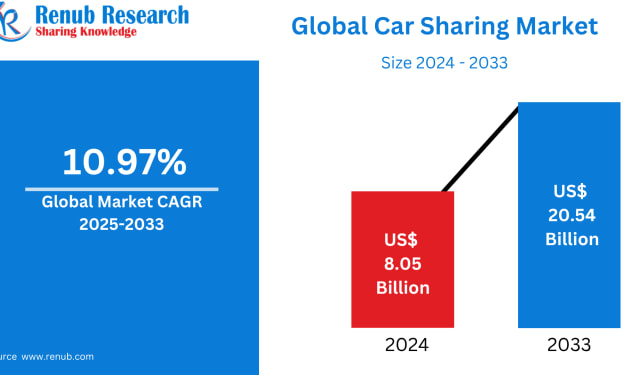
Car Sharing Market Size and Forecast 2025–2033
Introduction: A New Era of Mobility The global transportation landscape is undergoing a profound transformation. Once dominated by private vehicle ownership, urban mobility is now being reshaped by digital platforms, sustainability priorities, and changing consumer behavior. At the center of this shift stands the Car Sharing Market, a model that emphasizes access over ownership, flexibility over permanence, and efficiency over excess.
By Aaina Oberoi7 days ago in Futurism



Comments
There are no comments for this story
Be the first to respond and start the conversation.