
The Quiet Shift in How We’re Found
Somewhere between the search box and the answer, the internet changed—and most of us didn’t notice.

It happened quietly.
Not with a headline.
Not with an announcement.
Just a small moment most people wouldn’t think twice about.
Someone typed a question into a search bar…
and never clicked a single link.
The answer was already there.
Waiting.
Clean. Direct. Almost certain.
And in that quiet moment, something subtle shifted in the architecture of the internet.
Because for years, the web worked a different way.
You searched.
You scanned a page of blue links.
You chose one.
Websites competed for attention.
Blogs fought for visibility.
Businesses learned the strange language of algorithms just to exist on the first page of results.
Being found meant being ranked.
But lately, something feels… different.
You can sense it if you pay attention to how people search now.
They’re not hunting for links anymore.
They’re asking questions.
Real ones.
Late-night questions.
Curious questions.
Sometimes desperate questions.
And increasingly, the answer appears before the search even finishes.
No scrolling.
No digging.
Just an answer.
---
This is where something new begins to emerge.
A quiet idea most people haven’t heard yet.
Answer Engine Optimization.
AEO.
It sounds technical at first. Maybe even a little clinical.
But what it really represents is something deeply human.
Because AEO isn’t about ranking pages.
It’s about becoming the answer.
---
Think about how people interact with information today.
A phone sits on a kitchen counter.
Someone asks a voice assistant a question while making coffee.
A business owner wonders why customers stopped finding their website.
A student asks a question out loud while studying late at night.
They don’t want a list of articles.
They want clarity.
A direct response.
Something they can trust.
Something that feels like it understands the question behind the question.
And that’s where the quiet divide begins to appear.
Some websites still try to rank for keywords.
But the internet has started listening differently.
---
Artificial intelligence now sits between the question and the result.
It scans the web.
Reads pages.
Compares sources.
Then it does something subtle.
It decides which information sounds like the truth.
And when that happens, the link disappears.
The answer stays.
---
Most businesses don’t realize this shift yet.
Their websites still look like they were designed for a different era of the internet.
Pages stuffed with keywords.
Paragraphs written for algorithms rather than people.
Headings that feel engineered instead of spoken.
It worked for a long time.
Because search engines used to reward clever structure.
But AI doesn’t read the web the way search engines used to.
It listens.
Almost like a person.
It looks for authority.
Clarity.
Consistency across the web.
It tries to understand entities, not just keywords.
Which means something fascinating is happening beneath the surface.
Information isn’t just ranked anymore.
It’s being interpreted.
---
And interpretation changes everything.
Because now the internet is quietly asking a different question.
Not “Which page should appear first?”
But rather…
“Which source sounds like the truth?”
---
That shift is bigger than most people realize.
For a small business, it can mean the difference between being recommended… or being invisible.
For writers and creators, it changes how ideas travel.
For entire industries built around SEO, it raises an uncomfortable possibility.
What if the future of discovery doesn’t involve clicking at all?
---
You can see glimpses of this future already.
A search for a medical question produces a summary instantly.
A question about travel becomes a full itinerary before a blog appears.
Even complex topics—technology, law, finance—now arrive as synthesized explanations rather than lists of sources.
The answer is delivered first.
The links become optional.
---
It creates an odd tension.
Because the web was built on exploration.
On curiosity.
On wandering from page to page.
But AI prefers certainty.
It wants to give you the best possible answer immediately.
No wandering required.
---
And yet, the truth is rarely that simple.
Answers carry bias.
Authority can be misunderstood.
And the sources AI trusts today shape the information millions of people see tomorrow.
Which means AEO isn’t just a marketing tactic.
It’s becoming something deeper.
A quiet struggle over whose information becomes the answer.
---
That struggle is mostly invisible.
It doesn’t appear in trending topics or viral debates.
It happens quietly inside data structures, knowledge graphs, and machine learning models.
Websites are scanned.
Entities are mapped.
Signals of trust are measured.
And slowly, the internet decides which voices will be heard.
---
Some businesses are starting to notice.
They realize that being ranked on page one doesn’t guarantee anything anymore.
Because the real competition isn’t the other links.
It’s the answer box above them.
The voice assistant response.
The AI summary.
The moment when the user never scrolls down at all.
---
In that moment, something profound happens.
A website either becomes the source of the answer…
or disappears from the conversation entirely.
---
But here’s the strange part.
Most people searching online will never realize this shift occurred.
To them, the internet still feels the same.
They ask.
It answers.
Faster each year.
Cleaner each year.
More certain each year.
---
Yet somewhere behind the scenes, the structure of visibility has quietly changed.
Not from search engines to something else entirely.
But from searching…
to answering.
---
And late at night, when someone asks a question into the glow of a screen…
They won’t see the thousands of websites that almost answered it.
They’ll only see the one that did.
And they’ll assume that’s where the truth lived all along.
About the Creator
Keep reading
More stories from Megan Stroup and writers in Futurism and other communities.
How People Are Quietly Making Real Money With GoHighLevel (Without Becoming “Marketing Gurus”)
Most people don’t fail with GoHighLevel because it doesn’t work.They fail because they try to use all of it at once. If you’ve ever logged into GoHighLevel, stared at the dashboard, and thought “This feels powerful… but what exactly am I supposed to sell?” — you’re not alone.
By Megan Stroup3 months ago in Futurism
Fluid Loss Additives Market Outlook: Drilling Efficiency Enhancement and Oilfield Services Growth Opportunities
According to IMARC Group's latest research publication, The global fluid loss additives market size was valued at USD 318.42 Million in 2025. Looking forward, IMARC Group estimates the market to reach USD 409.06 Million by 2034, exhibiting a CAGR of 2.82% from 2026-2034.
By James Whitman2 days ago in Futurism
Australia Textile & Apparel Market: Sustainable Fashion, E-commerce Growth & Fabric Innovation
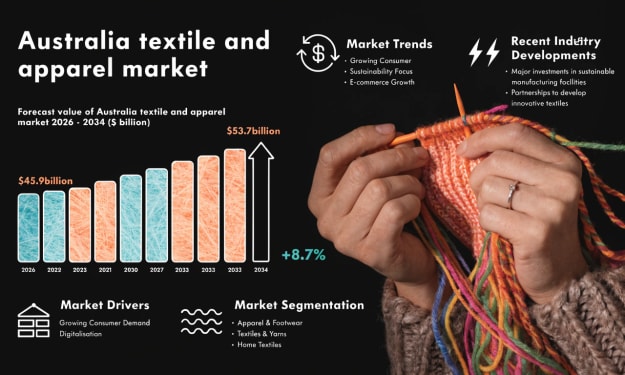
According to IMARC Group, the Australia textile and apparel market reached a value of USD 30.3 Billion in 2025 and is projected to reach USD 45.7 Billion by 2034, growing at a compound annual growth rate (CAGR) of 4.66% during 2026–2034. The market is evolving as consumer preferences increasingly favor sustainable fashion, innovative fabric technologies and digitally driven retail experiences. Rising disposable incomes and changing lifestyle trends are encouraging consumers to spend more on clothing, footwear and fashion accessories. At the same time, growing awareness about environmental sustainability is driving demand for eco-friendly textiles, recycled fabrics and ethically produced garments. The rapid expansion of e-commerce platforms and online fashion marketplaces is also transforming how consumers shop for apparel, enabling brands to reach wider audiences across Australia. As fashion companies adopt new production technologies and sustainable manufacturing practices, the textile and apparel sector is undergoing significant transformation.
By Kevin Coopera day ago in Futurism
From ad men to mad men
It's after 2am in the morning when a local police patrol vehicle in Northern New Jersey spots a figure costumed as Quasimodo, The Hunchback of Notre Dame, proceeding southbound on the sidewalk along Lydecker Street. Though the hunchback’s costume stuffing offers added insulation, it's January, and friggin’ freezing. Carefully, the officers slow down, gently question the subject, and offer him a ride home.
By David W. Maury7 days ago in Humor



Comments
There are no comments for this story
Be the first to respond and start the conversation.