
The Quantum Bridge: How Particles Connect Across Time
Exploring the mysterious entanglement that could redefine reality and our understanding of time itself

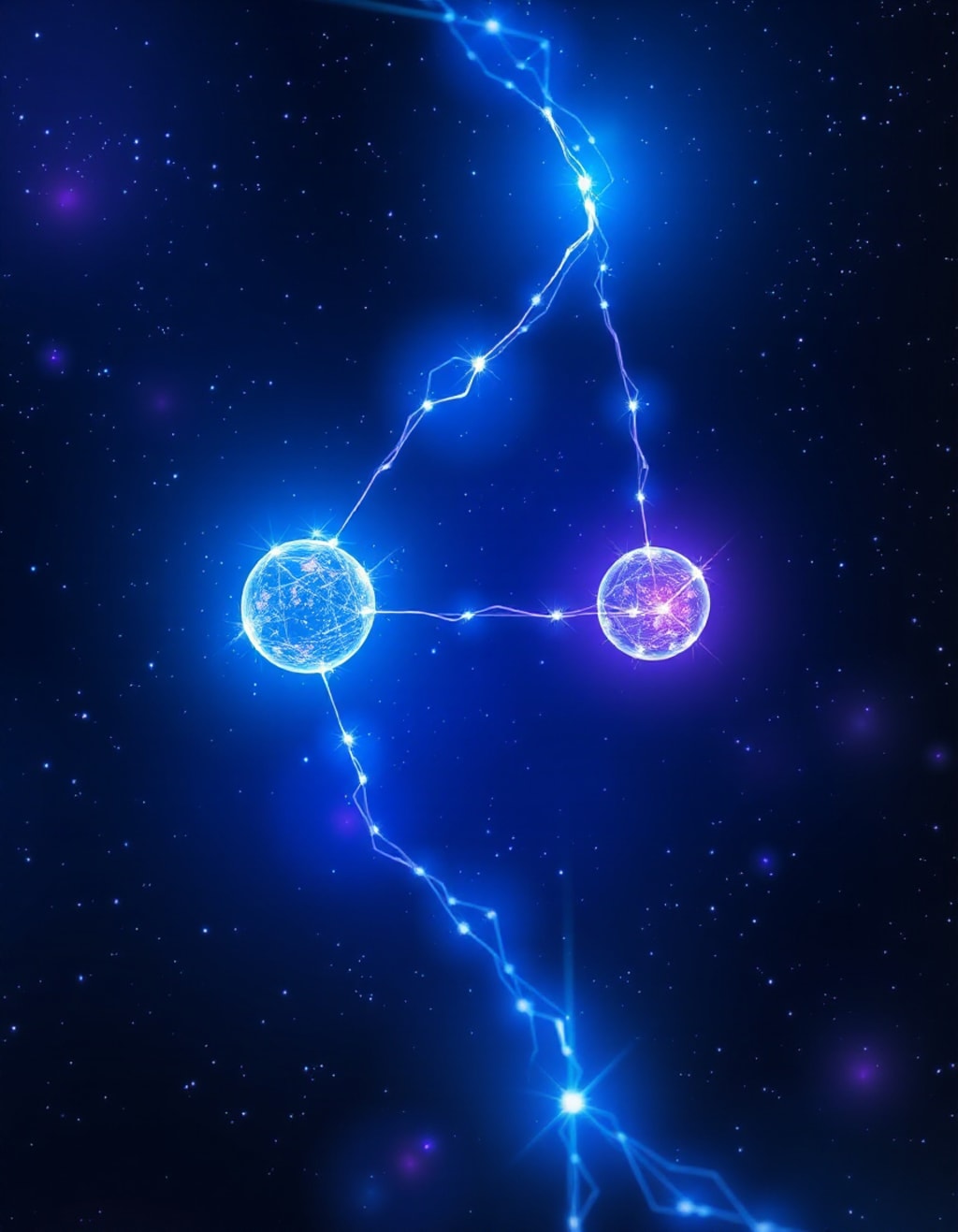
What if I told you that two particles, no matter how far apart in space or time, can instantaneously affect each other’s state? That’s the astonishing reality scientists have uncovered through the phenomenon known as quantum entanglement — a mysterious “bridge” that connects particles across distances and even, possibly, across time itself.
For decades, quantum entanglement has fascinated physicists, philosophers, and science enthusiasts alike. It challenges our very intuition about how the universe works. How can two separate entities, perhaps light-years apart, remain intertwined in a way that what happens to one immediately influences the other?
But what if this connection is not just spatial — what if it’s temporal as well? Could entangled particles reach across the fabric of time, linking moments separated by seconds, years, or even longer? Let’s dive into this mind-bending frontier of physics and explore how the quantum bridge may rewrite our understanding of reality.
Understanding Quantum Entanglement: A Primer
To grasp the full wonder of the quantum bridge, we first need to understand the basics of entanglement itself.
In classical physics, objects behave independently — what happens to one object doesn’t instantly affect another far away. But quantum mechanics defies this. When two particles become entangled, their quantum states become linked such that measuring one immediately determines the state of the other, regardless of the distance between them.
Imagine a pair of coins flipped together, but mysteriously, no matter how far apart the coins are, if one lands heads, the other always lands tails — instantly. This “spooky action at a distance,” as Einstein famously called it, has been repeatedly proven in laboratories.
Entanglement is more than a curiosity. It’s the foundation for revolutionary technologies like quantum computing, quantum cryptography, and quantum teleportation. But the deeper implications — especially in time — are still a subject of intense research.
Bridging the Gap: Entanglement Across Time?
While spatial entanglement is well studied, physicists have recently begun exploring whether entanglement can also link particles across different moments in time — a phenomenon known as temporal entanglement.
In experiments, scientists prepare a quantum system at one time and then “entangle” it with measurements or states at a later time. Remarkably, correlations emerge between events separated by time in a way similar to spatial entanglement.
This raises profound questions:
Could quantum states “communicate” backward or forward in time?
Does the flow of time become less linear at the quantum level?
And if so, what does that mean for our classical perception of cause and effect?
Some theories suggest that entanglement may create a bridge through time, linking moments in the past and future. This bridge could potentially allow information to be shared or influence events across time — without breaking known physical laws like causality.
The Science Behind the Quantum Bridge
Physicists use complex mathematical tools — like density matrices and Bell inequalities — to analyze and prove entanglement. Recent breakthroughs in quantum optics and superconducting qubits allow temporal entanglement to be observed in the lab.
One notable experiment involved entangling photons created at different times, then measuring their polarization states to confirm they share quantum correlations despite the temporal gap.
These results hint at a universe far more interconnected than we ever imagined. Space and time might be woven together by the delicate threads of entanglement, forming a vast cosmic web where everything is connected not just spatially, but temporally.
Implications: Rethinking Reality and Time
If entanglement truly bridges time, this could have enormous implications for physics and philosophy alike.
1. Time May Not Be Linear
Our everyday experience suggests time flows in one direction — from past to future. But quantum mechanics often challenges such straightforward intuitions. Temporal entanglement might imply that past, present, and future coexist in a complex web of probabilities.
2. New Possibilities for Quantum Computing
Temporal entanglement might unlock new computational powers by allowing quantum processors to use information from “future” states, optimizing algorithms beyond current limits.
3. Quantum Communication Beyond Space and Time
Imagine sending information not just instantly across space, but potentially across moments in time. While still speculative, such possibilities could revolutionize communication technologies.
The Philosophical Frontier
Beyond the lab, the quantum bridge raises questions about free will, determinism, and the nature of consciousness. If future events can influence the present via entanglement, how does this affect our understanding of choice and fate?
Some philosophers speculate that consciousness itself could be linked to quantum processes, possibly using temporal entanglement to integrate memories, experiences, and decisions across time.
While this remains highly theoretical, it adds a fascinating dimension to the mystery of the quantum bridge.
Challenges and Skepticism
Despite these exciting developments, temporal entanglement is still a new and controversial area. Replicating results, ruling out alternative explanations, and integrating the concept into established physical theories remain challenges.
Moreover, many physicists emphasize that temporal entanglement does not violate causality — the principle that cause precedes effect. Any theory proposing backward time communication must be consistent with this cornerstone of physics.
The Road Ahead
The quest to understand the quantum bridge is just beginning. New technologies like ultrafast lasers, superconducting circuits, and quantum networks will allow even more precise experiments probing the link between particles in time.
Meanwhile, theoretical physicists are developing advanced frameworks that unify quantum mechanics and relativity, possibly revealing the deeper structure of spacetime itself — woven together by the threads of entanglement.
In the coming decades, what seems like science fiction today might become the foundation of new technologies and even reshape our understanding of existence.
Final Thoughts
The quantum bridge between particles across time challenges everything we thought we knew about reality. It hints at a universe where space and time are intertwined in a delicate dance of probability and connection.
As scientists continue to unravel this mystery, we may soon find that the boundaries of time are not as fixed as they seem. The particles whisper secrets across moments, building bridges that connect the past, present, and future in ways we are only beginning to comprehend.
The quantum world invites us to look deeper — and imagine a reality far stranger and more beautiful than we ever dreamed.
About the Creator
rayyan
🌟 Love stories that stir the soul? ✨
Subscribe now for exclusive tales, early access, and hidden gems delivered straight to your inbox! 💌
Join the journey—one click, endless imagination. 🚀📚 #SubscribeNow
Flywheel Energy Storage Systems Market Worth USD 1003.3 Million by 2034 at 9.3% CAGR
Overview The Global Flywheel Energy Storage Systems (FESS) Market is on a robust growth trajectory, with projections indicating a rise from USD 412.3 million in 2024 to USD 1,003.3 million by 2034. This expansion represents a steady CAGR of 9.3% throughout the forecast period from 2025 to 2034. A significant catalyst for this growth is North America's USD 204.9 million investment in grid modernization, which has substantially accelerated the adoption of advanced FESS technologies.
By Hayden Kulas6 days ago in Futurism
Stablecoins Powering the Next Financial Revolution
In a world where digital transformation is accelerating faster than ever, financial systems are undergoing a quiet but powerful revolution. Businesses, startups, and institutions are searching for ways to move money faster, reduce costs, and eliminate the delays of traditional banking. The answer to this growing demand lies in an innovation that combines the reliability of traditional currencies with the speed of blockchain technology—stablecoins.
By Ritu Singh2 days ago in Futurism



Comments (1)
Quantum entanglement is mind-blowing. The idea that particles can affect each other instantly, regardless of distance, is hard to wrap my head around. It makes me wonder how this could impact our understanding of cause and effect. And if it can work across space, why not time? What are the potential applications if we can entangle particles across different moments? I've always been fascinated by how quantum mechanics challenges our classical intuitions. The coin flip analogy really helps visualize entanglement. But I'm curious about the practical limitations. How do we control and measure these entangled states accurately? And what's the biggest hurdle preventing us from fully exploring the temporal aspects of entanglement?