
The Next Decade of Tech: What Will the World Look Like in 2035?
How Artificial Intelligence, Human Augmentation, and Invisible Computing Will Redefine Daily Life

Introduction: Standing at the Edge of a Technological Turning Point
Every decade brings innovation, but some decades reshape civilization itself. The period between now and 2035 is poised to be one of those defining eras. We are no longer talking about faster smartphones or smarter apps—we are talking about a world where technology becomes ambient, predictive, and deeply personal.
By 2035, technology will not just sit in our pockets or on our desks. It will live in our homes, our cities, our bodies, and—most importantly—our decision-making processes. The way we work, learn, travel, heal, and even define identity will be transformed.
This article explores what the world may look like in 2035—not through science fiction, but through **real trajectories already in motion today**.
1. Artificial Intelligence Becomes a Daily Companion, Not a Tool
In 2035, AI will no longer feel like “software.” It will feel like infrastructure—as fundamental as electricity.
From Assistants to Co-Thinkers
Today’s AI helps us write emails or answer questions. By 2035:
- AI systems will anticipate needs before users express them.
- Personal AI agents will manage finances, health monitoring, scheduling, and learning.
- Decision-making will be collaborative—humans will consult AI the way professionals once consulted experts.
Rather than replacing human intelligence, AI will extend it, acting as a cognitive partner that remembers everything, analyzes patterns instantly, and offers context-aware suggestions.
2. Work Will Be Skill-Based, Not Job-Based
The concept of a “career” will radically change.
The End of Static Job Titles
By 2035:
- Traditional job roles will dissolve into dynamic skill marketplaces.
- People will work on short-term problem-solving missions rather than lifelong positions.
- AI will match human skills to global opportunities in real time.
Human Skills That Will Matter Most
- Creativity and original thinking
- Emotional intelligence and empathy
- Ethical judgment
- Complex problem-solving
Routine and repetitive work will largely disappear—not because humans failed, but because machines finally succeeded at handling it.
3. Education Will Be Personalized, Continuous, and Borderless
The classroom of 2035 will not be a room.
AI-Driven Learning Paths
Education will be:
Fully personalized based on learning speed, interests, and strengths
Lifelong, not front-loaded into childhood
Accessible from anywhere, often through immersive environments
Students will learn by doing, using simulations, virtual labs, and real-world problem scenarios.
Degrees will matter less than **verified skill portfolios** continuously updated through AI assessment.
4. Healthcare Will Shift From Treatment to Prediction
Medicine in 2035 will focus on preventing illness before symptoms appear.
Predictive and Preventive Care
- Wearable and implantable devices will continuously monitor vital health data.
- AI systems will detect anomalies years before disease develops.
- Personalized treatment plans will be adjusted in real time.
Hospitals will become centers for critical care only, while most healthcare happens at home through remote monitoring and virtual doctors.
Longevity science will also advance, extending not just lifespan—but healthspan.
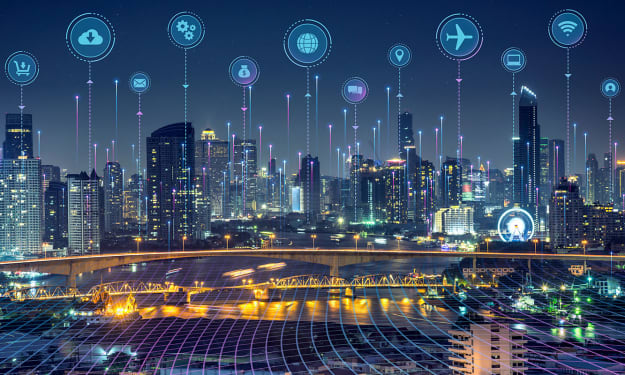
5. Smart Cities Will Think, Adapt, and Respond
Cities in 2035 will behave like living systems.
Urban Intelligence
Traffic lights will adapt dynamically to congestion.
Energy grids will self-balance based on demand.
Waste systems will optimize recycling automatically.
Autonomous vehicles will dominate transportation, reducing accidents and transforming urban design. Parking lots will shrink, green spaces will grow, and commute time will be reclaimed as personal time.
6. The Internet Will Become Invisible
By 2035, the internet will no longer feel like something we “use.”
From Screens to Surroundings
- Voice, gesture, and neural interfaces will reduce reliance on screens.
- Augmented reality will overlay digital information onto the physical world.
- Information will appear only when relevant, then disappear.
This shift will reduce digital overload and create a more natural relationship between humans and technology.
7. Privacy, Ethics, and Control Will Define the Tech Debate
With immense power comes immense responsibility.
The New Ethical Battlefield
Key questions of 2035:
- Who owns your data—you or the systems that analyze it?
- How much decision-making should we delegate to machines?
- Can societies balance surveillance with safety?
Nations and organizations that prioritize ethical technology frameworks will earn public trust, while those that don’t will face resistance and instability.
8. Humans Will Augment Themselves
Human enhancement will move from taboo to normal.
The Rise of Augmented Humans
- Brain-computer interfaces will help restore and enhance cognitive abilities.
- Physical augmentation will assist mobility, strength, and recovery.
- Memory enhancement and sensory expansion may become possible.
The definition of “human ability” will expand, raising philosophical questions about identity, fairness, and access.
Conclusion: A World That Feels Both Familiar and Unrecognizable
The world of 2035 will not feel like a sudden shock—it will feel like a natural evolution. The transition will be gradual, but the outcome will be profound.
Technology will fade into the background, quietly shaping lives while humans focus more on meaning, creativity, and connection. The greatest challenge will not be building these technologies—but deciding how wisely we use them.
The next decade will not be about machines becoming more human.
It will be about humans deciding what kind of future they want to become.
About the Creator
Keep reading
More stories from noor ul amin and writers in Futurism and other communities.
The Impact of Emerging Technologies Across Industries
The rapid pace of technological advancements is disrupting industries across the globe. From AI-driven automation to blockchain, the rise of these technologies is reshaping how we work, interact, and even think. As businesses and governments adapt to this new technological landscape, the resulting shifts promise both challenges and opportunities for growth.
By noor ul amin3 months ago in Futurism
PropTech Market Outlook: Digital Transformation in Real Estate and Growth Opportunities
According to IMARC Group's latest research publication, The global proptech market size reached USD 35.4 Billion in 2024. Looking forward, IMARC Group expects the market to reach USD 114.8 Billion by 2033, exhibiting a growth rate (CAGR) of 13.25% during 2025-2033.
By Michael Richard3 days ago in Futurism
Anthropic Expands Claude “Cowork” With Job-Specific Tools and In-App Workflows, Keeping Wall Street on Edge
What Happened (Facts) Anthropic announced a new round of workplace-focused updates to its Claude assistant during a virtual event on Tuesday, pushing deeper into what it frames as “office work” rather than just coding.
By Behind the Tech3 days ago in Futurism
I was in a Toxic Relationship, with my Workplace
“You got that?” My ex yelled. His hands were balled into fists at his side. At six foot three, he towered over me. A normal person would have been afraid, but I looked up a video of George Lopez repeatedly saying, “I got this,” and showed it to him. I had grown used to this treatment, so much so that I didn’t blink when he ripped the phone from my hand and threw it across the room.
By Jade M.a day ago in Confessions



Comments
There are no comments for this story
Be the first to respond and start the conversation.