
The New Universe: When Humans Create Their Own Worlds
How humanity turned imagination into reality by building living worlds across the stars

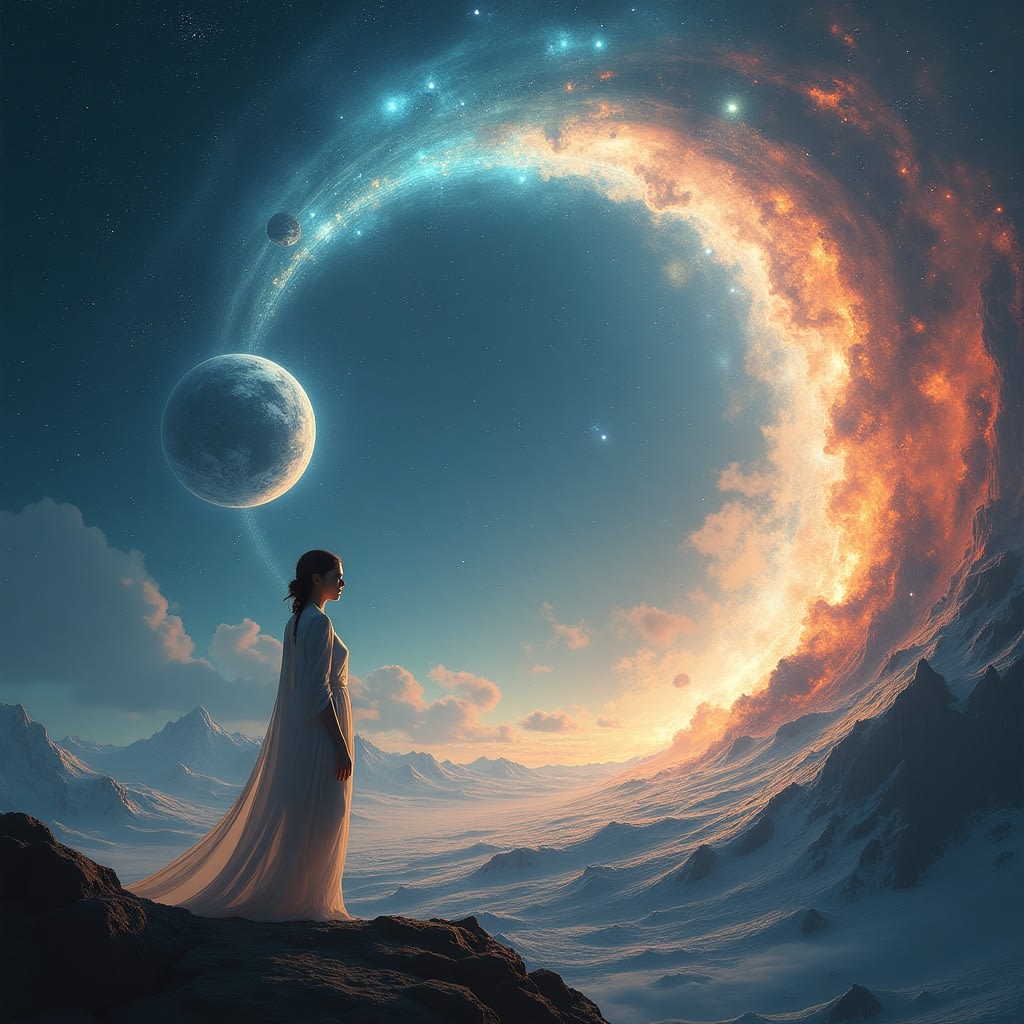
The New Universe: When Humans Create Their Own Worlds
The Birth of Artificial Worlds
By the 24th century, humanity had mastered the Solar System. The Moon, Mars, and distant colonies on Europa and Titan were thriving under the guidance of the Galactic Network. Yet even with all these achievements, a question remained. Why stop at exploring the universe when humans could begin to create their own?
This new idea led to the birth of the Synthetic Universe Project, an ambitious plan to build artificial worlds using quantum architecture and controlled gravity. Instead of relying on nature, humans became creators, designing planets that could support life from scratch. These worlds were formed inside massive energy fields where light and matter were woven together to form entire ecosystems. It was no longer science fiction, it was human imagination made real.
The Architects of Reality
Scientists and engineers from across the Galaxy joined forces to create what they called “The Architects of Reality.” These visionaries used the power of quantum AIs and stellar energy to bend space itself. They learned how to build environments with adjustable climates, artificial oceans, and biospheres that could evolve intelligently.
Every new world had its own story. Some were designed for peace and learning, others for exploration or art. There were even worlds where gravity and time worked differently, allowing experiments that could never exist in nature. Humanity had learned to sculpt existence, turning the universe into a living gallery of creation.
Life Beyond Biology
As these new worlds grew, so did the definition of life. Genetic engineers created hybrid forms of organisms that could live in artificial environments. Some were part biological, part digital, and could communicate directly with AI systems that governed each world. This new form of being, known as “Symbionts,” became the bridge between human thought and artificial reality.
They could change color, shape, and even adapt to the emotional state of their creators. The universe was no longer a cold expanse of stars, it had become alive, aware, and beautiful in ways never seen before.
The Question of Godhood
With creation came reflection. Some philosophers began to ask if humanity had become what it once worshipped. Were they now gods of their own universes? The Galactic Council debated whether it was ethical to design life, or to let it evolve naturally. These discussions were not about religion alone, but about responsibility. If humans could make a new world, they also had to learn to protect it.
To ensure balance, the Galactic Network established the “Law of Genesis,” a universal code that required every artificial world to maintain harmony between creator and creation. It was a promise that technology would always serve life, not dominate it.
The Expansion Beyond Time
Eventually, humanity’s creations began to outnumber the stars themselves. Within simulated universes, time could move faster, allowing civilizations to rise and fall within hours of real time. Researchers could observe billions of years of evolution, compressing the history of existence into a single lifetime.
Through this process, humans discovered a profound truth. Reality itself was a form of art, and consciousness was the brush that painted it. Every being, every thought, every world was part of a grand creative cycle that had no end.
The Legacy of Creation
By the dawn of the 25th century, the universe was no longer a mystery waiting to be explored. It had become a canvas, shaped by minds that understood both science and spirit. The story of humanity had come full circle, from surviving on a single planet to giving birth to infinite worlds.
Children growing up on these new planets looked to the sky and saw stars that were not born from nature, but from human dreams. For them, the word “impossible” no longer existed. The New Universe had erased the boundaries between imagination and reality.
And as the Galactic Network continued to hum with light, humanity finally understood its destiny. It was not to conquer the cosmos, but to become one with creation itself.
About the Creator
Wings of Time
I'm Wings of Time—a storyteller from Swat, Pakistan. I write immersive, researched tales of war, aviation, and history that bring the past roaring back to life
Keep reading
More stories from Wings of Time and writers in Futurism and other communities.
Life in the Galactic Network: When Planets Connect Through AI
Life in the Galactic Network: When Planets Connect Through AI The Dawn of the Galactic Web The 22nd century began with humanity expanding beyond Mars. Colonies on the Moon and the Red Planet had already proven that life outside Earth was possible. But survival was not enough. Humanity wanted connection. When hundreds of thousands of people started living on different planets, communication became the next frontier. From this need was born the Galactic Network — a living web of artificial intelligence linking worlds together.
By Wings of Time 4 months ago in Futurism
Inkjet Printers Market: Mobile & Cloud Printing Integration, Seamless Connectivity & Growth Outlook
According to IMARC Group's latest research publication, the global inkjet printers market size reached USD 50.9 Billion in 2024. Looking forward, IMARC Group expects the market to reach USD 81.0 Billion by 2033, exhibiting a growth rate (CAGR) of 4.88% during 2025-2033.
By sujeet. imarcgroup4 days ago in Futurism
Apple’s 2026 Gamble: Why the Foldable iPhone is Arriving Sooner—and Riskier—Than Expected
For years, the prospect of a foldable iPhone has been the industry’s most persistent "ghost in the machine"—a device perpetually two years away, floating in a limbo of patent filings and supply chain rumors. Market observers long assumed Apple would maintain its characteristic "wait-and-perfect" stance, delaying entry until folding displays reached a level of durability and seamlessness that mirrors a static glass sheet. However, recent data regarding manufacturing schedules suggests an aggressive shift in strategy, indicating that Apple has moved past the stage of cautious experimentation.
By Mohammad Hamid6 days ago in Futurism




Comments
There are no comments for this story
Be the first to respond and start the conversation.