
The Moon Archives: Earth’s Forgotten Memory Buried in Lunar Dust
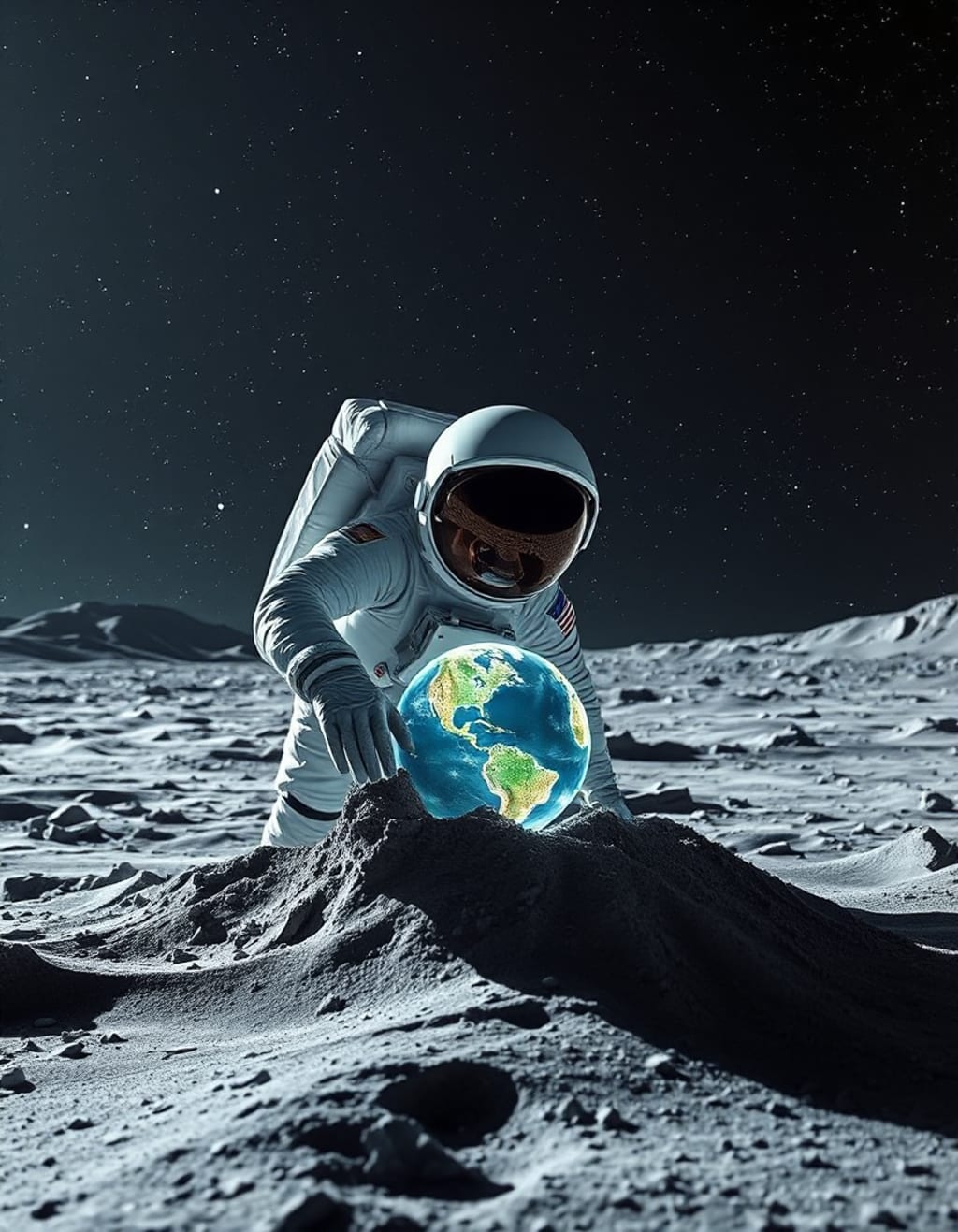
In the Sea of Tranquility, beneath meters of regolith, humanity discovers a memory vault built not by aliens—but by ourselves. The Moon, it turns out, has been Earth's last witness

1. The Forgotten Echo in Lunar Orbit
In 2043, after decades of unmanned exploration, the UK-led Artemis-Britannica mission sent humans back to the Moon—not to conquer, but to excavate. The mission’s goal was bold: investigate strange electromagnetic echoes detected beneath the Sea of Tranquility.
Initial readings suggested ancient cosmic ray remnants. But what the team found defied astrophysical logic.
Beneath the surface, where Apollo 11 once landed, a non-natural geometric cavity reflected radar scans—a six-sided structure, deep below regolith layers untouched for millennia.
It wasn’t alien.
It was human-made.
2. The Vault That Shouldn’t Exist
Dr. Reeva Shaw, lead British lunar archaeologist, lowered herself into the chamber after five days of precise drilling. Inside, she saw what resembled a collapsed observatory: hexagonal plates, broken latticework, and faint engravings in over 50 languages—including Sumerian, English, and binary.
It was a Lunar Archive, unlike anything in recorded history.
And there was no record of it ever being built.
The plates weren’t constructed from modern materials. They contained graphene-calcite composites, too advanced for any 21st-century nation—yet sealed beneath three meters of undisturbed lunar dust.
A single phrase ran across the top in gold lettering:
“In Dust, We Store Memory.”
3. The Secret of the Terran Codex
Within the vault lay three concentric cylinders the size of barrels. Each one was filled with ultra-thin slates stacked like records, encrypted with what appeared to be climate, ecological, and population data.
NASA, ESA, and China’s CNSA denied knowledge of the vault. But open-source AI analysis traced the digital pattern on one slate to data loss fragments from 2067—the year a cyberwar erased nearly 30% of Earth’s climatological archives.
Was this archive a back-up vault, secretly constructed to preserve our planet’s most sensitive data?
A single recovered plate confirmed it. It contained detailed atmospheric readings of Earth from 1980 to 2025—identical to models once thought completely lost.
This wasn't science fiction.
It was forgotten science.
4. Who Built the Moon Archive?
Theorists flooded the internet. Some claimed a shadow space agency. Others believed it was AI—future artificial intelligence, looping back to preserve humanity’s data before the Fall.
But the truth emerged when Dr. Shaw deciphered a seal on one inner wall. It read:
Project Ourea: United Earth Data Conservation Initiative, 2029
Launched: via Artemis X, hidden under lunar regolith.
Project Ourea had been a joint UK–Japan–Canada moonshot launched after the Great Server Collapse of 2027, when climate warfare, solar storms, and quantum ransomware destroyed decades of planetary archives.
To prevent extinction-level data loss, scientists encrypted the Earth's memory and launched it to the only stable place left:
The Moon—our eternal safe deposit box.
5. Why We Forgot
But why was Project Ourea erased from Earth’s collective memory?
The answer was as terrifying as it was poetic.
In 2032, during global political upheaval and climate panic, Project Ourea was classified, dismantled, and deleted—considered “utopian waste” in the age of orbital militarisation. Files were shredded, satellites lost, and team members sworn to silence.
It wasn’t conspiracy—it was collective collapse. Humanity forgot itself, to survive itself.
But the Moon remembered.
6. The Storyplates
Each slate inside the vault wasn’t just raw data. Many contained “Storyplates”—infographic narratives, personal logs, cultural capsules, and even genetic patterns of extinct plant life.
One slate displayed the heat map of the Amazon’s last unburned quadrant. Another played a child's lullaby from submerged Bangladesh. A third held the entire migratory path of British red kites, recorded in 4D flow diagrams.
These weren’t just records.
They were testimonies of a world nearing collapse.
Project Ourea hadn’t just stored science.
It stored emotion, encoded in geometry and light.
7. Earth Reacts
The public revelation of the Moon Archive caused global rupture. Some rejoiced—seeing it as proof that humanity once cared enough to save itself.
Others mourned, realising that Earth’s most accurate history lay not in museums or clouds—but buried in grey dust, millions of miles away.
The UK Parliament launched the Lunar Humanities Act, demanding full public access to the Moon Archive. Scientists were flown to the Moon Base Terra-1, now repurposed into the Lunar Memory Institute.
For the first time in centuries, archaeology had a future-facing mission.
8. A Memory of Green
One of the most haunting discoveries came from a single etched panel showing the Tree of Life—not mythological, but biological.
It listed extinct species in a clockwise spiral: Northern White Rhino, European Eel, Coral Polyp 223, each linked to time-stamped extinction events from 2005 to 2041.
Encoded in its roots was a sentence in multiple languages:
“They died. We forgot. So we planted memory where no fire reaches.”
It was signed with initials: E.M.D. — later identified as Dr. Elara May D’Souza, a British ecologist believed to have disappeared during the climate riots of 2031.
She hadn’t died. She had gone to the Moon.
9. The Lunar Reckoning
By 2045, researchers found over 12,000 data plates, many still unreadable due to solar degradation. But quantum decoding made progress.
One plate contained a full ecological map of pre-industrial Britain—flora, fauna, pollen distribution, and even ancient folk songs linked to seasonal crops.
Another showed the psychological patterns of collapsing societies, sourced from wearable biosensors distributed in secret during the 2020s. The insights are now used to inform post-crisis education worldwide.
Britain, in particular, embraced the find. Universities offered new degrees in Space Memory Engineering, while Scotland opened a replica of the archive in Inverness, attracting millions.
The Moon had made Britain remember its forgotten Earth.
10. The Archive Speaks
In 2047, a team successfully activated one of the deepest slates—one that required heat, not light, to decode.
When activated, it displayed a holographic message:
“This is not a record of what we lost. It is a toolkit for what you still have.”
“We knew you’d find this. You are us—after forgetting. Now remember.”
Below the message glowed one final log-in screen. The password?
Gaia.
The vault unlocked fully. And the Moon Archive sang.
Soundless in space, but eternal in signal.
About the Creator
rayyan
🌟 Love stories that stir the soul? ✨
Subscribe now for exclusive tales, early access, and hidden gems delivered straight to your inbox! 💌
Join the journey—one click, endless imagination. 🚀📚 #SubscribeNow
The Future of Work: How Gen Z is Rebuilding Career Culture from The Ground Up
She is twenty-four years old, running a client meeting from a sunlit flat in Lisbon while her colleague dials in from a co-working space in Seoul. The project is due by Thursday. Nobody is watching the clock. The work is getting done beautifully, and everyone involved chose to be here.
By CurlsAndCommas7 days ago in Futurism
Razor Market: Subscription-Based Grooming Services, Consumer Loyalty & Growth Outlook
According to IMARC Group's latest research publication, The global razor market size reached USD 12.7 Billion in 2024. Looking forward, IMARC Group expects the market to reach USD 16.3 Billion by 2033, exhibiting a growth rate (CAGR) of 2.65% during 2025-2033.
By sujeet. imarcgroup3 days ago in Futurism


Comments (1)
This is some seriously fascinating stuff. The idea of a human-made structure on the moon that's been there for millennia is mind-blowing. I wonder how they managed to build something so advanced without leaving a trace on Earth. And the fact that it contains data from a cyberwar years later? That's wild. Makes you think about all the secrets hidden in space. What do you think they were trying to protect with this lunar archive?