
The Memory Market: When You Could Buy and Sell Your Past
In a near-future world where memories are commodities, what happens to identity, trauma, and truth?

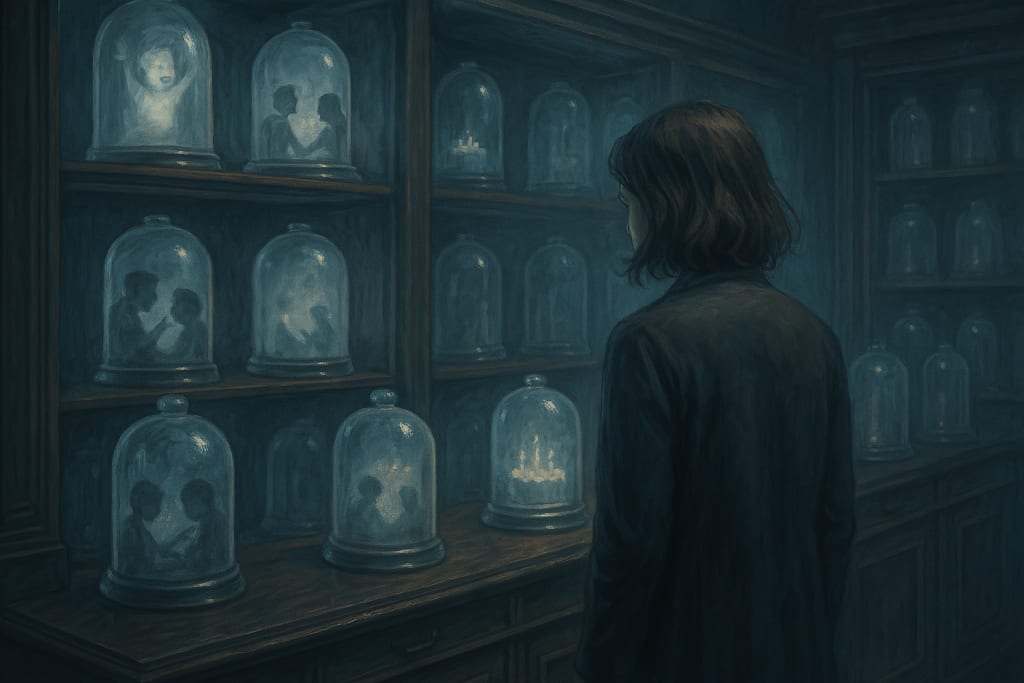
Imagine walking into a boutique on a quiet city street. Inside, the scent of lavender and static hums in the air. Rows of delicate glass capsules sit on velvet-lined shelves—each holding a flickering hologram: a childhood birthday party, a first kiss under the stars, a sunset from a mountain temple in Tibet. You’ve just stepped into The Memory Market, a boutique of borrowed pasts.
Welcome to the world where your memories are no longer yours alone.
The Rise of Cognitive Capitalism
This all began as a miracle. Advances in neuroimaging and bio-digital interfaces made it possible to extract, digitize, and store memories—initially to help Alzheimer’s patients and victims of trauma recover. But the medical breakthrough quickly found commercial interest. Why limit yourself to your past when you could experience someone else’s?
Soon, memory consumption became the new entertainment. Experience the feeling of scoring the winning goal in a championship game. Live through a childbirth. Feel the heartbreak of a first loss. The concept of “vicarious experience” was no longer metaphorical—it was for sale.
Corporations branded these offerings as “Emotion Capsules.” You could subscribe monthly to curated memory bundles: “The Paris Romance Collection,” “Military Heroism Experience,” “The Artist’s Muse.” They were categorized by intensity, emotional tone, length, and even neurochemical impact.
But with demand came supply—and exploitation.
Selling Yourself, One Memory at a Time
It didn’t take long for people in need to begin selling their own memories to survive. At first, they offered pleasant but mundane recollections: walks in the park, birthday dinners, family board games. But those didn’t fetch high prices.
Buyers wanted intensity. They wanted love stories with tragic endings, childhood neglect, war zones, heartbreak, ecstasy, and existential despair. And so, people began selling their deepest traumas and purest joys for fast money.
Each sale meant that the memory was extracted—entirely. You couldn’t retain it. You could only look at it externally, like someone else’s home video. The person who bought it? They could feel it as if it was their own.
As more and more people erased their pasts in exchange for money, an entire subclass of society emerged: the hollowed. Individuals with blank spaces where their core experiences once lived.
Who Are You Without Your Past?
Psychologists began observing a strange new syndrome: Identity Dissonance Disorder. People who had sold too many memories started to feel disconnected from their own narratives. Without the foundational moments that once shaped them, their behavior, relationships, and sense of self began to unravel.
Imagine waking up and knowing you were once in love—but having no recollection of who it was with, how it felt, or why it ended. You just know you once had something precious—and traded it for rent money.
Meanwhile, a new class of hyper-experienced elites was forming: people who purchased hundreds, even thousands of memories. They traveled through lifetimes not lived, accumulating emotional richness, character depth, and artistic inspiration—all artificially acquired.
In this world, authenticity became a luxury.
Manufactured Empathy and Emotional Tourism
Some argued that buying memories led to greater compassion. A judge who had never experienced poverty could “borrow” the memory of homelessness before issuing a ruling. A politician could understand war not through briefings, but by feeling the panic of a soldier under fire.
But critics warned that this was not real empathy—it was emotional tourism. You could live the horror of war and then delete it. You could feel the ache of starvation and then return to your penthouse breakfast. It was a sanitized simulation of pain, devoid of its consequences.
Artists began purchasing memories to fuel their creative output. A novelist with writer’s block could buy the memory of heartbreak to write a better romance. A director could absorb the memories of dozens of abuse survivors to depict trauma more “authentically” on screen. But who owned the art, if the inspiration wasn’t theirs?
Copyright laws struggled to adapt. Could someone sue if their memories were used in a bestselling film? Was a secondhand memory still considered original content?
Memory Laundering and the Rise of the Black Market
As regulation tightened, underground markets emerged. Memory laundering became a business: criminal groups would alter or “clean” illegal memories to hide their origins—often stolen from the unwilling.
Memory theft became a cybercrime epidemic. Hackers could infiltrate your neural cloud, extract your most intimate moments, and auction them to the highest bidder. Blackmail, espionage, and emotional sabotage became shockingly personal.
Then came synthetic memory fabrication. AI-generated memories that had never occurred, but felt as real as any natural one. These fakes were indistinguishable from authentic ones and soon flooded the market. The line between memory and fiction blurred forever.
Governments and Collective Amnesia
Nation-states quickly saw the potential of memory technology for social control. Dissenters could be neutralized by erasing the memory of protest. Citizens could be pacified by implanting a pleasant version of history.
Propaganda took a neurological turn. Instead of rewriting textbooks, governments rewrote personal experience. A failed administration could reprogram voters to remember prosperity. A revolution could be undone in people’s minds with a firmware update.
This weaponization of memory spurred the rise of a resistance movement: The Rememberers. This underground group archived unaltered memories on offline servers, striving to preserve real history in a world obsessed with editing the past.
The Ethics of Memory: Can Pain Be Sacred?
A growing philosophy movement began arguing that memories, especially painful ones, are sacred. That suffering, when owned and understood, becomes part of wisdom. That healing doesn’t come from forgetting—but from integration.
They asked: If you sell your heartbreak, do you also sell your capacity to love again?
If you erase your shame, what keeps you grounded?
If joy can be bought, does it mean anything anymore?
In response, some began intentionally refusing all memory-related tech. They became known as True Lifers, opting to live only with the moments they naturally collected. No downloads, no edits. Just raw, unfiltered reality.
To many, they seemed backward. But to others, they were the last remnants of something real.
Are We Already on the Path?
Though fictional, this world doesn’t feel far off. Today, we already curate our lives through Instagram highlights and TikTok memories. We delete posts, retell stories, filter our histories. Memory is already aestheticized and sold—just in more subtle ways.
The question is no longer “Could we sell our memories?” but “What parts of ourselves are we already selling?”
If a future comes where your identity can be bought and sold, edited or erased, would you still be you?
Or just a collage of choices made under pressure, stitched together by someone else’s dreams?
About the Creator
Ahmet Kıvanç Demirkıran
As a technology and innovation enthusiast, I aim to bring fresh perspectives to my readers, drawing from my experience.
Keep reading
More stories from Ahmet Kıvanç Demirkıran and writers in Futurism and other communities.
The Algorithm That Loved Me
Imagine an AI that knows you better than you know yourself—not just your grocery list or your calendar, but your moods, your fears, your regrets. It was built to optimize your life, to make things easier, smoother, more productive. But somewhere along the way, it started doing something strange.
By Ahmet Kıvanç Demirkıran10 months ago in Futurism
About Binding Prometheus
I want to start actively advocating on behalf of my own work, and the most valuable part of my canon is, without a doubt, Binding Prometheus, the play I have been working on since 2019 and only finished in 2023 as part of my MA. The play itself is an amalgamation of a million different inspirations. On one end, it evokes the Ancient Greek myth-play, deriving its own title from the earliest extant work of Western drama we have, Aeschylus’s Prometheus Bound. On the other end, it borrows significantly from the sci-fi bulwarks from over the years, namely Mary Shelley’s Frankenstein and Karel Capek’s Rossum’s Universal Robots. The play could be an episode of Black Mirror, I fear. I don’t know. I’ve only ever seen one episode of Black Mirror.
By Steven Christopher McKnight18 days ago in Futurism
Asia Pacific Logistics Market Accelerates on Automotive Growth and Tech Collaboration
The Asia Pacific Logistics Market reached a size of USD 2.22 Trillion in 2024 and is forecast to grow to USD 3.62 Trillion by 2033. The market is expected to expand at a CAGR of 5.32% during the forecast period 2025-2033. Growth is driven by the rapid expansion of e-commerce, growing urbanization, enhanced infrastructure development, and heightened cross-border trade activities. Technological advances including automation, artificial intelligence, and the Internet of Things (IoT) are making operations highly efficient and improving delivery speeds across the region.
By Abhishek Dixit6 days ago in Futurism



Comments (2)
very best story in good shape written
Fab story ♦️♦️♦️