
The Longyou Caves: Man-Made Megastructures or Forgotten Tech?
Massive underground chambers carved into solid rock, with no historical record

Introduction
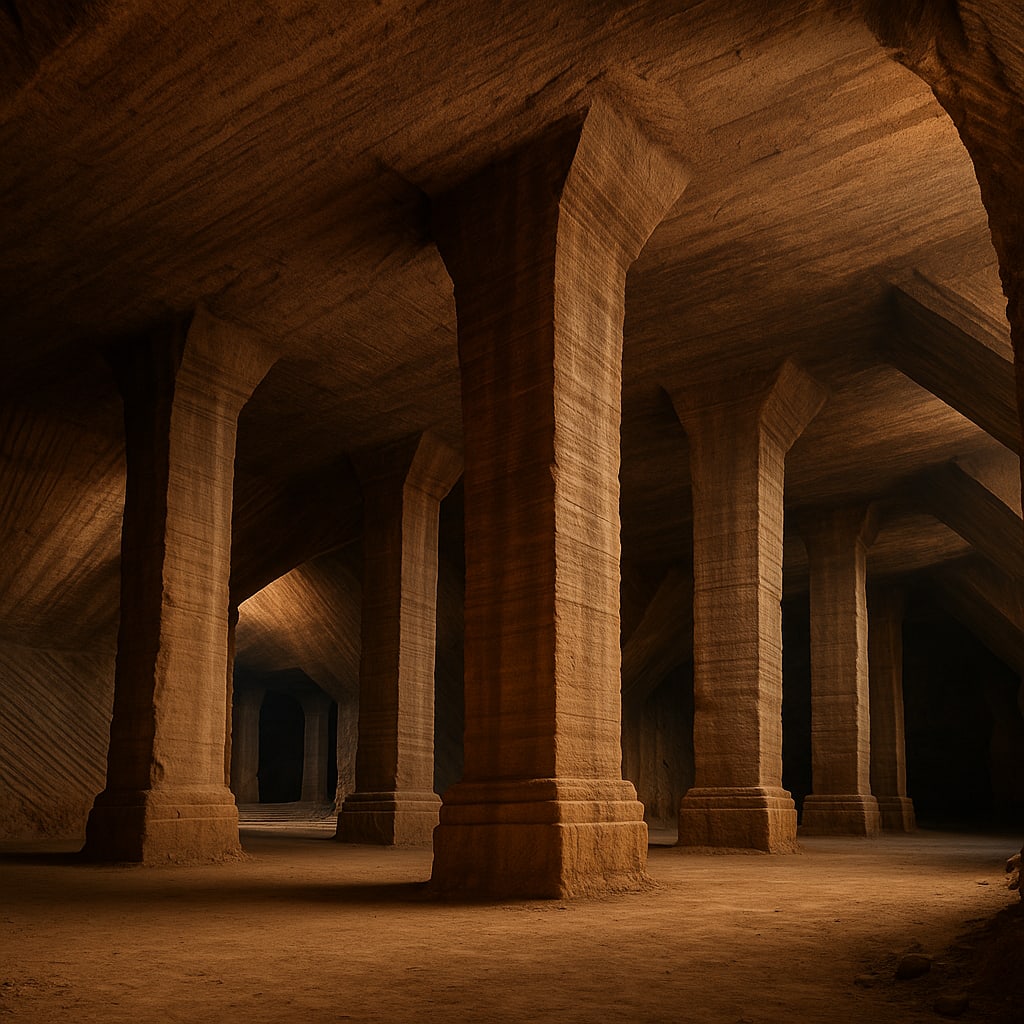
In the hills of Zhejiang Province, China, lies one of the most mysterious sites on Earth: the Longyou Caves. Discovered in 1992 by a group of curious villagers, these immense underground chambers remain one of the greatest unsolved enigmas of ancient engineering. Carved directly into solid siltstone, the caves cover thousands of square meters, with ceilings as high as a six-story building. And yet, astonishingly, there is not a single mention of their construction in any historical record.
Are the Longyou Caves merely an extraordinary feat of forgotten Chinese engineering, or do they point toward something deeper, evidence of pre-flood civilizations, lost knowledge, or even ancient energy systems?
The Mystery of Their Creation
Each cave is carved with remarkable precision. The walls, ceilings, and supporting columns all bear the same distinctive chisel marks: long, diagonal grooves that run in parallel, almost like the striations of a machine. Archaeologists estimate that just one chamber would have required hundreds of workers many years of labor using traditional tools. And yet, no tools have ever been found, no legends preserved, no documentation of their construction exists.
Even stranger, the caves remain structurally sound after more than two thousand years. There has been no collapse, no flooding, no natural erosion. It is as if the builders had an advanced understanding of geology, weight distribution, and structural integrity far ahead of their time.
If the caves were built during the Qin or Han dynasties, why do the meticulous Chinese historical records, known for documenting even the smallest construction projects, remain silent about such a monumental undertaking?
Engineering Beyond the Possible
The sheer size of the caves raises serious questions. The chambers reach heights of over 30 meters, with carved beams and ceilings that defy collapse. In modern construction, engineers use complex calculations, steel reinforcement, and surveying equipment to achieve such stability. For an ancient civilization armed with little more than bronze or iron tools, this should have been impossible.
Some researchers have proposed that the Longyou Caves might have been quarries, but this explanation quickly fails. Quarries leave behind irregular shapes, rubble, and rough surfaces. The Longyou chambers, by contrast, are elegant, precise, and uniform. They were not carved for extraction, they were constructed as spaces to be used.
Signs of Advanced Planning
Perhaps the most baffling aspect is the uniformity of design. Every chamber follows the same architectural style, down to the smallest detail. The parallel grooves carved into the walls have led some to speculate that a single workforce, guided by central planning, or even advanced machinery, was at work.
Consider the logistics:
Removing millions of cubic meters of solid rock.
Transporting the debris without leaving significant traces.
Coordinating the labor of hundreds, perhaps thousands, of workers.
Achieving all of this without a single mistake that compromised structural safety. This suggests not only advanced engineering knowledge but also centralized organization on a massive scale.
Forgotten Tech or Lost Civilization?
One of the more controversial theories is that the Longyou Caves may date back to a civilization predating recorded Chinese history, possibly even to a pre-flood era. Many ancient cultures, from Mesopotamia to Mesoamerica, speak of great floods that destroyed earlier civilizations. Could the Longyou chambers be a remnant of such a forgotten world?
If so, the caves might not have been simple shelters or storerooms. Some researchers suggest they could have been energy chambers, designed to harness acoustic or electromagnetic forces. The resonant qualities of the caves, deep, echoing, and uniform, hint at intentional design, as if the builders understood how to manipulate sound or vibration.
Symbolism and Purpose
Without inscriptions or artifacts, the purpose of the caves remains speculative. Yet their scale implies significance. No one invests such labor without purpose. Theories range from:
Underground temples or ceremonial spaces. Storage facilities for grain or water. Hidden refuges during conflict. Energy centers tied to forgotten technologies. The lack of artifacts is itself puzzling. It is as if the caves were carefully cleared and abandoned, leaving only the architecture as a silent testimony.
Echoes Across the World
The Longyou Caves are not unique in their mystery. Across the globe, we find echoes of similar feats:
The underground cities of Cappadocia in Turkey, vast networks carved into volcanic rock. The ancient rock-cut temples of India, like Ellora and Ajanta, where entire mountainsides were hollowed into intricate chambers. The megalithic stonework of Peru, where blocks fit so precisely that not even a blade of grass can slide between them.
Each of these sites raises the same questions: how, why, and by whom? They suggest a pattern, an ancient global knowledge of stonework and underground engineering that modern history struggles to explain.
A Human Connection
What makes the Longyou Caves so fascinating is not just their technical mystery, but their human dimension. Imagine the lives of the builders: descending into the darkness, chiseling tirelessly for years, guided by some vision or command. Were they laborers serving an emperor? Or initiates in a forgotten order, working to preserve knowledge for the future?
When you stand inside one of these chambers today, you feel more than awe. You feel the presence, the weight of effort, intelligence, and intention that carved these immense halls into being.
The Bigger Question
Ultimately, the Longyou Caves force us to ask bigger questions about history itself. Are we truly the pinnacle of human achievement, or are we inheritors of knowledge long forgotten? Are these caves evidence that humanity has risen and fallen in cycles, with civilizations rising to heights we can scarcely imagine, only to be wiped out and remembered as myth?
Conclusion
The Longyou Caves remain a riddle in stone. Whether they were the work of ancient Chinese engineers, a pre-flood civilization, or something more mysterious, they defy our assumptions about the past. Their silence speaks volumes: no texts, no legends, no explanations, only vast halls carved in perfect symmetry, waiting for us to rediscover their purpose.
Perhaps they were temples. Perhaps they were machines. Perhaps they were messages across time, whispering to us that history is not as simple as we believe. What is certain is this: the Longyou Caves are more than empty chambers. They are monuments to human ingenuity, or to a forgotten technology, that challenge us to look deeper, question harder, and wonder what else lies hidden beneath the surface of our world.
About the Creator
The Secret History Of The World
I have spent the last twenty years studying and learning about ancient history, religion, and mythology. I have a huge interest in this field and the paranormal. I do run a YouTube channel
Keep reading
More stories from The Secret History Of The World and writers in Futurism and other communities.
Volume 7: After the Sky Opens: Life in the First Days of Disclosure
Life in the First Days of Disclosure The moment humanity has waited for will not arrive with fanfare or fireworks. It will come with silence broken by a collective gasp, a shockwave of realization that spreads not from governments or generals, but from the people who look to the sky and understand that everything has changed. Disclosure will not be the end of a mystery; it will be the beginning of a reckoning. And what follows in the days, weeks, and months after will test the very soul of humanity.
By The Secret History Of The WorldExclusive • 7 months ago
Australia Bedsheet Market: Sustainability Trends, Smart Textiles & E-commerce Growth
According to IMARC Group, the Australia bedsheet market reached USD 2,316.4 Million in 2025 and is projected to grow to USD 3,130.0 Million by 2034, exhibiting a compound annual growth rate (CAGR) of 3.30% during 2026–2034. The steady expansion reflects evolving consumer preferences for comfort, sustainability, and premium home aesthetics across Australia. Rising awareness about environmentally friendly materials, increasing adoption of smart textile technologies, and expanding digital retail platforms are collectively strengthening Australia bedsheet market share. As bedding products transition from basic household essentials to lifestyle-enhancing investments, innovation and online accessibility are reshaping competitive dynamics.
By Shrestha Roy7 days ago in Futurism
Neuralink: The Dawn of the Connected Mind or the Death of Private Thought?
The Last Frontier of Privacy For centuries, the human mind has been the only truly private place left on Earth. You can hide your browser history, you can encrypt your messages, and you can wear a mask in public. But your thoughts? Those were yours alone. No algorithm could touch them, and no surveillance camera could see them.
By Priyantha Wijethunga5 days ago in Futurism




Comments
There are no comments for this story
Be the first to respond and start the conversation.