
The Light-Speed AI Revolution: How Photonic Chips Could Make Smart Devices Faster and Cooler
Fresh insight on Ai series

Intro / Lede
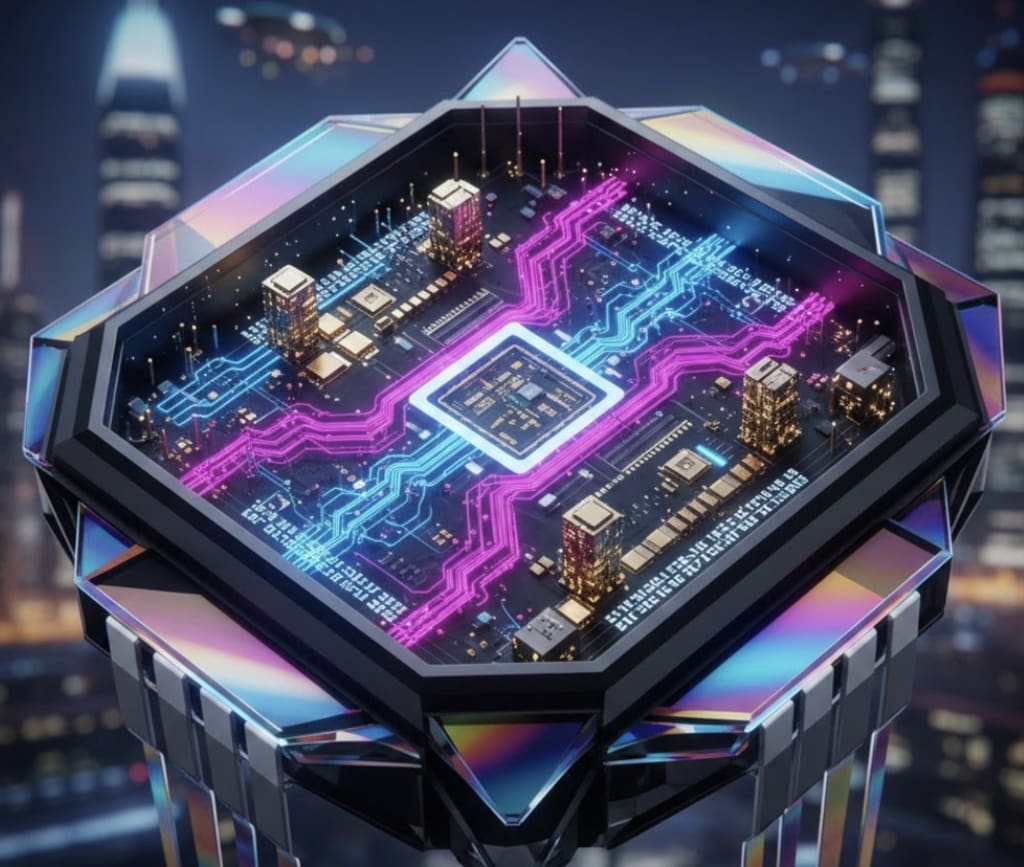
Imagine your phone running a powerful AI model without draining battery, or a tiny gadget that recognizes voice, images and learns on the fly — all while consuming a fraction of today’s power. That’s the real promise behind photonic AI chips: using light (photons) instead of electrons to do the heavy math. If industry and labs turn promise into products, the way we build and use AI could flip fast.
What are photonic AI chips?
Traditional chips move electrons around metal wires. Photonic chips use pulses of light traveling through tiny optical circuits etched on silicon. Light can move faster, cross without interfering, and carry more information per second. That gives photonic designs the potential to run some AI tasks far quicker and with less heat — a huge win when power and latency matter.
Why now?
For years photonics lived mostly in fiber-optic cables and fancy labs. Lately a few things changed: researchers built integrated photonic accelerators that actually perform machine-learning computations on-chip, and industry players are demoing co-packaged optical connectivity to tackle datacenter bottlenecks. Those steps move photonics from concept toward real hardware that can be manufactured at scale.
Everyday impact — what this would mean for people
Faster on-device AI: smarter cameras, better translation, instant voice assistants that don’t need the cloud.
Longer battery life: energy-sipping inference means fewer plugs and cooler devices.
New gadgets: ultra-low-latency wearable AR/VR and embedded AI in places that can’t fit big GPUs.
The caveats
Photonic chips aren’t magic: some AI ops still map better to electronic circuits, manufacturing optics to chip-scale precision is hard, and the software stack needs to evolve. Expect a hybrid future — photonics for the heavy, parallel ops and electronics for control.
Why writers and creators should care
This isn’t just “another chip” story. If photonics scales, it changes who owns AI — bringing power out of centralized datacenters into local devices. That shifts privacy, creativity, and the economics of apps. For creators, that could mean new classes of local AI tools (think: real-time video editing on your phone without uploads).
Micro action for readers
If you love tinkering, watch for developer kits and demos from labs and startups — these are often the first place photonics meets real software. For writers: track co-packaging announcements and university demos — they’re the headlines that hint at real adoption.
The Silent Crisis Photonic Chips Are Solving
We don’t usually think about it, but every time you stream a video, generate an image with AI, or send a message across the world, millions of electrical signals fire inside datacenters. Those signals create heat — and heat forces companies to build massive cooling systems. Today, cooling AI infrastructure is becoming one of the biggest hidden problems in the tech world.
Datacenters already consume more energy than entire countries. And as AI models get bigger, the electricity demand is skyrocketing. Companies are running out of ways to cool chips down without building giant, warehouse-sized air conditioners. This is where photonics becomes more than “just another chip innovation.” It becomes a lifeline.
Because photonic chips move information using light, they generate significantly less heat. Less heat means less cooling. And less cooling means lower energy bills, fewer emissions, and a path forward that doesn’t burn the planet just to answer a million AI queries per second. This is why the biggest players — cloud companies, academic labs, semiconductor giants — are aggressively exploring photonic architectures. They’re not doing it for fun. They’re doing it because the current path is not sustainable.
Hybrid Future: Where Photonics and Electronics Work Together
A lot of people imagine a future where photonic chips completely replace electronic chips. That’s not how this will play out. The real future is hybrid.
Electronics are still incredibly good at certain tasks — logic, memory storage, control systems. Photonics shines at high-speed, parallel processing. So the winning design in the next decade will look like a fusion: electronics for control, photonics for heavy math. Think of it like a race car: the engine stays the same, but the turbocharger completely transforms performance.
This hybrid model is already appearing in research prototypes: optical accelerators controlled by electronic processors, offering the best of both worlds. For consumers, this means your next phone, laptop, or wearable could have a “light engine” coexisting with traditional silicon.
Why Photonics Feels Like the Early Days of GPUs
In the early 2000s, graphics cards were simple tools for gamers. Nobody predicted they’d become the backbone of AI and supercomputing. Photonic chips feel like that moment.
Right now, they’re niche and experimental. But the conditions are identical:
AI is exploding in demand, energy efficiency is becoming non-negotiable, and new types of hardware suddenly make sense
If photonics follows the GPU timeline, today’s prototypes could become tomorrow’s default.
CTA
We’re watching a hardware shake-up that could make AI faster, greener, and more personal. Stay tuned for the freshest tech insights!
About the Creator
Sebastian De Lima
Dot…com?
Keep reading
More stories from Sebastian De Lima and writers in Futurism and other communities.
Carbon, Not Silicon, Is the Endgame
Intro Silicon has been a heroic material. For seven decades it carried the world’s computing dreams from room-sized ENIAC racks to the pocket computers we carry today. But silicon’s reign is now a story of diminishing returns. Transistors have shrunk to a scale where quantum tunneling, heat, and interconnect loss are the real blockers, not clever circuit tricks. That doesn’t mean computing dies — it means the stack changes. For the next chapter, carbon is not just an alternative; it’s the material logic of a radically different kind of computing.
By Sebastian De Lima24 days ago in Futurism
About Binding Prometheus
I want to start actively advocating on behalf of my own work, and the most valuable part of my canon is, without a doubt, Binding Prometheus, the play I have been working on since 2019 and only finished in 2023 as part of my MA. The play itself is an amalgamation of a million different inspirations. On one end, it evokes the Ancient Greek myth-play, deriving its own title from the earliest extant work of Western drama we have, Aeschylus’s Prometheus Bound. On the other end, it borrows significantly from the sci-fi bulwarks from over the years, namely Mary Shelley’s Frankenstein and Karel Capek’s Rossum’s Universal Robots. The play could be an episode of Black Mirror, I fear. I don’t know. I’ve only ever seen one episode of Black Mirror.
By Steven Christopher McKnight11 days ago in Futurism
Saudi Arabia Skincare Market: Vision 2030, Dermatology-Backed Products, Innovation & Brand Expansion
According to IMARC Group's latest research publication, the Saudi Arabia skincare market size reached USD 1.33 Billion in 2024. Looking forward, IMARC Group expects the market to reach USD 1.97 Billion by 2033, exhibiting a growth rate (CAGR) of 4.48% during 2025-2033.
By Jeffrey Wilson4 days ago in Futurism
Where's the Glory?
In breaking news, rehabilitated Republican Senator Johnnie Johnson (Pronouns: HE, HIM, HIS) called a press conference from the Men’s room of the New Orleans Louis Armstrong International Airport, Concourse B, across from the Ignatius Reilly’s Lucky Dog stand. The Senator had just returned from a sexual reorientation rehabilitation program in Memphis, TN after being publically disgraced at a Buckee’s Truckstop restroom soliciting sex from an undercover cop three months ago. He is a founding member of the Reformed Christians for Christ, a conservative, pro-family and ex-gay advocacy group. In the spirit of being reborn, Senator Johnson invited reporters to marvel at his plans for a major remodeling of airport bathrooms.
By Cathy Schieffelin4 days ago in Humor


Comments
There are no comments for this story
Be the first to respond and start the conversation.