
The Latest Breakthrough in the Double-Slit Experiment
MIT Puts to Rest the Wave-Particle Duality Debate

MIT Puts to Rest the Wave-Particle Duality Debate
In July 2025, physicists at the Massachusetts Institute of Technology (MIT) achieved what is arguably the cleanest and most compelling realization to date of the famed double-slit experiment. Conducted in Cambridge, Massachusetts, this “idealized” rendition of the 1801 Young experiment pitted Einstein’s century-old intuition against Bohr’s quantum orthodoxy—and emerged as a decisive vindication of Bohr’s principle of complementarity.
Location & Date
The experiment, led by Nobel laureate Wolfgang Ketterle, was performed at MIT's Research Laboratory of Electronics and Department of Physics, in the MIT-Harvard Center for Ultracold Atoms. The research findings were published in Physical Review Letters on July 22, 2025, with a press release following on July 28, 2025.
The Scientific Challenge: Einstein vs. Bohr
The double-slit experiment, first devised by Thomas Young in 1801, demonstrated light’s wave-like nature through interference patterns. A century later, quantum mechanics reframed the paradox: light and matter exhibit both particle and wave behavior—but not simultaneously.
In 1927, Albert Einstein proposed a clever thought experiment: if a slit is allowed to recoil when a photon passes, one could, in principle, detect the photon’s particle nature by measuring the recoil, while still preserving the interference pattern—thereby witnessing both wave and particle behaviors at once. Niels Bohr countered using the uncertainty principle: any such measurement inevitably disturbs the system, destroying the interference.
Experimental Setup: Atoms as Slits
Ketterle’s team, including first author Vitaly Fedoseev alongside Hanzhen Lin, Yu-Kun Lu, Yoo Kyung Lee, and Jiahao Lyu, devised an atomic-scale analog of this thought experiment.
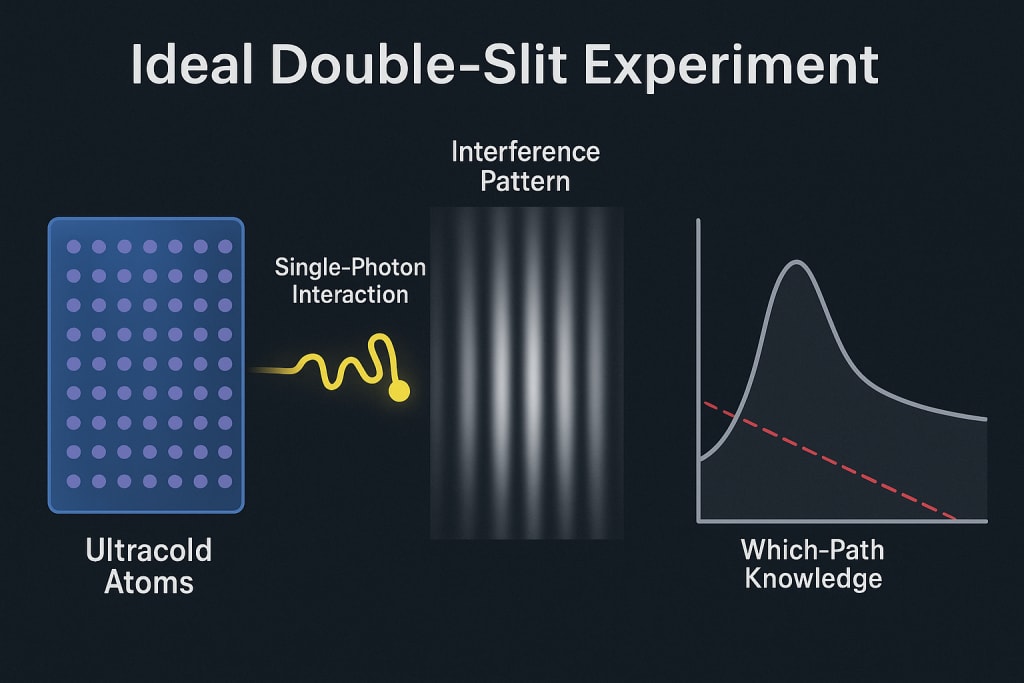
Ultracold Atoms: Over 10,000 atoms were cooled to microkelvin temperatures and arranged in a crystal-like optical lattice using laser beams.
Single-Photon Interaction: Weak light pulses ensured that, on average, each atom scattered at most one photon at a time.
Atomic Fuzziness (Which-Way Control): By tuning the laser confinement, researchers controlled how “fuzzy” each atom's position was. A tighter hold meant well-localized atoms (favoring wave behavior), while a looser hold made them spread, more easily disturbed, thereby imparting “which-path” information and nudging photons toward particle behavior.
Measuring the Trade-Off
The core result: the more the researchers could in principle determine which atom scattered the photon, the more the interference (wave-like pattern) vanished. Conversely, when path information receded, the interference strengthened—perfectly mirroring the predictions of quantum theory.
In experimental runs, the team even turned off the lasers holding the atoms—analogous to Einstein’s “spring-suspended slit”—and measured behavior in a matter of a microsecond before the atoms fell under gravity. Even in this “spring-less” scenario, the result was identical: one could observe wave behavior or particle behavior, but never both at once.
What They Found
Einstein’s hope dashed: The team clearly demonstrated that attempting to record both properties simultaneously collapses the interference pattern—affirming Bohr’s complementarity and refuting Einstein’s recoiling-slit proposal.
Role of the “Spring” dispelled: The mechanical analogy of a spring was shown to be irrelevant. What truly matters is the quantum “fuzziness” of atomic position and its entanglement with photons—not any classical mechanics element.
“Gedanken experiment” made real: Ketterle described the setup as an actual realization of a thought experiment that Einstein and Bohr could only have imagined a century ago.
Statement from the Team
Wolfgang Ketterle: “What we have done is an idealized Gedanken experiment.”
Vitaly Fedoseev: Emphasized that “the springs do not matter—what matters are quantum correlations between photons and atoms.”
Yoo Kyung Lee: Noted the symbolic resonance of settling this debate in the same year the UN declared the International Year of Quantum Science and Technology, 2025.
Scientific & Historical Significance
This experiment represents a pinnacle in experimental quantum physics, achieving atomic-level fidelity to the elusive behavior of light. It resolves a foundational debate that began in the early 20th century and brings quantum thought experiments firmly into the laboratory.
Moreover, the use of ultracold atoms and controlled quantum states underscores the advancements in quantum technology—both as tools for fundamental science and as a testament to how far experimental capabilities have progressed since the era of Einstein and Bohr.
Final Thoughts
MIT’s 2025 double-slit experiment stands as a landmark in physics. It verifies that wave-particle duality cannot be observed simultaneously, confirms Bohr’s principle of complementarity, and triumphs over Einstein’s longstanding challenge—all in the most stripped-down, elegant fashion imaginable.
By replacing mechanical slits with single atoms and using quantum control to dial in fuzziness, the researchers transformed a century-old thought experiment into empirical reality. Their work not only settles historic debate—in the International Year of Quantum Science and Technology no less—but also paves the way for future experiments exploring the foundational mysteries of quantum mechanics.
Sources
Ketterle, W., et al. (2025). Macroscopic Matter-Wave Interference of Ultracold Atoms in a Double-Slit Geometry. Physical Review Letters, American Physical Society.
MIT News Office. (2025). MIT physicists demonstrate new double-slit experiment with ultracold atoms. Massachusetts Institute of Technology.
ScienceDaily. (2025). Breakthrough in wave-particle duality: MIT’s double-slit experiment with ultracold matter.
Nature News. (2025). Matter-wave interference confirmed at macroscopic scales: MIT experiment settles long debate. Nature Publishing Group.
About the Creator
Mohamed hgazy
Fiction and science writer focused on physics and astronomy. Exploring the human experience through imagination, curiosity, and the language of the cosmos.
Keep reading
More stories from Mohamed hgazy and writers in Futurism and other communities.
3D Printing
Start writing...3D Printing How 3D Printing Has Shaped Industry and Science In the past few decades, one of the most exciting technological revolutions has been 3D printing, also known as additive manufacturing. What started as a small idea in research labs is now transforming industries such as medicine, aerospace, construction, and even education. The history of 3D printing is full of fascinating inventors, groundbreaking innovations, and unexpected applications that continue to push the boundaries of human creativity.
By Mohamed hgazy7 months ago in Futurism
GCC Fruit Juice Market Analysis: Key Drivers, Market Dynamics & Future Prospects
According to IMARC Group's latest research publication, GCC fruit juice market size reached USD 3.7 Billion in 2024. The market is projected to reach USD 5.6 Billion by 2033, exhibiting a growth rate (CAGR) of 4.8% during 2025-2033.
By Abhay Rajputabout 5 hours ago in Futurism


Comments
There are no comments for this story
Be the first to respond and start the conversation.