
The Last Light of Albion
When the Sun Fades, Will Science Save Our World?

I. The First Dim
It began with a flicker.
Not the flicker of a failing light bulb, but of something far more ancient, more permanent—or so we thought. The Sun, that ever-burning furnace which had bathed Earth in light for over four billion years, dimmed for a fraction of a second.
Most missed it.
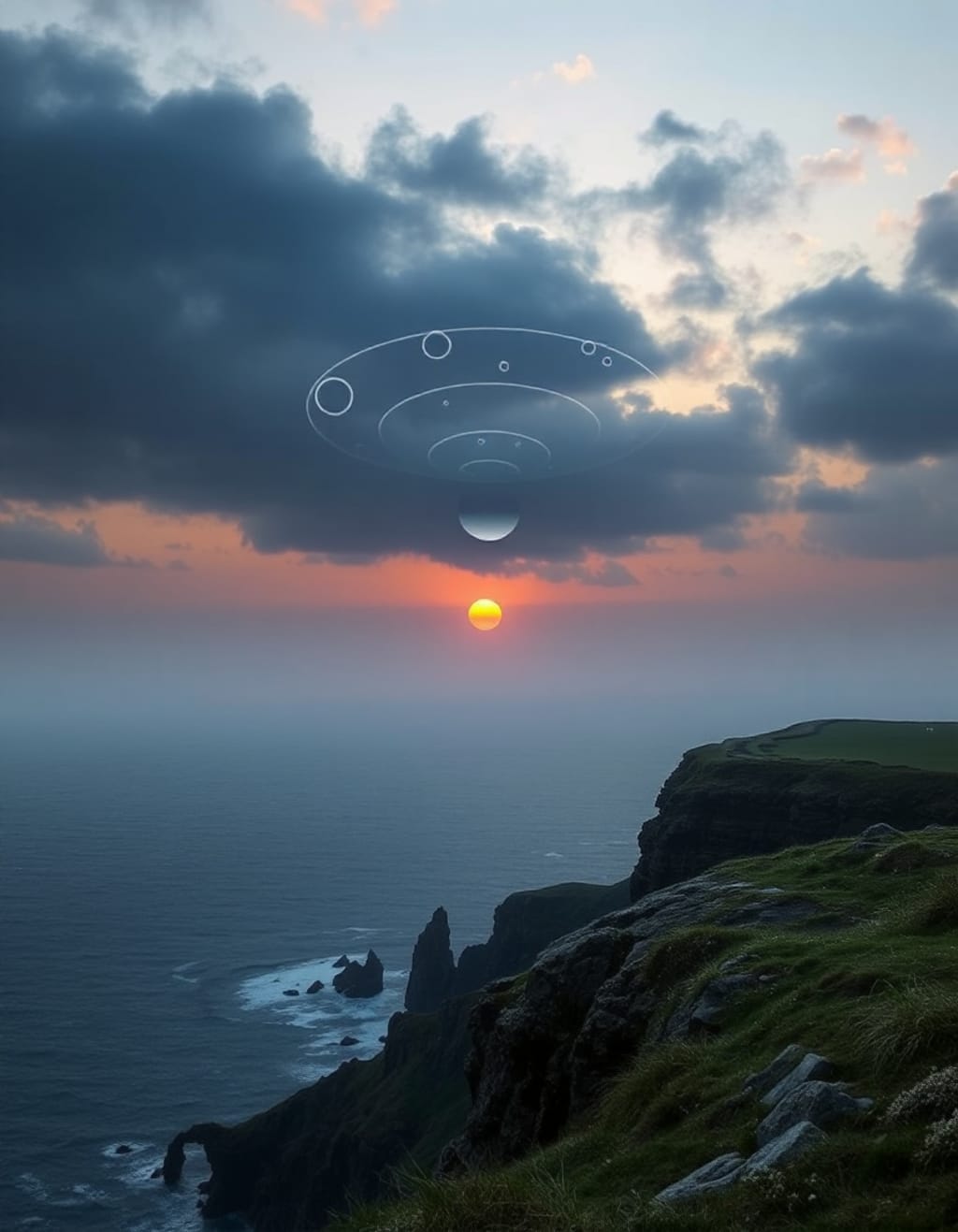
But in the quantum observatory nestled along the rocky cliffs of Cornwall, a team of British astrophysicists saw it in real time. The lead scientist, Dr. Thomas Elridge, watched as the photon levels dropped by 0.0002%, then returned to normal. A whisper in the void.
He might have dismissed it as equipment error if it hadn't happened again. And again. Each time, the dimming grew longer. The pulses were symmetrical, precise, and—most terrifying of all—mathematical.
The Sun was sending signals.
II. Albion Responds
They called it “The Morse Phenomenon.” And soon, the world noticed.
Panic swept through governments, scientists, and ordinary people alike. Was this a natural anomaly? An alien communication? Or worse—evidence of stellar decay?
It was England that acted first. After all, it had begun there, and the British public, torn between anxiety and pride, embraced the title that international media had given the country: The Last Light of Albion.
Cambridge, Oxford, and Imperial College London joined forces to form Project Helios, a multinational think tank determined to decipher the pulses before permanent darkness descended.
III. A Message from the Furnace
The scientists eventually cracked the pattern.
The pulses were prime-number sequences encoded with variables that described physical constants—Planck’s constant, the speed of light, gravitational acceleration. But then came the impossible: a variable that changed over time. The Sun was reacting to us.
Project Helios researchers began experimenting. They beamed quantum patterns at the Sun from the Earth’s magnetosphere. They embedded fractal pulses in deep-space telescopes. To their astonishment, the Sun responded. It dimmed slightly every time a specific frequency was sent. There was intelligence behind the fire.
The conclusion was staggering: the Sun was alive.
Not alive in the way we understand biology, but conscious—an ancient awareness born from plasma and gravity and time. And it had just noticed humanity’s presence in the cosmos.
IV. The Sun’s Warning
As Earth tumbled toward an energy crisis, the Sun’s pulses began to change.
They were no longer just mathematical—they were visual. Solar flares, shaped into patterns like crop circles across the chromosphere, depicted spirals, decay chains, entropy.
One unmistakable symbol emerged again and again: a falling spiral, engulfed in shadow.
Dr. Elridge and his team interpreted it as a warning. Humanity had tilted the balance—climate catastrophe, overpopulation, resource exhaustion. The Sun was offering not judgment, but a choice.
If we continued, the light would go out—not metaphorically, but literally. The Sun would enter a quantum dormant state, pulling Earth into a deep solar minimum that could last centuries.
A new ice age.
The world had to respond—together.
V. Operation Dawncode
The United Nations held an emergency summit under red skies. Britain led the initiative to develop Dawncode, a global protocol for emitting synchronized quantum pulses—messages of harmony, sustainability, and repair. These were not just symbolic gestures. They would show the Sun that its child, Earth, had matured.
Across the globe, energy systems shifted. Carbon usage plummeted. Forests were restored. Oceans were cleaned. Not because of guilt or fear, but because now Earth had an audience—the very star that gave it life.
And the Sun responded. Its flickers softened. Light grew warmer again. Plants bloomed out of season. It was as though the Sun smiled.
VI. The Solar Choir
But then something even stranger occurred.
People—scientists, artists, children—began to hear things. Not voices exactly, but tones, harmonies. When mapped against solar data, the frequencies aligned with sunspot activity. The Sun was communicating through vibration. And some minds were attuned to it.
A new generation of thinkers emerged: solar sensitives. Some called them “Sun Whisperers.” Others feared them. But they spoke of peace, of cosmic symbiosis, of the Sun as a guardian—one that had watched Earth’s evolution since the first bacteria split in deep ocean vents.
It was not our god. It was not our enemy. It was our ancient parent.
VII. The Night Parliament
Still, not everyone accepted this cosmic intimacy.
In secrecy, several nations formed an alliance called The Night Parliament. Their theory: the Sun was manipulating humanity, using warmth as leverage. They wanted to reassert control—build artificial suns, star-reactors, and ultimately sever Earth’s “dependency” on what they viewed as a celestial tyrant.
They launched Project Umbra—a plan to install massive orbital mirrors that could block solar messages.
Britain protested. Dr. Elridge warned them: “You don’t unplug your heart just because you fear its power.”
But the mirrors went up.
And the Sun dimmed again.
VIII. Albion’s Final Gift
The United Kingdom made a bold decision. It dismantled every Umbra satellite in its airspace and broadcasted a message from Stonehenge, encoded in quantum patterns and traditional Morse: “We choose to walk in the light, not the shadow.”
The Sun responded.
It flared—not in anger, but in illumination. Across the skies of Earth, an aurora borealis danced unlike any seen before, visible even from London. The colors were not random. They formed patterns. They told stories—of galaxies, of birth, of memory.
And at the centre of that radiant storm, a shape glowed: Albion, the old name for Britain, stylized as a light-bearing figure.
It was the Sun’s acknowledgment, maybe even its blessing.
IX. A New Covenant
The world stood still.
The Night Parliament disbanded. Project Helios evolved into a new international body: SolNet, designed to maintain dialogue with the Sun and monitor humanity’s progress.
Earth entered the Solar Renaissance, an age of solar harmonics, environmental repair, and technological harmony. Music was composed using solar frequencies. Buildings were powered by bio-resonant solar collectors. And people lived with one new understanding:
The universe was watching.
The Sun was not just energy.
It was memory. It was history. It was the silent witness to everything we had been—and everything we could become.
X. Conclusion: The Last Light, Rekindled
“The Last Light of Albion” had not faded after all. It had simply shifted—from flame to understanding.
In Cornwall, Dr. Elridge stood at the cliff’s edge once more, not with dread, but with gratitude. The sky was glowing. Not just with sunlight, but with purpose.
Humanity had spoken.
And the Sun had answered back.
About the Creator
rayyan
🌟 Love stories that stir the soul? ✨
Subscribe now for exclusive tales, early access, and hidden gems delivered straight to your inbox! 💌
Join the journey—one click, endless imagination. 🚀📚 #SubscribeNow
When a Spark Becomes a Storm
Section 1: The Hidden Reservoirs of Potential Energy — The Underlying Foundations of Catastrophic Failure At the core of systemic vulnerability lies a fundamental, often overlooked principle: complex, large-scale systems—be they electrical grids, geological formations, chemical stores, or atmospheric phenomena—are capable of harboring enormous quantities of stored potential energy. This energy is often invisible, silent, and contained within the physical structure or state of the system, maintained in a metastable equilibrium by control systems, environmental conditions, or natural processes.
By Peter Thwing - Host of the FST Podcast4 days ago in Futurism



Comments (1)
This is fascinating! The idea of the Sun sending signals is mind-blowing. I wonder what these signals mean for us. And it's cool how the scientists are trying to communicate back. Do you think there are other ways we could interact with the Sun's signals? I'm also curious about the variable that changes over time. What could be causing that? It makes me think there's a lot more going on than we initially thought. How do you think this discovery will impact our understanding of the universe?