
The Image of the Future
A Game for Foresight and Engagement

In 1961, Fred Polak (1907- 1985) published The Image of the Future. Born Frederik Lodewijk Polak in the Netherlands, Polak, who was Jewish, survived the Holocaust by going into hiding during World War II. By the mid-twentieth century, he had become a prominent sociologist and one of the founders of modern futures studies.
His Wikipedia page notes that Polak had fellowships with UNESCO, the Ford Foundation, and the Council for Europe, as well as several professional positions and accolades across his career. However, not much is known about Polak beyond these standard biographical details. We can only surmise how his experience in World War II may have shaped his focus on how an individual's sense of agency combines with a natural propensity for either optimism or pessimism to generate a dominant orientation to thinking about the future.
The Image of the Future, re-issued in 1973, with translation by Elise Boulding (https://storyfieldteam.pbworks.com/f/the-image-of-the-future.pdf), reflected the intensely literary culture of the mid-twentieth century. Over three hundred pages long, this painstaking opus ranges across the history of human interest in anticipating the future and sits squarely within the tension and optimism of the Cold War space race between the United States and the Soviet Union. It crosses the realms of sociology, history, and speculative fiction and, while a challenging and sometimes bewildering read, continues to yield important insights for anyone interested in contributing to positive social and organizational outcomes through foresight.
Indeed, despite its clear debt to its own place and time, Polak’s work remains relevant to our disruptive and uncertain era. It is in his honor that one major tool of foresight today is the “Polak Game,” a simple but effective ice-breaking exercise for facilitating group discussions about future scenarios and pathways in either organizations or communities. Various scholars and foresight practitioners have used variants of the basic idea (Peter Hayward, Swinburne University, is credited with the initial adaptation), but the essential approach of the Polak Game is quite straightforward.
First, the facilitator gauges how participants feel about the future — that is, whether each attendee is essentially optimistic or pessimistic about potential futures pathways in a specific area. One might consider, for example, the future of work to the year 2040, and ask participants to consider whether they feel positive or negative about such trends as automation, working-from-home, the gig economy, etc.
Participants are then asked if they believe, individually, that they have agency over the future or if such large-scale processes are fundamentally beyond the ability of most people to affect. When combined, the two axes of attitude and agency yield four possible combinations: 1) optimistic/active; 2) optimistic/passive; 3) pessimistic/active; 4) pessimistic/passive. The exercise allows groups to do a stock take of individual perspectives prior to engaging in foresight work and can generate productive discussion about why individuals might take a specific position. It can also be illuminating for both the facilitator and the participants to gauge the range of views around the table and to revisit the exercise after the foresight process, to see if anyone has moved position in a significant direction.
The field of contemporary foresight is large and provides a range of quantitative and qualitative tools for participatory futures work and facilitative dialogues. The Polak Game is one of the earliest and most accessible tools and it continues to be a deceptively easy way to create a space within which rich and productive discussions and pathways can emerge. To let Fred Polak conclude in his own words, “when the dominant images of a culture are anticipatory, they ‘lead’ social development and provide direction for social change.”
About the Creator
The GenX Joint
My name is Amy Fletcher. My writing focuses on movies, art, photography, pop culture, and tech. I am fascinated by the 1960s/70s and all things tech-futuristic.
Reader insights
Nice work
Very well written. Keep up the good work!
Top insights
Expert insights and opinions
Arguments were carefully researched and presented
Heartfelt and relatable
The story invoked strong personal emotions
Keep reading
More stories from The GenX Joint and writers in Futurism and other communities.
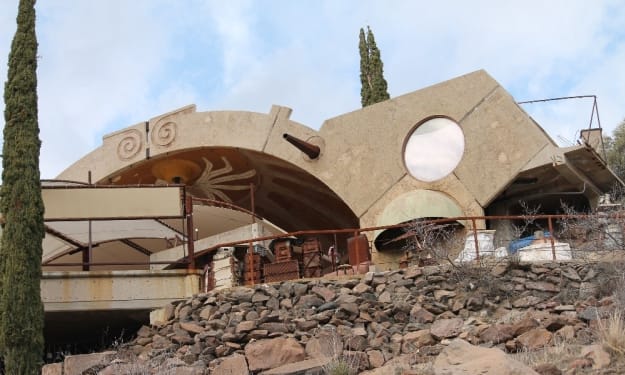
A City of the Future in the Arizona Desert
Arcosanti is a self-described “urban laboratory” situated in the Arizona desert, approximately seventy miles from the sprawling suburbs of Scottsdale (a mega-suburb of Phoenix). In 1970, Paolo Soleri and a small band of volunteers broke ground on this architectural experiment in arcology (a Soleri neologism combining architecture and ecology). Soleri believed that arcologies would eventually displace the automobile, the suburbs, and the single-family home in favor of vertically designed, compact, three-dimensional city structures that addressed problems such as pollution, resource depletion, and food scarcity. In the Age of Aquarius, these utopian ideas attracted a steady migration of young people, hippies, and drop-outs who were willing to donate labor in exchange for getting in on the ground floor of the city of the future.
By The GenX Joint4 years ago in Futurism
About Binding Prometheus
I want to start actively advocating on behalf of my own work, and the most valuable part of my canon is, without a doubt, Binding Prometheus, the play I have been working on since 2019 and only finished in 2023 as part of my MA. The play itself is an amalgamation of a million different inspirations. On one end, it evokes the Ancient Greek myth-play, deriving its own title from the earliest extant work of Western drama we have, Aeschylus’s Prometheus Bound. On the other end, it borrows significantly from the sci-fi bulwarks from over the years, namely Mary Shelley’s Frankenstein and Karel Capek’s Rossum’s Universal Robots. The play could be an episode of Black Mirror, I fear. I don’t know. I’ve only ever seen one episode of Black Mirror.
By Steven Christopher McKnight13 days ago in Futurism
Saudi Arabia Skincare Market: Vision 2030, Dermatology-Backed Products, Innovation & Brand Expansion
According to IMARC Group's latest research publication, the Saudi Arabia skincare market size reached USD 1.33 Billion in 2024. Looking forward, IMARC Group expects the market to reach USD 1.97 Billion by 2033, exhibiting a growth rate (CAGR) of 4.48% during 2025-2033.
By Jeffrey Wilson6 days ago in Futurism
Center Stage with Gina C.
*** I'm keen to republish the interviews I did for my series with Vocal creators. It's been a few years and I thought it might be nice to revisit these wonderful conversations. I'll be releasing them one at a time for a few weeks/months.
By Heather Hubler7 days ago in Interview


Comments
There are no comments for this story
Be the first to respond and start the conversation.