
The Human-First Road to Eco-Friendly AI
Yes, it's possible. No, it's not that hard.


Almost daily, some headline tells us we’re killing the planet. My own kid pointed out the other day that it’s been hotter lately since a new AI-powered facility opened near us. That’s not clickbait - that’s our backyard. It’s happening.
Training massive language models - the so-called “thinking machines” - is not gentle on the environment. It takes power, and it takes resources. More than probably anything else we’ve ever done in tech. But AI isn’t a single switch you can flip off. It’s not one building, one machine, or one CEO you can write a letter to. It’s a toolbox - an entire system of gears, pulleys, hair-thin wires, and glass.
So, do we bulldoze every garden path to make room for it? Or do we stop and figure out how to make space for something alive to grow alongside it?
The Scope of the Problem
Training GPT-3 - just one large language model - required roughly 1,287 megawatt-hours of electricity. That’s about the same annual energy use as 120 average U.S. homes. It produced around 550 metric tons of CO₂ equivalent - the same as driving a car 1.3 million miles or burning 600,000 pounds of coal (Patterson et al., 2021; OpenAI estimates).
Data centers already consume 1–1.5% of all electricity worldwide, and AI workloads are making that number climb. In Google’s own reporting, AI now accounts for about 15% of its total power use. And all that energy doesn’t disappear quietly - waste heat from one large data center can raise the local temperature by 1–2°C, the equivalent of every household in a small town lighting a bonfire at once.
And that’s just the training. Once a model is live, millions of queries per day keep those servers running, fans spinning, and cooling systems gulping down electricity around the clock. Multiply that by hundreds of companies racing to “go bigger” and you’ve got a constant, growing drain.
The Illusion of Offsets
Tech companies love to wave the “carbon neutral” flag. They’ll buy carbon credits, promise to plant trees, or talk vaguely about “emissions reductions” while continuing business as usual.
Here’s the math: an average mature tree absorbs about 48 pounds of CO₂ per year. To offset GPT-3’s training once, you’d need 23,000 mature trees in the ground for a year. Not seedlings. Not a sapling stuck in a corporate slideshow. Real trees, breathing in real air.
That sounds impossible, until you stop thinking of it as one company’s problem and start looking at it on a neighborhood scale.
From Global Problem to Local Garden
You don’t have to own a forest to help. Bamboo can pull 700–800 pounds of CO₂ per acre per year. Native shrubs like lilac, viburnum, or forsythia can absorb 10–15 pounds each annually. Even small perennials - daisies, black-eyed Susans, ornamental grasses - add up if you plant them densely.
Now picture this: an entire neighborhood swaps sterile lawns for dense, pollinator-friendly gardens. Every yard has shrubs, flowers, grasses, maybe a young tree or two. Alone, one garden’s contribution is modest. Together, block by block, you’re looking at a measurable dent in the carbon math - the kind of dent you can see in your own space, not just in a press release.
BettyBot’s Built-In Plan
This isn’t just theory for me - I’ve baked it into my own AI project, BettyBot by Dee. From day one, the build has been human-first, bootstrapped, and intentionally small-footprint. That means smaller, more efficient models. Minimal server waste. Local data storage options so we’re not constantly pinging a cloud halfway across the country for every request.
And yes - BettyBot already has a real-world offset plan: seed balls. Cheap to make, easy to distribute, and surprisingly effective. Toss them into an empty lot, along a roadside, or in your own garden, and you’ll get a mix of carbon-capturing plants and pollinator blooms.
Every BettyBot user will eventually be able to participate. Why? Because if you’re going to run AI, you should offset its damage before it happens, and keep offsetting as you grow.
It’s the opposite of “move fast and break things.” It’s “move intentionally and plant things.”
Why This Matters
AI’s environmental impact is not inevitable. We choose how big, how fast, and how wasteful our models are. We choose whether our data centers run on coal or wind. We choose whether to design tools that need a billion parameters just to say “good morning,” or ones that are smaller, smarter, and easier on the planet.
And we choose whether to talk about change, or to plant something that actually is change.
The next time you see a headline about AI heating up the planet, remember: it’s not a death sentence — it’s a decision point. We can bulldoze every path, or we can grow gardens beside them.
If I have anything to say about it, BettyBot will be planting hers long before she leaves a single footprint.
Sources:
Patterson et al. (2021). Carbon Emissions and Large Neural Network Training.
International Energy Agency (2023). Electricity consumption in data centres and AI.
U.S. Department of Energy. Average CO₂ absorption per mature tree.
Google Environmental Report (2023). Operational electricity usage breakdown.
Visual concept created with AI to capture the idea
Author Note: I’m building a trauma-informed emotional app that actually gives a damn and writing up the receipts of a life built without instructions for my AuDHD. ❤️ Help me create it (without burning out): https://bit.ly/BettyFund
About the Creator
Danielle Katsouros
I’m building a trauma-informed emotional AI that actually gives a damn and writing up the receipts of a life built without instructions for my AuDHD. ❤️ Help me create it (without burning out): https://bit.ly/BettyFund
Keep reading
More stories from Danielle Katsouros and writers in Futurism and other communities.
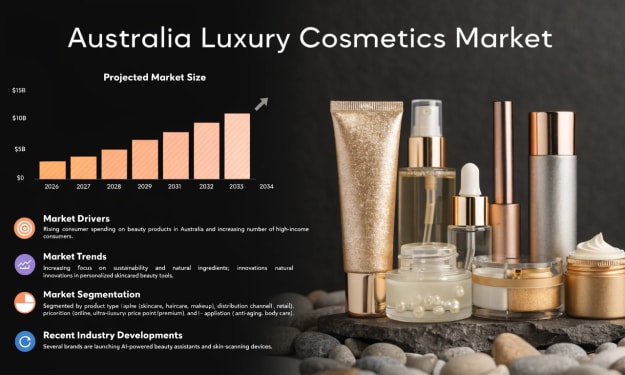
Australia Luxury Cosmetics Market: Premium Demand, Retail Expansion & Brand Innovation
According to IMARC Group, the Australia luxury cosmetics market reached USD 1.6 Billion in 2025 and is projected to grow to USD 2.3 Billion by 2034, exhibiting a compound annual growth rate (CAGR) of 3.92% during 2026–2034. The steady expansion of the market reflects rising disposable incomes, evolving beauty standards, and a growing preference for premium personal care products across Australia. Consumers are increasingly investing in high-end skincare, makeup, and fragrance products that promise quality, performance, and exclusivity. With digital influence reshaping purchasing decisions and sustainability becoming central to brand identity, the Australia luxury cosmetics market share continues to expand within the broader beauty and personal care industry.
By Shrestha Roy6 days ago in Futurism
The BAFTA Awards
By now, in a stunning departure from recent years, most of the world is aware of what happened at the BAFTA film awards. Social Media Headlines will tell you the bare bones: that John Davidson, a Tourette's Syndrome advocate, shouted a racial slur at two Actors of Colour, Michael B Jordan and Delroy Lindo.
By Natasja Rose4 days ago in Psyche



Comments (1)
I'm so glad Substack redirected me here to the full article. You know my feelings on this, and we can agree to disagree on our ability to offset the damage AI can do not just to our climate but also to our mental health if left unregulated, regardless of a few like yourself who have nothing but good intentions. I will say you did a hell of a lot of research on this and wrote a concise informative article framing your opinion- Bravo!