
The Hidden Code in Ice: How Melting Glaciers Are Unlocking Ancient Viruses and Forgotten DNA
As Earth’s ice retreats, what lies beneath isn’t just water—it’s a frozen archive of ancient life. From prehistoric microbes to unknown viruses, the thawing world may rewrite biology, medicine, and even history

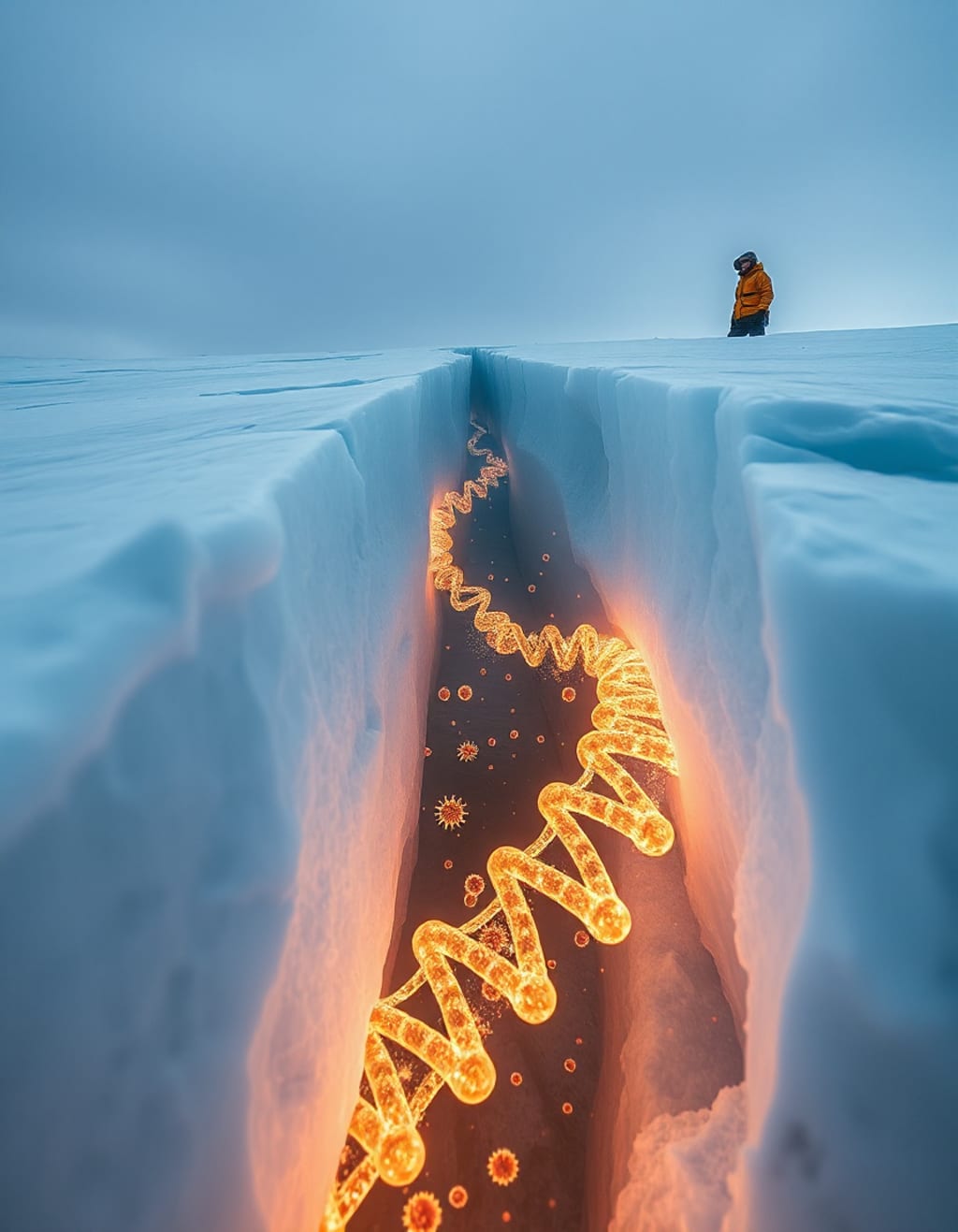
In the silent white corridors of the Arctic, the world is thawing—and it's telling a story no library ever recorded. Beneath centuries of snow and millennia of glacial ice lie frozen time capsules of Earth's long-lost life.
For thousands of years, microbes, pollen, animal remains, plant cells, and even viruses have been trapped beneath thick sheets of ice. Some date back tens of thousands of years—some older than any civilisation. As the planet warms, these glaciers are melting fast, not only altering coastlines and ecosystems, but also revealing organisms the modern world has never seen.
Welcome to the scientific frontier known as glacial biology—a realm where climate change unearths the very building blocks of life from Earth’s frozen vault.
And scientists are only beginning to decode it.
A Shifting Landscape
In Greenland, Alaska, Siberia, and Antarctica, glaciers and permafrost are receding at an alarming rate. According to the British Antarctic Survey, Antarctic Peninsula glaciers have retreated more than 80% in the last 50 years. Arctic permafrost is thawing at record speed.
But while climate scientists sound the alarm over rising seas, biologists and geneticists are paying attention to something else: what the ice is leaving behind.
Frozen wolf cubs with intact fur. Woolly rhinoceroses still bearing muscle tissue. But more than relics of extinct animals, it’s the microscopic world—the ancient bacteria, fungi, and viruses—that has stunned the scientific community.
Why?
Because they’re not all dead.
The 30,000-Year-Old Virus That Came Back to Life
In 2014, a team of French and Russian scientists drilled deep into Siberian permafrost and extracted samples from 30 metres below the surface. Within them, they discovered a giant virus they named Pithovirus sibericum—a monster in microbial terms, over 1,500 nanometres long.
It was 30,000 years old.
And when thawed, it infected a modern amoeba.
Successfully.
This was the first direct proof that ancient viruses could revive after tens of thousands of years—and possibly retain infectious capabilities. Since then, dozens of other “zombie viruses” have been identified.
None (yet) pose a known threat to humans.
But the implications are enormous.
What Is Hiding in the Ice?
In 2022, scientists from the CryoBio Project published findings of 13 revived viruses from seven different ancient permafrost locations. These viruses came from various time periods, up to 48,500 years old, and displayed functional genetic integrity.
Some showed structural similarities to viruses that today affect animals, plants, or even humans.
That same year, at a site in Canada’s Yukon, melting ice revealed the remains of an extinct horse species with intact DNA—something researchers believe may provide clues to evolution, extinction, and climate adaptation.
As each glacier recedes, Earth’s longest-lost species are showing their faces again.
And the question scientists are quietly asking is:
What happens when we find something we can’t control?
The Biology of Preservation
Unlike other natural archives like amber or fossilised bone, ice preserves not just structure, but function. Many microorganisms go into cryptobiosis—a state of suspended metabolism that allows them to survive extreme environments.
Tardigrades, famously dubbed “water bears,” were found alive in both Himalayan glaciers and Antarctic snow. Bacteria extracted from ice cores taken in Greenland have shown signs of life after 120,000 years of dormancy.
These findings challenge modern biology’s understanding of life cycles. Could hibernating lifeforms offer new approaches to medicine, organ preservation, or space travel?
NASA thinks so.
The European Space Agency has sent microbes retrieved from Arctic glaciers into orbit to test their resistance to radiation. Surprisingly, many survived.
It turns out, glaciers may be storing not just our past, but clues to surviving the future.
A Dangerous Resurrection?
Not all discoveries are hopeful.
In 2016, a heatwave in Siberia triggered a permafrost melt that exposed the buried carcass of a reindeer infected with anthrax. The thawed bacteria spread to local herds and humans, causing dozens of hospitalisations and at least one death.
Suddenly, the idea of ancient pathogens returning wasn’t theoretical—it was happening.
Epidemiologists are now watching glacial regions as emerging hotspots for microbial risk.
If smallpox or influenza strains are released from forgotten graves, would we recognise them in time?
Would we be immune?
The modern immune system has evolved around modern threats.
But the ice is melting into history, and history isn’t always kind.
Genetic Goldmines
Yet within this risk lies immense scientific value.
The melting ice sheets are also exposing long-extinct species whose DNA is shockingly well-preserved.
In Greenland, researchers uncovered plant DNA more than 2 million years old—the oldest ever sequenced. In the UK, biologists are now experimenting with cold-preserved DNA to understand environmental resilience, focusing on plants and algae from frozen samples.
These sequences can unlock:
Lost gene functions
Drought and cold resistance traits
New compounds for antibiotics or cancer treatments
Even in agriculture, old plant DNA may help us reintroduce ancient strains of crops that survived climate events we are now facing again.
The ice is not just melting.
It’s teaching us.
A British Frontier in Arctic Research
Britain has been at the forefront of polar science since the heroic age of Shackleton and Scott. Today, institutions like the British Antarctic Survey and University of Cambridge’s Scott Polar Research Institute are pushing boundaries in glacial microbiology.
British teams are sequencing ancient microbes, cataloguing DNA libraries, and collaborating with climate scientists to predict biological threats.
In 2023, a British-led expedition extracted samples from a glacier in Svalbard and discovered novel species of extremophiles—organisms that could survive extreme cold, pressure, and even high radiation.
Their use?
Biotech companies are already looking into enzymes from these organisms for industrial use: in food processing, waste treatment, and even cancer research.
It’s a new industrial revolution.
Only this time, it’s built on ancient ice.
Ethical Questions in a Melting World
With opportunity comes responsibility.
Should we resurrect ancient viruses for study? Should we recreate extinct species using glacial DNA?
Projects like Revive & Restore aim to bring back the woolly mammoth by inserting ancient genes into modern elephants. The science is almost there.
But are we ready to play god with DNA from the deep past?
And if we don’t study them now, before the glaciers disappear completely, are we letting knowledge—and potential threats—slip away forever?
Scientists walk a fine ethical line between curiosity and caution. But the glaciers aren’t waiting.
They are vanishing faster than predictions.
And they are opening the vault anyway.
The Future: Cryoarchives and Global Risk Maps
To prepare for what’s to come, British and international teams are now building cryoarchives—biological time capsules storing DNA from melting regions in secure labs, from Arctic Norway to Cambridge.
The goal: create a global map of ancient organisms, viruses, and genetic material before they are lost—or unleashed.
Machine learning algorithms are now being used to predict where the next biological emergence could occur based on ice melt rates, local fauna, and ancient burial sites.
We are no longer just studying glaciers.
We are treating them as bio-reactive environments.
Conclusion: The Memory of Ice
In the end, glaciers are more than frozen water.
They are repositories of memory—holding not only climatic data in their layers, but the biological archive of life itself.
As they melt, they do not disappear quietly.
They speak—in genetic codes, in ancient pathogens, in long-lost species blinking into sunlight for the first time in millennia.
The question is no longer if they will reveal something dangerous or miraculous.
The question is:
Will we be ready to listen?
About the Creator
rayyan
🌟 Love stories that stir the soul? ✨
Subscribe now for exclusive tales, early access, and hidden gems delivered straight to your inbox! 💌
Join the journey—one click, endless imagination. 🚀📚 #SubscribeNow
About Binding Prometheus
I want to start actively advocating on behalf of my own work, and the most valuable part of my canon is, without a doubt, Binding Prometheus, the play I have been working on since 2019 and only finished in 2023 as part of my MA. The play itself is an amalgamation of a million different inspirations. On one end, it evokes the Ancient Greek myth-play, deriving its own title from the earliest extant work of Western drama we have, Aeschylus’s Prometheus Bound. On the other end, it borrows significantly from the sci-fi bulwarks from over the years, namely Mary Shelley’s Frankenstein and Karel Capek’s Rossum’s Universal Robots. The play could be an episode of Black Mirror, I fear. I don’t know. I’ve only ever seen one episode of Black Mirror.
By Steven Christopher McKnight17 days ago in Futurism
AI's Approach to Medical Device Software Design
The healthcare industry is undergoing a rapid digital transformation, driven by the increasing adoption of connected medical devices, smart diagnostics, and software-powered patient care systems. At the heart of this evolution lies medical device software design, a specialized discipline that blends healthcare expertise, regulatory compliance, and advanced engineering to create reliable, life-critical digital solutions.
By Steve Waugha day ago in Futurism



Comments (1)
This is fascinating stuff. I had no idea glaciers held so many secrets. It's crazy to think there are viruses that old still out there. Makes you wonder what else is waiting to be discovered as the ice melts. Do you think we should be more worried about these ancient viruses potentially causing problems in the future? Also, it's amazing how much we can learn from these frozen remains. It really shows how important it is to study these areas before it's too late.