
The Groom Who Walked Away
A Story of Conscience Love, and Sacrifice in a Punjabi Village

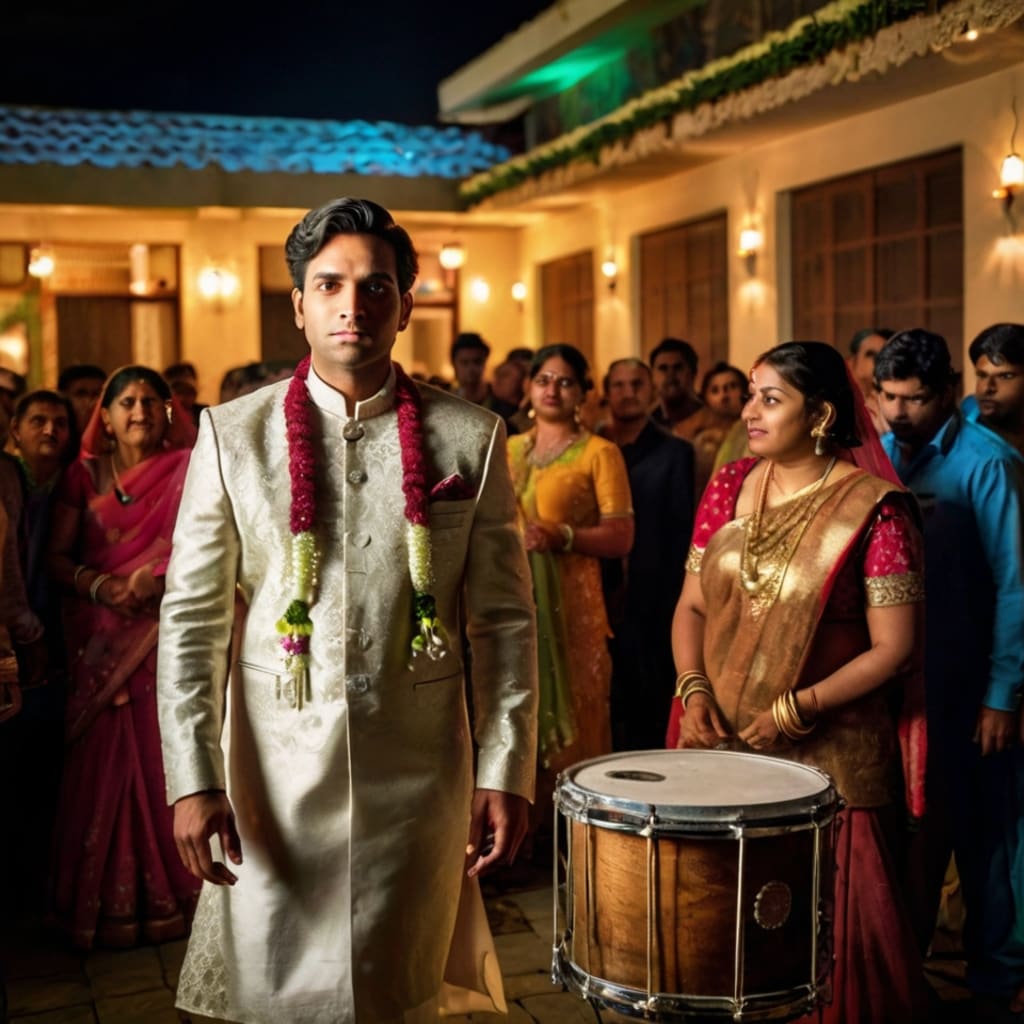
When Conscience Speaks Louder than Tradition
BY:Khan
Since childhood, I had often heard elders say that marriages are written in the heavens. It was a belief I carried with curiosity, but when life presented me with an unforgettable incident, that curiosity turned into certainty. Indeed, every event unfolds under the divine decree of the Creator—even the tiniest particle in the universe bows to His command.
This story took place in my own village. My friend Tariq’s wedding had been arranged in another part of the village, and I was invited to attend. The night of the mehndi was full of festivity—drums beat loudly, there was dancing and singing, and at intervals, celebratory gunfire lit the night sky. Friends, relatives, and acquaintances had gathered in large numbers. By around 2 a.m., the event drew to an end. Tariq, being the son of a wealthy landowning family, had no shortage of luxury. Their estate was vast, their mansion grand, and their servants many.
Tariq himself was handsome, cheerful, and kind-hearted. Unlike many privileged young men, he was not careless or immoral. He was known for his generosity, his ability to bring joy to others, and his willingness to help anyone in need. In the village and beyond, his popularity was unmatched.
That night, after the function, I returned home while most guests slept wherever they found space. But in the morning, my friend Nauman woke me abruptly with startling news. “Tariq is missing!” he said. “We’ve searched the whole village, but there’s no sign of him. The wedding procession is supposed to leave soon—cars and buses are honking, the band is here, but the groom is nowhere to be found.”
Panic spread like wildfire. A joyous home turned into a house of mourning. The elders of the community gathered and, after much discussion, decided that Tariq’s younger brother Arshad should be prepared to step in. In their eyes, this would save the family’s honor and prevent the bride’s family from being humiliated.
But word had already reached the bride’s household. They sent a messenger with a sharp warning: “We know everything. Do not dare bring another in Tariq’s place. If it is not Tariq, then no one should come.” At the same time, another message was quietly sent to Junaid, Tariq’s cousin. “Be ready,” it read. “Bring a few relatives and come. We have made arrangements.”
For Junaid, this was like winning the lottery. He had long been in love with Saima, the bride-to-be, who was also his maternal uncle’s daughter. They had grown up together, and their affection for each other was no secret. Yet when the proposal was being considered, Saima’s parents chose Tariq over Junaid because of wealth and social status. Love was set aside; fortune took priority.
In our society, I thought bitterly, wealth often overshadows relationships. Brothers can be pitted against brothers for land, sons against fathers for inheritance. Families are torn apart for a few acres, and countless murders have stained the soil of greed.
Thus, Junaid stepped in, and the two childhood sweethearts were finally united. Time passed, and the incident became an old memory. But even now, whenever I hear wedding music in the village, I cannot help but recall Tariq’s vanished wedding day.
Two years after Junaid and Saima’s marriage, Tariq returned from Dubai. Naturally, everyone wanted to know the truth about his sudden disappearance. But he never gave a clear answer. One evening, while I was in my fields, I saw him nearby. Our lands bordered each other, so I called him over to my resting place. After some time, I asked directly, “Tariq, why did you do it? Why bring shame upon your family? Why abandon the wedding at the last moment? What compelled you?”
He looked at me with calm, steady eyes and said, “Haider Bhai, it is better to burn in the fire of whispers for a few days than to burn in the fire of conscience for a lifetime. That night, if I had gone ahead with the wedding, Saima would have become my wife in the eyes of society. But in her heart, she had already rejected me. Tell me, what good is a marriage when only the tongue agrees but the heart refuses?”
He paused, then continued, “I knew the truth, Haider Bhai. Saima and Junaid loved each other since childhood. Their bond was pure, yet it was being broken apart and weighed against my wealth. I could not let that happen. My conscience scolded me. It told me I was about to commit a crime—not against law, but against two hearts. Why should I be their executioner?”
I sat silently as he spoke. His voice carried neither regret nor bitterness, only conviction.
“People will gossip for a few days,” he said. “The community will taunt my family, but such things pass. What matters is that two hearts, meant for each other, are now together. If my stepping aside allowed their happiness, then I am content. As they say, marriages are indeed made in heaven. What Allah wills is always for the best. Today, Junaid and Saima live happily, blessed with two children. May God keep them safe. As for me, the Creator will surely have someone destined for me as well.”
Hearing his words, I was left in awe. Tariq had chosen the harder path, sacrificing his own pride for the sake of love and justice. While the world saw disgrace, he had found peace within himself.
About the Creator
Smart Home Technology: What Life Looks Like When Your Home Can Actually Think
It is seven in the morning and the kitchen already knows. The blinds have lifted just enough to let in soft light without waking anyone who is still sleeping. The kettle began heating two minutes ago.
By CurlsAndCommasa day ago in Futurism
Magnet Market Outlook: Industrial Machinery Demand, Automation Growth & Industry Forecast to 2025
The global magnet industry is undergoing a significant transformation, evolving from a traditional component sector into a strategic pillar of the modern green economy. According to IMARC Group’s latest data, the global magnet market size reached USD 41.75 Billion in 2024. Looking forward, IMARC Group estimates the market to reach USD 58.7 Billion by 2033, exhibiting a CAGR of 3.82% during 2025-2033.
By Andrew Sullivan7 days ago in Futurism




Comments
There are no comments for this story
Be the first to respond and start the conversation.