
The Future of Technology: Artificial Intelligence Takes Center Stage
The Future of Technology: Artificial Intelligence Takes Center Stage

Artificial Intelligence (AI) has been around for decades, but recent advancements in the field have sparked a renewed interest and excitement in its potential to revolutionize various industries. From self-driving cars to intelligent personal assistants, AI is rapidly transforming the way we live and work. In this article, we will explore some of the latest developments in AI and its impact on the future of technology.
Natural Language Processing (NLP)
One of the most significant breakthroughs in AI has been in the field of Natural Language Processing (NLP). NLP refers to the ability of computers to understand human language and respond in a way that is natural and intuitive. This is achieved through the use of algorithms that analyze human language and identify patterns that allow the computer to understand the meaning behind the words. NLP has led to the development of intelligent personal assistants like Siri, Alexa, and Google Assistant, which can understand and respond to voice commands. NLP is also being used in chatbots, customer service, and even in the creation of chat fiction.
NLP has been around for a while, but recent advancements in the field have made it much more accurate and reliable. One of the major advancements has been the development of deep learning algorithms that allow computers to understand the context in which language is used. This has led to the creation of chatbots that can hold more natural conversations and respond to questions in a way that is more similar to human speech. Another advancement has been the development of transfer learning, which allows computers to use knowledge from one task to improve their performance on another task. This has led to the development of more accurate language models that can generate more realistic and sophisticated responses.
The potential applications of NLP are virtually endless. NLP can be used to improve customer service by providing more accurate and helpful responses to customer inquiries. NLP can also be used to create more engaging chat fiction that can be personalized to the reader's interests. In the future, we can expect to see NLP being used in a wide range of applications, from healthcare to education.
Machine Learning (ML)
Machine Learning is another area of AI that has been making great strides in recent years. ML algorithms enable computers to learn from data and improve their performance without being explicitly programmed. ML is being used in a variety of applications, from image recognition to fraud detection.
The most significant development in ML in recent years has been the development of deep learning algorithms. These algorithms are based on artificial neural networks that are designed to mimic the structure and function of the human brain. Deep learning algorithms have been used to achieve remarkable breakthroughs in areas like image and speech recognition. For example, deep learning algorithms have been used to develop facial recognition systems that can identify individuals with incredible accuracy.
Another exciting application of ML is in the field of healthcare. ML algorithms are being used to analyze large datasets of medical records and identify patterns that can be used to develop predictive models for diseases. These models can be used to identify individuals who are at risk of developing a disease and provide personalized treatment plans.
The potential applications of ML are virtually endless. ML can be used to improve fraud detection by analyzing large datasets of financial transactions and identifying patterns that indicate fraudulent activity. ML can also be used to improve cybersecurity by analyzing network traffic and identifying potential threats.
Deep Learning (DL)
Deep Learning is a subset of Machine Learning that involves training artificial neural networks to perform complex tasks like image and speech recognition. DL has led to some remarkable breakthroughs in areas like self-driving cars and facial recognition. DL is also being used to develop more sophisticated chatbots that can understand context and carry out more natural conversations.
The most significant development in DL has been the development of generative models. These models are based on neural networks that can generate new data that is similar to the data used to train the model. This has led to the development of impressive applications like DeepFake videos, which are videos that use artificial intelligence to replace the face of one person with the face of another person.
DL has also been used in the development of autonomous systems like self-driving cars. Self-driving cars use a combination of sensors and DL algorithms to identify objects in the environment and make decisions about how to navigate through the environment. DL algorithms have also been used in robotics to develop robots that can perform complex tasks like assembling products in a factory.
The potential applications of DL are virtually endless. DL can be used to develop more sophisticated virtual assistants that can carry out more complex tasks like scheduling appointments and booking travel. DL can also be used to develop more advanced recommendation systems that can provide more personalized recommendations to users.
Robotics
Robotics is another area where AI is making significant strides. Robotics involves the development of machines that can perform tasks that are typically performed by humans. AI is being used in robotics to develop machines that can perform complex tasks like assembling products in a factory or performing surgery.
One of the most significant developments in robotics has been the development of collaborative robots, or cobots. Cobots are robots that are designed to work alongside humans in a collaborative manner. Cobots are being used in a variety of industries, from manufacturing to healthcare.
Another exciting application of robotics is in the field of space exploration. Robots are being used to explore other planets and moons in our solar system. For example, NASA's Mars rover uses AI algorithms to navigate the Martian terrain and identify potential scientific targets.
The potential applications of robotics are virtually endless. Robotics can be used to develop machines that can perform dangerous tasks like bomb disposal or firefighting. Robotics can also be used to develop machines that can assist people with disabilities or perform tasks that are difficult for humans, such as underwater exploration.
Ethical Considerations
As AI becomes more advanced and more widespread, there are ethical considerations that must be taken into account. One of the most significant ethical concerns is the potential impact of AI on employment. As machines become more capable of performing tasks that were traditionally performed by humans, there is a concern that many jobs may become obsolete.
Another ethical concern is the potential for AI to be used in ways that are harmful to society. For example, AI could be used to develop autonomous weapons that could be used in warfare. There is also a concern that AI could be used to perpetuate biases and discrimination.
To address these ethical concerns, it is essential that AI be developed in a responsible and transparent manner. It is also essential that AI be developed in collaboration with experts in fields like ethics, law, and social science.
Conclusion
Artificial Intelligence is rapidly transforming the way we live and work. From intelligent personal assistants to self-driving cars, AI is enabling machines to perform tasks that were once thought to be the exclusive domain of humans. NLP, ML, DL, and robotics are just a few of the areas where AI is making significant strides.
While AI has enormous potential to improve our lives, it is essential that we take into account the ethical considerations associated with its development and use. As we move forward into the future, it is essential that we develop AI in a responsible and transparent manner, with a focus on creating machines that enhance human capabilities rather than replacing them.
About the Creator
pasin corau
follow me on twitter
Keep reading
More stories from pasin corau and writers in Futurism and other communities.
The Future of Connectivity: The Rollout and Potential of 5G Networks
As the world becomes increasingly connected and reliant on technology, the demand for faster and more reliable internet speeds continues to grow. This is where 5G networks come in - the next generation of mobile networks that promise to deliver lightning-fast download and upload speeds, lower latency, and greater network capacity. The rollout of 5G networks is expected to bring significant improvements in speed and connectivity, which could pave the way for new applications like smart cities, autonomous vehicles, and virtual reality.
By pasin corau3 years ago in Futurism
Vertical AI Market Projected to Reach USD 115.4 Billion By 2034
The Global Vertical AI Market is projected to reach approximately USD 115.4 Billion by 2034, increasing from USD 12.9 Billion in 2024, and it is expected to grow at a CAGR of 24.5% during the forecast period from 2025 to 2034. This expansion is supported by the increasing demand for industry-specific artificial intelligence solutions that address specialized operational requirements.
By Roberto Cruma day ago in Futurism
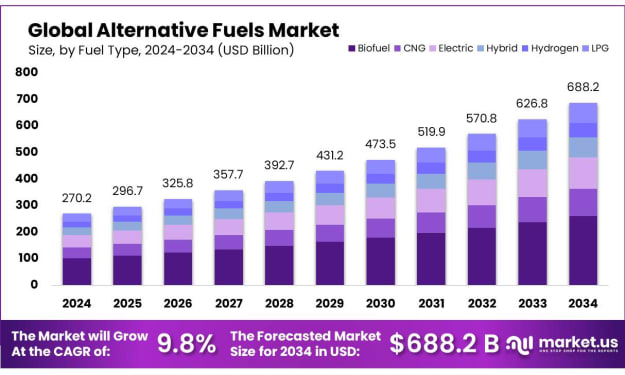
Alternative Fuels Market Insights: USD 688.2 Billion by 2034
Overview The Global Alternative Fuels Market is on a strong growth trajectory, projected to expand from USD 270.2 billion in 2024 to USD 688.2 billion by 2034, representing a compound annual growth rate of 9.8% over the forecast period. North America currently leads the market, accounting for a 43.2% share of global revenue in 2024.
By Hayden Kulas2 days ago in Futurism



Comments
There are no comments for this story
Be the first to respond and start the conversation.