
The Future of Remote Work: Will the Digital Nomad Lifestyle Become Mainstream?
Remote Work

The shift toward remote work has transformed how professionals around the world approach their careers. The COVID-19 pandemic accelerated this trend, allowing more people to work from home or anywhere with an internet connection. This new paradigm has sparked interest in the digital nomad lifestyle, where individuals combine work with travel, enjoying the flexibility of location-independent careers. The question arises: will the digital nomad lifestyle become mainstream in the future?
The Current State of Remote Work
Remote work was once viewed as a luxury reserved for freelancers, tech workers, or specific industries. However, in 2024, it is clear that remote work is no longer a trend but a defining feature of the modern workplace. Major corporations and small startups alike have adopted remote-first or hybrid models, allowing employees to work from anywhere. Tools like Zoom, Slack, and project management software have enabled seamless collaboration across continents.
Statistical insights suggest that remote work is not only here to stay but growing at a fast pace. According to Global Workplace Analytics, the number of people working remotely has increased by 159% over the last decade. Companies are finding benefits such as lower overhead costs, higher employee satisfaction, and access to a global talent pool. With more businesses adopting flexible work policies, the digital nomad lifestyle seems like a natural extension of remote work.
The Appeal of Digital Nomad Lifestyle
The digital nomad lifestyle offers unique opportunities for professionals. For many, the idea of working from a beachside café in Bali or a bustling city in Europe is a dream come true. No longer tethered to a specific location, individuals can explore new cultures, broaden their horizons, and maintain their professional careers simultaneously.
Moreover, the cost of living in certain countries is significantly lower than in cities where many remote workers previously resided. For instance, a software developer in New York City may choose to live in Chiang Mai, Thailand, and maintain the same salary while enjoying a drastically lower cost of living. This freedom not only boosts financial flexibility but also improves work-life balance.
The Challenges of Digital Nomad Lifestyle
While appealing, the digital nomad lifestyle presents its own set of challenges. Stability is often a concern, as constant travel can disrupt routines and lead to burnout. Finding reliable Wi-Fi, managing time zone differences, and maintaining consistent communication with teams based in different locations are common difficulties faced by nomads.
Additionally, taxation and legal hurdles can complicate this lifestyle. Many countries have strict visa regulations, and working while traveling may violate certain immigration laws. However, several countries are recognizing the rise of digital nomadism and have begun offering special visas to accommodate these workers. Estonia, for example, introduced a "Digital Nomad Visa" to attract remote workers, while countries like Barbados, Portugal, and Costa Rica have implemented similar policies.
Is Digital Nomad Lifestyle Sustainable?
The sustainability of this lifestyle depends on the evolving infrastructure and policies around remote work. Some experts argue that for the digital nomad lifestyle to become mainstream, significant advancements must be made in global connectivity and digital infrastructure. Additionally, governments must adapt tax laws and offer flexible visa options to attract this growing workforce.
While there is potential for more widespread adoption, not all industries are conducive to such a lifestyle. Jobs that require physical presence, such as healthcare or manufacturing, are unlikely to adopt remote work at the same level as tech or creative industries. However, as more companies embrace flexible policies and build remote-friendly cultures, there is a strong likelihood that digital nomadism will become more accessible to a broader range of professionals.
The Role of Employers and Governments
For the digital nomad lifestyle to move into the mainstream, employers and governments must collaborate to create the right environment. Employers need to recognize that offering flexibility increases productivity and employee retention. Companies like Twitter and Shopify have announced permanent work-from-anywhere policies, setting a precedent for others.
Governments, on the other hand, need to create frameworks that support this lifestyle by simplifying visa processes, offering tax incentives, and building digital infrastructures. In particular, digital nomad visas offer a unique opportunity for countries to boost their economies through tourism while attracting global talent.
Conclusion
The digital nomad lifestyle represents the future of work for many professionals who seek freedom and flexibility. While it may not yet be mainstream, the increasing trend toward remote work and the growing infrastructure to support digital nomads suggest that this lifestyle will continue to gain momentum in the coming years. As employers and governments adapt to these new realities, the digital nomad lifestyle could become a viable option for millions of people across various industries.
Sources:
Global Workplace Analytics - Remote Work Statistics
Forbes - The Rise of Remote Work
Medium - Digital Nomad Visa Programs
About the Creator
Keep reading
More stories from Avinash Vikram singh and writers in Futurism and other communities.
The Rise of Biohacking: Will Humanity Control Its Own Biology?
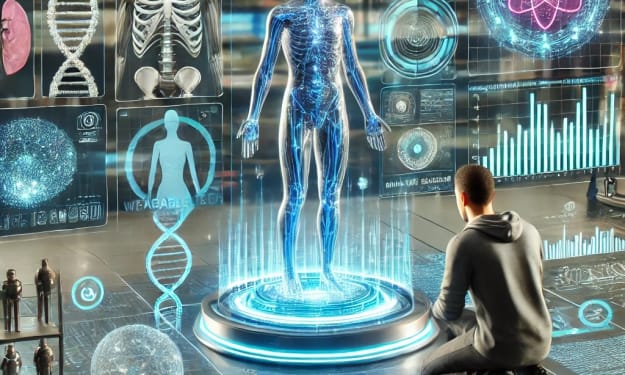
Biohacking a rapidly emerging field, is positioned at the intersection of biology, technology and personal health optimization. It encompasses a broad range of practices, from simple dietary adjustments to cutting-edge genetic modifications. The core idea behind biohacking is the pursuit of enhancing physical and cognitive functions by manipulating the human body and mind through various biological interventions. With advancements in biotechnology, biohacking is no longer confined to professional labs or research institutions. Instead, it has grown into a movement that anyone with curiosity and determination can explore. However, the ethical, societal, and scientific implications of controlling biology on such a personalized level remain profound and complex.
By Avinash Vikram singhabout a year ago in Futurism
Your Galaxy Watch 7 Just Got a Major 2026 Refresh: 4 Things You Need to Know
For many of us, the ping of a software update notification often triggers a brief moment of anxiety—a nagging worry that a new patch might slow down a reliable device or tether us to a charger. However, in the high-stakes tech landscape of early 2026, these updates have evolved into the primary way our hardware actually improves over time. As the new Galaxy S26 series makes its debut, Samsung is ensuring the Galaxy Watch 7 receives the same software dignity as its latest flagships, proving this 2024-era wearable remains a vital, high-performing pillar of the ecosystem. The big news this week? The February 2026 security update has officially moved beyond its initial testing grounds in South Korea and has gone global.
By Tech Horizonsabout 22 hours ago in Futurism
Australia Aerospace and Defense Market: Sovereign Defense Capability Development, Next-Generation Aerospace Systems & Integrated Security Infrastructure
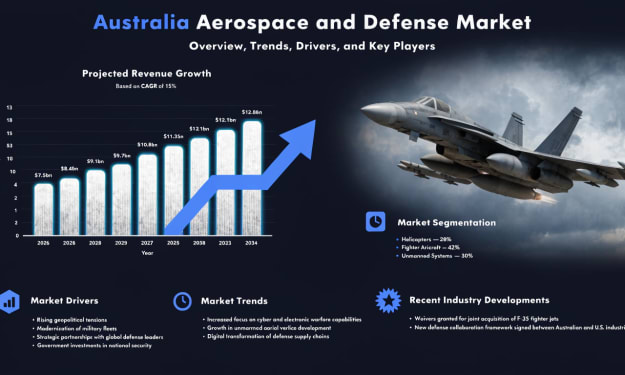
According to IMARC Group, the Australia aerospace and defense market reached a value of USD 13.6 Billion in 2025 and is projected to reach USD 21.4 Billion by 2034, growing at a compound annual growth rate (CAGR) of 5.04% during 2026–2034. The market is expanding as Australia strengthens its national security framework and invests in advanced aerospace technologies and defense capabilities. Rising geopolitical considerations and evolving security challenges are encouraging governments to increase defense budgets and modernize military infrastructure. Programs focused on sovereign defense capability development are encouraging domestic manufacturing of defense equipment, aircraft systems and advanced military technologies. At the same time, collaborations between Australian defense agencies and international contractors are accelerating innovation and enabling technology transfer. Investments in next-generation aerospace systems, cyber defense technologies and satellite communication infrastructure are further supporting the growth of the aerospace and defense sector.
By Kevin Cooper3 days ago in Futurism
The Forsyth House Fire
Since 1851, Forsyth House has stood on the corner of Union Street and Gordon Street in the heart of Glasgow. Its iconic, or was... because on Sunday 8th of March, 2026, a fire broke out in a small, seemingly un-named shop in the building and tore all that history down. As I write, the rubble is still unsettled and the street is still blocked off. Central Station is quiet on the upper level, and around 30 small businesses have quite literally gone up in smoke.
By S. A. Crawford2 days ago in The Swamp


Comments (1)
Great article! Thanks for sharing these forward-thinking insights! The idea of the digital nomad lifestyle becoming mainstream is truly exciting. As remote work continues to evolve, it's interesting to see how more companies are embracing flexibility and adapting to support remote employees from anywhere. At Black Piano (https://www.blackpiano.co.uk/), we've seen the benefits of this shift first-hand, with employees working from different parts of the world while staying connected and productive. I’m curious, what do you think the biggest challenges will be for companies trying to support a fully global remote workforce?