
The Future of Intelligent Automation: How AI is Transforming Business Operations
The power of IA lies in its ability to not only automate repetitive tasks but also make real-time decisions, adapt to complex environments, and continuously improve through machine learning and analytics.

As technology continues to advance at an unprecedented pace, businesses around the globe are turning to automation to remain competitive and operationally efficient. Among these transformative technologies, Intelligent Automation (IA) stands out, combining artificial intelligence (AI) with automation to enhance and optimize a wide range of business operations. The power of IA lies in its ability to not only automate repetitive tasks but also make real-time decisions, adapt to complex environments, and continuously improve through machine learning and analytics.
In this blog, we’ll explore how Intelligent Automation is transforming business operations, what the future holds for this technology, and how companies like Trantor are making it possible for organizations to stay ahead of the curve.
1. The Evolution of Intelligent Automation
Intelligent Automation represents a significant leap from traditional automation. Where basic automation handles repetitive, rule-based tasks, IA integrates AI and advanced analytics to process vast amounts of data, identify patterns, and learn from them, thereby enhancing its own performance over time. This evolution empowers IA to handle complex decision-making processes and tackle tasks that typically require human judgment.
Traditional automation, limited to predefined workflows, was often static and rigid. IA, however, is dynamic and adaptable, making it suitable for processes across industries, from finance and healthcare to manufacturing and customer service. As businesses realize the value of this technology, many are moving beyond automation for efficiency gains to IA for strategic advantage.
2. How AI Enhances Business Operations through Intelligent Automation
AI plays a pivotal role in IA by enhancing the ability to process and analyze data quickly, identify trends, and make decisions autonomously. Here are some key ways in which AI-driven IA is transforming business operations:
Streamlined Processes and Improved Efficiency
Intelligent Automation Services can streamline routine tasks, enabling employees to focus on higher-value activities that require creativity and strategic thinking. This capability is especially beneficial in back-office functions, where automation of data entry, invoice processing, and payroll management can save hundreds of hours each year.
Enhanced Customer Experience
By leveraging AI, IA solutions can analyze customer interactions and predict their needs, leading to proactive service offerings. Chatbots, for instance, use natural language processing to understand and respond to customer inquiries instantly, delivering personalized responses based on real-time data. This ensures customers receive consistent, prompt, and accurate support.
Better Data Insights for Decision-Making
IA tools equipped with machine learning algorithms can analyze massive data sets, identifying patterns that are difficult for human analysts to discern. Predictive analytics and forecasting models allow companies to make informed decisions based on current trends and anticipated outcomes.
Reduced Operational Costs
By automating both mundane and complex tasks, IA reduces the need for extensive manual labor, lowering operational costs. This cost-saving element becomes especially vital for businesses looking to scale without a proportional increase in workforce or expenditure.
3. Key Technologies Driving Intelligent Automation
Several advanced technologies form the backbone of Intelligent Automation, each contributing unique capabilities to enhance business processes:
Robotic Process Automation (RPA)
RPA focuses on automating rule-based tasks that require little to no human intervention. This technology works best with structured data and predictable workflows, handling tasks like data extraction, form processing, and report generation. When combined with AI, RPA evolves from simple task automation to sophisticated Intelligent Process Automation (IPA) capable of complex decision-making.
Machine Learning and AI Algorithms
Machine learning enables IA to go beyond predefined rules, learning from data and improving its performance over time. By incorporating machine learning, IA systems can handle unstructured data, make accurate predictions, and personalize experiences.
Natural Language Processing (NLP)
NLP enables IA systems to interpret and process human language, making it possible for machines to understand and respond to text or spoken inputs. This capability is critical for customer service applications, where chatbots and virtual assistants communicate with customers in real-time.
Computer Vision
Computer vision allows IA systems to interpret visual information, such as images or videos, making it valuable in industries like manufacturing and healthcare. For example, IA-powered systems in manufacturing use computer vision to detect defects in products, ensuring high-quality outputs.
Cognitive Analytics
Cognitive analytics combines data from multiple sources, both structured and unstructured, to provide a holistic view of business performance. With cognitive analytics, IA can identify bottlenecks, optimize processes, and forecast future trends more accurately.
4. Industries Embracing Intelligent Automation
Several industries are at the forefront of adopting Intelligent Automation, leveraging its capabilities to enhance productivity, cut costs, and improve decision-making. Here are some notable examples:
Finance
In the financial sector, IA is revolutionizing functions such as fraud detection, regulatory compliance, and customer service. Intelligent algorithms analyze vast datasets in real-time to identify fraudulent transactions, ensuring security for both banks and customers. Additionally, IA helps streamline compliance by automatically verifying transactions and generating necessary reports.
Healthcare
In healthcare, IA supports medical professionals by automating administrative tasks, improving patient record management, and aiding in diagnostic procedures. Computer vision and machine learning models can analyze medical imaging data, assisting doctors in making accurate diagnoses and recommending treatments.
Retail and eCommerce
Retailers leverage IA to optimize supply chains, personalize marketing efforts, and improve customer service. Predictive analytics models help retailers anticipate demand fluctuations and manage inventory levels more effectively. In eCommerce, chatbots enhance the customer experience by offering personalized product recommendations and handling customer inquiries.
Manufacturing
IA enables manufacturers to achieve higher levels of efficiency through predictive maintenance, quality control, and real-time monitoring. By analyzing data from machinery, IA systems predict when maintenance is needed, reducing downtime and preventing costly breakdowns.
5. Challenges and Considerations for Intelligent Automation
Despite its potential, implementing IA comes with challenges that organizations must address to realize its full benefits:
Data Security and Privacy
The integration of AI into business processes raises concerns around data security and privacy. Companies need to ensure that IA systems comply with data protection regulations and protect sensitive information.
Skill Gaps and Workforce Readiness
Adopting IA requires a workforce that understands how to use and manage these technologies. Organizations must invest in training and development to ensure their teams are prepared to work alongside IA solutions effectively.
Cost of Implementation
Implementing IA technologies can be capital-intensive, especially for small and mid-sized businesses. However, by working with established Intelligent Automation providers like Trantor, companies can find tailored solutions that fit their budget and maximize ROI.
Complexity of Integration
Integrating IA with legacy systems can be challenging, particularly for organizations with outdated infrastructure. This challenge highlights the importance of working with experienced automation consultants who can ensure a smooth transition.
6. The Future of Intelligent Automation: What’s Next?
As Intelligent Automation continues to evolve, we can expect several trends to shape its future:
Increased Personalization
AI algorithms will become even better at analyzing individual preferences, allowing companies to deliver highly personalized experiences. From product recommendations to customer support interactions, personalization will become an essential part of automation.
AI-Augmented Workforce
Rather than replacing human workers, IA will augment their capabilities, allowing employees to focus on strategic initiatives rather than repetitive tasks. This trend will lead to a new model of work where humans and AI collaborate seamlessly.
Expansion of Intelligent Automation Across Industries
As the technology matures, more industries will adopt IA, even those that have traditionally been slow to embrace automation, such as education and legal services.
Integration with Emerging Technologies
The integration of IA with technologies like blockchain, edge computing, and the Internet of Things (IoT) will unlock new possibilities. For example, combining IA with IoT data can enable real-time decision-making in logistics and supply chain management.
Conclusion
Intelligent Automation is transforming how businesses operate, offering unprecedented opportunities for growth, efficiency, and innovation. By combining AI with automation, IA enables organizations to unlock the full potential of their data, make better decisions, and deliver superior customer experiences. As this technology continues to evolve, companies that invest in IA will be well-positioned to thrive in an increasingly competitive market.
Companies like Trantor provide the Intelligent Automation Services that organizations need to stay competitive, helping them navigate the complexities of implementing and integrating IA solutions. As businesses look toward the future, embracing Intelligent Automation will become essential not only for staying competitive but for leading the charge into a new era of digital transformation.
About the Creator
Keep reading
More stories from Sam Wilson and writers in Futurism and other communities.
Top Trends Shaping Digital Experience Platforms in 2024
As businesses continue to prioritize the quality of digital interactions with their customers, Digital Experience Platforms (DXPs) are evolving at a rapid pace. These platforms offer a comprehensive suite of tools for creating, managing, and optimizing digital interactions across various channels. With advancements in technology and rising user expectations, DXPs are becoming more innovative, versatile, and essential to businesses’ success. In 2024, several key trends are expected to shape how organizations leverage DXPs to improve customer engagement, streamline processes, and drive growth.
By Sam Wilsonabout a year ago in Futurism
About Binding Prometheus
I want to start actively advocating on behalf of my own work, and the most valuable part of my canon is, without a doubt, Binding Prometheus, the play I have been working on since 2019 and only finished in 2023 as part of my MA. The play itself is an amalgamation of a million different inspirations. On one end, it evokes the Ancient Greek myth-play, deriving its own title from the earliest extant work of Western drama we have, Aeschylus’s Prometheus Bound. On the other end, it borrows significantly from the sci-fi bulwarks from over the years, namely Mary Shelley’s Frankenstein and Karel Capek’s Rossum’s Universal Robots. The play could be an episode of Black Mirror, I fear. I don’t know. I’ve only ever seen one episode of Black Mirror.
By Steven Christopher McKnight18 days ago in Futurism
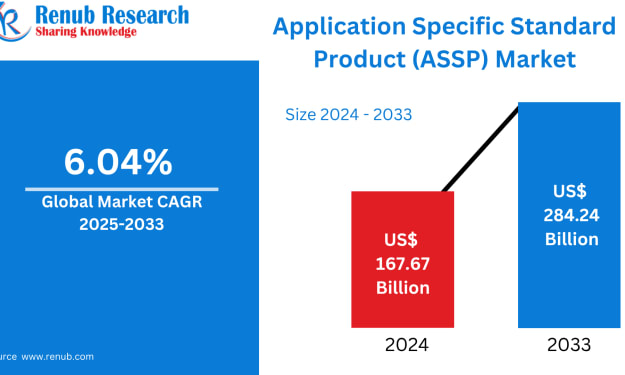
Application Specific Standard Product (ASSP) Market Size and Forecast 2025–2033
Introduction: A Market Built for Precision The global semiconductor industry is undergoing a profound transformation as demand shifts from general-purpose processing toward specialized, application-focused solutions. At the heart of this shift lies the Application Specific Standard Product (ASSP)—a category of integrated circuits that blends the efficiency of custom chips with the scalability of standard semiconductor products. Designed to perform specific functions across multiple applications, ASSPs offer a powerful balance of performance, cost-effectiveness, and time-to-market.
By Renub Research7 days ago in Futurism



Comments
There are no comments for this story
Be the first to respond and start the conversation.