
Application Specific Standard Product (ASSP) Market Size and Forecast 2025–2033
How Specialized Semiconductors Are Powering the Next Wave of IoT, AI, and Smart Industries

Introduction: A Market Built for Precision
The global semiconductor industry is undergoing a profound transformation as demand shifts from general-purpose processing toward specialized, application-focused solutions. At the heart of this shift lies the Application Specific Standard Product (ASSP)—a category of integrated circuits that blends the efficiency of custom chips with the scalability of standard semiconductor products. Designed to perform specific functions across multiple applications, ASSPs offer a powerful balance of performance, cost-effectiveness, and time-to-market.
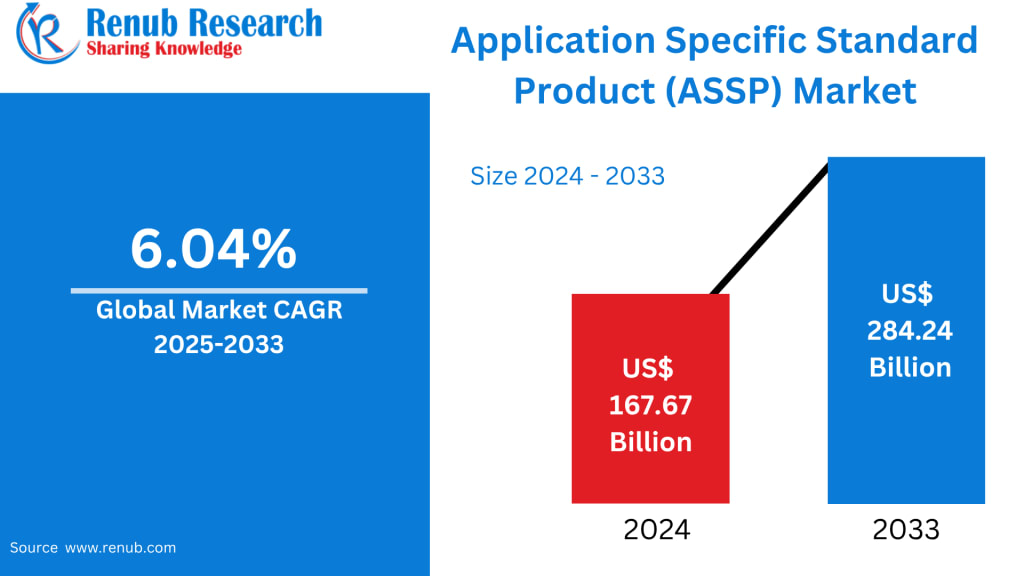
According to Renub Research, the Application Specific Standard Product (ASSP) Market is expected to reach US$ 284.24 billion by 2033 from US$ 167.67 billion in 2024, expanding at a compound annual growth rate (CAGR) of 6.04% from 2025 to 2033. This growth is driven by rising demand for high-performance semiconductor solutions, rapid adoption of IoT and AI technologies, and increasing customization across industries such as consumer electronics, automotive, and telecommunications.
As global industries push toward smarter, faster, and more efficient systems, ASSPs are emerging as indispensable building blocks of modern electronics—quietly enabling everything from connected homes to autonomous vehicles.
Application Specific Standard Product (ASSP) Industry Overview
An Application Specific Standard Product (ASSP) is a semiconductor integrated circuit developed to execute a particular function within a wide range of systems. Unlike Application-Specific Integrated Circuits (ASICs), which are custom-designed for a single customer or use case, ASSPs are standardized for broader markets while still targeting a defined application such as networking, multimedia processing, automotive control, or power management.
This unique positioning allows ASSPs to deliver several advantages:
Optimized performance for specific tasks
Lower power consumption compared to general-purpose processors
Cost efficiency through standardized manufacturing
Faster time-to-market than fully custom chip designs
ASSPs bridge the gap between highly customized ASICs and generic integrated circuits, making them ideal for manufacturers seeking specialized functionality without the expense and risk of custom silicon development. As electronics systems become more complex and compact, this balance between specialization and scalability is becoming increasingly valuable.
Industries such as automotive, telecommunications, industrial automation, and consumer electronics rely heavily on ASSPs to meet strict requirements around efficiency, safety, and reliability. With the rapid evolution of technologies like IoT, 5G, artificial intelligence, and advanced driver-assistance systems (ADAS), the demand for adaptable yet application-focused semiconductor solutions continues to rise.
Market Growth Outlook: 2025–2033
Renub Research forecasts a robust expansion for the ASSP market, projecting growth from US$ 167.67 billion in 2024 to US$ 284.24 billion by 2033, at a CAGR of 6.04% during the forecast period.
This upward trajectory reflects three major structural trends:
Digitization of industries – Manufacturing, energy, healthcare, and transportation are becoming increasingly data-driven and automated.
Proliferation of connected devices – From smart homes to industrial IoT, billions of devices now require low-power, application-optimized chips.
Rising complexity of electronics – Advanced systems demand specialized components that deliver performance without sacrificing efficiency.
As manufacturers race to develop smarter, smaller, and more energy-efficient products, ASSPs are becoming the semiconductor architecture of choice.
Key Growth Drivers
1. Rising Adoption of IoT and Smart Devices
The rapid expansion of the Internet of Things (IoT) represents one of the most significant growth catalysts for the ASSP market. IoT ecosystems—spanning wearable devices, smart home systems, industrial automation, and smart cities—require chips that are optimized for specific functions such as wireless communication, sensor integration, and real-time data processing.
ASSPs provide the ideal balance between customization and scalability. They enable manufacturers to integrate targeted functionality while keeping production costs manageable. Compared to general-purpose processors, ASSPs offer lower power consumption, reduced latency, and greater efficiency—critical advantages for battery-operated and always-connected devices.
The global rollout of 5G networks further amplifies this trend by enabling higher data speeds, lower latency, and more reliable connectivity. As connected devices multiply, so does the need for specialized semiconductor solutions capable of supporting next-generation communication and data handling.
2. Technological Advancements in Automotive Electronics
The automotive industry’s transformation toward electrification, connectivity, and automation has dramatically increased demand for ASSPs. Modern vehicles depend on advanced electronics for:
Driver assistance systems (ADAS)
Infotainment and connectivity
Battery management and powertrain control
Vehicle-to-everything (V2X) communication
ASSPs deliver the reliability and performance required for safety-critical, real-time automotive applications. As electric vehicles (EVs) and autonomous driving technologies advance, the complexity of onboard electronics continues to rise—making application-optimized semiconductors indispensable.
Stricter emission regulations and government incentives for EV adoption further accelerate this trend. Automotive manufacturers increasingly rely on ASSPs to enhance energy efficiency, improve safety, and reduce system integration complexity, positioning the automotive sector as one of the fastest-growing application areas for ASSPs.
3. Growing Demand for High-Performance Consumer Electronics
Consumer electronics remain a cornerstone of the ASSP market. Devices such as smartphones, smart TVs, gaming consoles, and wearables demand compact chips that deliver high performance with minimal power consumption. ASSPs enable manufacturers to embed specialized capabilities—such as multimedia processing, wireless connectivity, and power management—without the cost and development time associated with custom chips.
Emerging technologies like augmented reality (AR), virtual reality (VR), and AI-enabled consumer devices further increase the need for specialized semiconductor architectures. As product life cycles shorten and competition intensifies, manufacturers require faster development cycles and differentiated performance—both of which ASSPs provide.
Challenges Facing the ASSP Market
1. High Design Complexity and Development Costs
While ASSPs are more scalable than ASICs, their development still involves substantial design complexity. Creating chips that meet precise performance, power, and compatibility requirements requires advanced engineering expertise and significant R&D investment. Rapid technological change in sectors like automotive and telecommunications can also render designs obsolete before achieving long-term returns.
Smaller semiconductor firms often face barriers due to limited budgets and fabrication capacity. Balancing customization with mass production remains a critical challenge, particularly as device architectures become more integrated and multifunctional.
2. Supply Chain Disruptions and Semiconductor Shortages
Global semiconductor supply chain disruptions have highlighted vulnerabilities across manufacturing and logistics networks. Geopolitical tensions, natural disasters, and pandemic-related shutdowns have constrained access to fabrication capacity and raw materials.
Because ASSPs are often tailored for specific applications, delays in one component can disrupt entire product lines. Extended lead times, fluctuating silicon prices, and dependence on a limited number of foundries have increased costs and operational risks. To mitigate these challenges, companies are diversifying suppliers, investing in regional manufacturing, and strengthening inventory strategies.
Regional Market Insights
United States: Innovation and Domestic Manufacturing
The United States remains a central force in the global ASSP market, supported by strong R&D investment, technological leadership, and high demand across defense, consumer electronics, and automotive sectors. Major players such as Intel, Texas Instruments, and Broadcom continue to advance ASSP design for AI, IoT, and 5G applications.
Government initiatives aimed at boosting domestic semiconductor production and reducing reliance on foreign supply chains are accelerating industry growth. Rising adoption of electric vehicles and smart infrastructure further strengthens demand, positioning the U.S. market for steady expansion.
Germany: Automotive and Industrial Excellence
Germany’s ASSP market is driven by its world-class automotive and industrial automation sectors. As Europe’s automotive hub, the country requires high-reliability semiconductors for electric vehicles, autonomous systems, and power electronics. Companies such as Infineon Technologies and Bosch Semiconductor lead innovation in this space.
Germany’s focus on Industry 4.0, renewable energy, and sustainable manufacturing continues to expand opportunities for ASSP integration. Strong collaboration between research institutions and manufacturers further enhances technological competitiveness.
China: Scale, Policy Support, and Rapid Growth
China represents one of the fastest-growing ASSP markets, fueled by massive demand for consumer electronics, 5G infrastructure, and smart manufacturing. National initiatives such as “Made in China 2025” aim to strengthen domestic semiconductor capabilities and reduce import dependence.
Despite geopolitical challenges, China continues to invest heavily in fabrication facilities, R&D, and talent development. The expansion of electric vehicle production and IoT ecosystems positions China as both a major consumer and emerging producer of ASSPs.
Saudi Arabia: Digital Transformation and Emerging Demand
Saudi Arabia’s ASSP market is in its early stages but gaining momentum under the Vision 2030 initiative, which emphasizes digital transformation, smart cities, and industrial diversification. Investments in telecommunications, renewable energy, and automation are creating new opportunities for ASSP deployment.
The adoption of IoT in oil and gas operations and growing partnerships with global technology firms are further strengthening the country’s semiconductor ecosystem. While still developing, Saudi Arabia offers significant long-term potential as digital infrastructure expands.
Market Segmentation
By Type
Embedded Programmable Logic
Mixed-Signal
Analog Products
Digital Products
By Application
Automotive
Computers
Consumer Electronics
Communications
Industrial
By Geography
North America: United States, Canada
Europe: France, Germany, Italy, Spain, United Kingdom, Belgium, Netherlands, Turkey
Asia Pacific: China, Japan, India, Australia, South Korea, Thailand, Malaysia, Indonesia, New Zealand
Latin America: Brazil, Mexico, Argentina
Middle East & Africa: South Africa, United Arab Emirates, Saudi Arabia
Competitive Landscape
The ASSP market features a diverse mix of global semiconductor leaders and specialized manufacturers. Key players analyzed across company overview, leadership, strategies, SWOT, and sales performance include:
Infineon Technologies AG
Melexis
NXP Semiconductors N.V.
Onsemi
Renesas Electronics Corporation
STMicroelectronics N.V.
Keterex
MegaChips Corporation
PREMA Semiconductor GmbH
Cactus Semiconductor
These companies continue to invest in R&D, strategic partnerships, and advanced manufacturing to strengthen their positions in high-growth segments such as automotive electronics, AI acceleration, and industrial automation.
Final Thoughts: The Strategic Role of ASSPs in the Digital Economy
The Application Specific Standard Product (ASSP) market stands at the intersection of specialization and scalability—offering manufacturers a powerful alternative to both generic chips and costly custom designs. As industries embrace IoT, AI, electrification, and digital automation, the need for optimized, application-focused semiconductor solutions will only intensify.
With the market projected to grow from US$ 167.67 billion in 2024 to US$ 284.24 billion by 2033 at a CAGR of 6.04%, ASSPs are set to play a defining role in shaping the future of electronics. While challenges related to design complexity and supply chain resilience remain, ongoing innovation, regional investment, and technological integration continue to unlock new opportunities.
In an increasingly connected world, ASSPs are not just components—they are enablers of smarter industries, more efficient systems, and the next generation of digital transformation.
About the Creator
Renub Research
Renub Research is a Market Research and Consulting Company. We have more than 15 years of experience especially in international Business-to-Business Researches, Surveys and Consulting. Call Us : +1-478-202-3244
Keep reading
More stories from Renub Research and writers in Futurism and other communities.
United States Super Absorbent Polymer Market Size & Forecast 2026–2034
United States Super Absorbent Polymer Market Outlook The United States super absorbent polymer (SAP) market is positioned for consistent growth over the coming decade. According to Renub Research, the market is projected to expand from US$ 3.25 billion in 2025 to US$ 5.16 billion by 2034, reflecting a compound annual growth rate (CAGR) of 5.27% during 2026–2034. This steady trajectory is supported by strong demand from hygiene products, medical and healthcare applications, and water-retention solutions in agriculture and environmental management.
By Renub Research3 days ago in Futurism
About Binding Prometheus
I want to start actively advocating on behalf of my own work, and the most valuable part of my canon is, without a doubt, Binding Prometheus, the play I have been working on since 2019 and only finished in 2023 as part of my MA. The play itself is an amalgamation of a million different inspirations. On one end, it evokes the Ancient Greek myth-play, deriving its own title from the earliest extant work of Western drama we have, Aeschylus’s Prometheus Bound. On the other end, it borrows significantly from the sci-fi bulwarks from over the years, namely Mary Shelley’s Frankenstein and Karel Capek’s Rossum’s Universal Robots. The play could be an episode of Black Mirror, I fear. I don’t know. I’ve only ever seen one episode of Black Mirror.
By Steven Christopher McKnight11 days ago in Futurism
United States Wi-Fi Chipset Market Size and Forecast 2026–2034
Introduction: Wireless at the Heart of America’s Digital Economy Wireless connectivity has quietly become the backbone of modern life in the United States. From remote work and cloud computing to smart homes, streaming entertainment, and industrial automation, the nation’s dependence on fast, stable, and secure internet access has never been greater. At the center of this transformation lies one of the most critical components of the digital ecosystem: the Wi-Fi chipset.
By Janine Root 3 days ago in Futurism



Comments
There are no comments for this story
Be the first to respond and start the conversation.