
The Future of GPT-5: Revolutionary Leap or Evolutionary Step?
Exploring the Next Frontier of Artificial Intelligence and Its Transformative Impact on Society

As the artificial intelligence landscape continues to evolve at breakneck speed, the tech world holds its collective breath for the next major milestone: GPT-5. Following the groundbreaking releases of GPT-3 and GPT-4, which fundamentally transformed how we interact with AI systems, GPT-5 represents not just another iterative improvement, but potentially a paradigm shift that could redefine the boundaries of machine intelligence.
The Foundation: Understanding GPT's Evolution
To appreciate where GPT-5 might take us, we must first understand the remarkable journey that brought us here. GPT-1, released in 2018, was a proof of concept with 117 million parameters. GPT-2, with 1.5 billion parameters, demonstrated the power of scale but was initially deemed "too dangerous to release." GPT-3's 175 billion parameters marked the moment when large language models entered mainstream consciousness, while GPT-4 introduced multimodal capabilities and significantly improved reasoning.
Each generation hasn't merely added more parameters—though scale remains important—but has incorporated fundamental architectural innovations, better training methodologies, and more sophisticated alignment techniques. GPT-5 is expected to continue this tradition of qualitative leaps alongside quantitative improvements.
Anticipated Technical Breakthroughs
Enhanced Reasoning and Planning
One of the most anticipated improvements in GPT-5 is its reasoning capabilities. While GPT-4 can handle complex logical problems, it still struggles with multi-step reasoning that requires maintaining context across extended chains of thought. GPT-5 is expected to demonstrate more robust planning abilities, potentially incorporating techniques from reinforcement learning and tree search algorithms to think several steps ahead before responding.
This enhanced reasoning could manifest in more accurate mathematical problem-solving, better code debugging, and more sophisticated strategic thinking across various domains. The model might develop something closer to what we recognize as "understanding" rather than pattern matching, though the philosophical questions around machine understanding remain hotly debated.
Multimodal Integration
While GPT-4 introduced vision capabilities, GPT-5 is anticipated to achieve deeper multimodal integration. This could include not just seeing and understanding images, but generating images, processing video content, understanding audio, and potentially even interfacing with robotic systems in real-time.
Imagine a system that could watch a cooking video, understand the techniques being demonstrated, and then provide real-time guidance while you attempt the recipe, adjusting its advice based on visual feedback of your progress. This level of multimodal sophistication could transform how we think about AI assistants.
Reduced Hallucination and Improved Accuracy
One of the persistent challenges with current large language models is their tendency to "hallucinate"—confidently stating information that is incorrect or fabricated. GPT-5 is expected to incorporate better uncertainty quantification, allowing the model to express when it's unsure about information and to verify facts more reliably.
This improvement could involve integration with real-time knowledge bases, better training on factual accuracy, and possibly even the ability to cite sources or explain the reasoning behind its confidence levels. Such capabilities would make GPT-5 significantly more reliable for professional and academic applications.
Extended Context Windows
Current language models are limited by their context windows—the amount of information they can consider at once. GPT-5 is anticipated to support much longer context windows, possibly enabling it to process entire books, lengthy research papers, or extensive codebases as a single input.
This capability would revolutionize applications like document analysis, code review, and research assistance, allowing the AI to maintain coherence across much longer interactions and to work with larger, more complex datasets.
Potential Applications and Use Cases
Scientific Research and Discovery
GPT-5 could become an invaluable research partner, capable of reading and synthesizing vast amounts of scientific literature, identifying patterns and connections that human researchers might miss, and even proposing novel hypotheses. The model might assist in drug discovery by analyzing molecular structures and predicting interactions, or help climate scientists by processing enormous datasets to identify previously unnoticed patterns.
The key advancement would be GPT-5's ability to not just retrieve and summarize existing knowledge, but to generate genuinely novel insights by combining information from disparate fields in ways that lead to new discoveries.
Educational Revolution
In education, GPT-5 could provide truly personalized tutoring experiences, adapting in real-time to each student's learning style, pace, and interests. The system could generate customized learning materials, create interactive simulations, and provide feedback that's both encouraging and pedagogically sound.
More importantly, GPT-5 might democratize access to high-quality education by providing expert-level tutoring to students regardless of their geographic location or economic circumstances. This could help address educational inequalities on a global scale.
Creative Collaboration
The creative industries could see transformative changes with GPT-5's arrival. Rather than replacing human creativity, the system might become the ultimate creative collaborator—helping writers overcome blocks, assisting composers in exploring new musical territories, and enabling game developers to create more dynamic, responsive narratives.
GPT-5 might understand artistic intent at a deeper level, helping creators refine their vision while maintaining their unique voice and style. This could lead to new forms of human-AI artistic collaboration that we can barely imagine today.
Professional Services
In fields like law, medicine, and consulting, GPT-5 could serve as an incredibly sophisticated research assistant and decision-support system. Legal professionals might use it to analyze case law and identify precedents, while doctors could leverage its ability to synthesize medical literature and suggest differential diagnoses.
However, these applications would require exceptional reliability and transparency, pushing the boundaries of AI safety and interpretability.
Challenges and Concerns
Computational Requirements and Environmental Impact
The computational resources required for GPT-5 could be staggering. If the trend of increasing model size continues, GPT-5 might require training runs that consume enormous amounts of energy and computational resources. This raises important questions about the environmental sustainability of ever-larger AI models.
The industry is exploring more efficient architectures and training methods, but the tension between capability and sustainability will likely intensify with GPT-5's development.
Safety and Alignment
As AI systems become more capable, ensuring they remain aligned with human values becomes increasingly critical. GPT-5's enhanced capabilities could make misalignment more consequential. The system might be able to influence human behavior more effectively, potentially spreading misinformation or manipulation with unprecedented sophistication.
Developing robust safety measures, including better constitutional AI techniques and more sophisticated oversight mechanisms, will be crucial for GPT-5's responsible deployment.
Economic Disruption
GPT-5's capabilities could accelerate automation across knowledge work, potentially displacing jobs faster than new ones can be created. While this might increase overall productivity and wealth, the transition could be challenging for many workers.
Society will need to grapple with questions of wealth distribution, retraining programs, and possibly new social safety nets as AI capabilities expand.
Privacy and Data Concerns
Training GPT-5 will likely require vast amounts of data, raising questions about privacy, consent, and data ownership. As the model becomes more capable of reasoning about and remembering information, ensuring user privacy while maintaining functionality becomes increasingly complex.
The Competitive Landscape
GPT-5 won't exist in isolation. Google's Gemini, Anthropic's Claude, and other competitors are all racing toward similar capabilities. This competition could accelerate development but also increase the risk of cutting corners on safety to achieve first-mover advantages.
The geopolitical implications are also significant, as nations recognize AI leadership as crucial for economic and military competitiveness. This could lead to AI development becoming increasingly politicized and secretive.
Timeline and Expectations
While OpenAI has been relatively tight-lipped about GPT-5's release timeline, industry speculation suggests it could arrive within the next 2-3 years. However, the increasing complexity of these systems means development timelines are inherently uncertain.
The release might not be a single event but rather a series of capability improvements rolled out gradually, allowing for better testing and safety validation at each step.
Preparing for the Future
As we anticipate GPT-5's arrival, several key questions demand attention:
How can we ensure that the benefits of advanced AI are distributed equitably rather than concentrating power in the hands of a few organizations or nations? What governance structures need to be in place to manage systems with such broad capabilities? How can we maintain human agency and meaning in a world where AI can perform many cognitive tasks better than humans?
Educational institutions, governments, and organizations need to begin preparing now for the changes that GPT-5 might bring. This includes developing new curricula that emphasize uniquely human skills, creating regulatory frameworks that can adapt to rapidly evolving capabilities, and fostering public dialogue about the kind of future we want to build with these powerful tools.
Conclusion: Standing at the Threshold
GPT-5 represents more than just another AI model—it's a potential inflection point in the relationship between humans and artificial intelligence. Whether it becomes a tool that augments human capability and creativity or a force that fundamentally reshapes society depends largely on the choices we make in its development and deployment.
The conversations we have today about AI safety, governance, and ethics will shape how GPT-5 and its successors integrate into our world. As we stand at this threshold, the future remains unwritten, full of both extraordinary promise and significant responsibility.
The journey toward GPT-5 is not just about building a more capable AI system—it's about defining what kind of future we want to create together. In that sense, the future of GPT-5 is really the future of humanity itself, reflected through the lens of our most ambitious technological creation.
The question isn't just what GPT-5 will be capable of, but what we'll choose to do with those capabilities. That choice, ultimately, remains ours to make.
About the Creator
Keep reading
More stories from noor ul amin and writers in Futurism and other communities.
Why Python Became the Language Everyone Actually Wants to Use
I've been watching the programming world for years, and there's something fascinating about how Python quietly took over. You know how some technologies just feel forced? Python isn't one of them. It grew organically because people genuinely enjoyed using it—and that's rare in our field.
By noor ul amin6 months ago in Futurism
Plant-Based Food Market: How AI and Innovation Are Shaping the Future of Sustainable Nutrition
Introduction The global food industry is undergoing a significant transformation as consumers shift toward healthier and more sustainable dietary choices. One of the most prominent trends emerging from this shift is the growing popularity of plant-based foods. These products are derived entirely from plant sources such as soy, peas, almonds, oats, coconut, and other plant ingredients, offering alternatives to traditional animal-based products.
By James Smith3 days ago in Futurism
Australia Power Market: Renewable Energy Expansion, Grid Modernization & Electricity Demand Growth
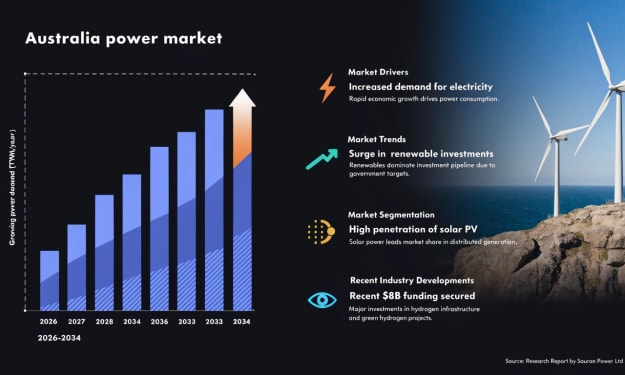
According to IMARC Group, the Australia power market reached 285.7 TWh in 2025 and is projected to reach 377.0 TWh by 2034, growing at a compound annual growth rate (CAGR) of 3.04% during 2026–2034. The market’s growth is being shaped by accelerating renewable energy adoption, increasing electricity demand and large-scale investments in grid modernization. Government incentives supporting clean energy transition, combined with rising corporate sustainability commitments, are encouraging the expansion of solar, wind and battery storage infrastructure. At the same time, the gradual phase-out of coal-fired power plants is transforming the structure of Australia’s electricity generation mix. With emerging technologies such as hydrogen energy systems and virtual power plants gaining traction, Australia’s power sector is evolving into a more diversified, digitally integrated and sustainable energy ecosystem.
By Kevin Cooper3 days ago in Futurism
Hottest in the Office
Dear Rafi, You’re very distracting to work around. For the first second I saw you the other day, I thought you were some type of executive. It took a moment to realize no, you were just the new guy, dressed up for the job he wants. Be still, my heart.
By Gabriel Shamesa day ago in Pride



Comments
There are no comments for this story
Be the first to respond and start the conversation.