
The Future of Cross-Platform mobile app development: Key Trends to watch in 2025
The Future of Cross-Platform Mobile App Development: Key Trends to Watch in 2025


The landscape of mobile app development is constantly evolving, and as we get closer to 2025, cross-platform mobile app development is more likely to be there in the picture.
With the business world pushing to reach more people across more platforms, cross-platform mobile applications have become necessary. Fast, cost-effective, and high-performance applications have never been in greater demand, and cross-platform frameworks have been answering these calls.
With cross-platform app development, developers can write a single codebase that can be deployed on multiple platforms- iOS, Android, and sometimes even the web. It thereby saves time as well as other resources while creating a uniform experience for users across many devices. Of course, because of emerging new technologies, tools, and methodologies every year, the future of cross-platform mobile application development is quite expected to witness a change.
In this blog, we’ll explore the key trends shaping the future of cross-platform app development in 2025 and beyond.
1. The Rise of Frameworks that Enhance Performance
One of the biggest challenges that developers have faced so far is trying to balance the speed of development and app performance. Most native apps have been preferred due to their fast and responsive nature, while cross-platform apps face performance issues. However, advancements in frameworks like Flutter, React Native, and Xamarin have made cross-platform applications much more efficient.
More people will request the development of high-performance cross-platform applications in 2025 and other years forward. More and more developers will make use of the best cross-platform mobile application development framework for apps that will promise a smooth user experience. This future also reveals frameworks to provide native-like performance capabilities: access to APIs or device hardware; and increased optimization techniques.
For example, Flutter, a UI toolkit created by Google, is already known for its ability to compile directly into native code.
2. AI and Machine Learning Integration in Cross-Platform Apps
Artificial intelligence and machine learning are propelling further changes into the industries. Developers will progressively integrate these technologies into cross-platform apps to develop functionality. In 2025, expect a lot of applications that use AI for personalization, predictive analytics, and automation, which will make an increasingly intelligent experience for users.
Other frameworks, such as cross-platform app frameworks, are also evolving to make integrating AI and ML easier. For example, Google has developed TensorFlow Lite and CoreML for iOS. Both of these can be used in Flutter or React Native applications and enable developers to include machine learning capabilities directly into their apps.
3. 5G Connectivity Driving Mobile App Innovation
Already, rollout in the deployment of 5G networks worldwide, by 2025 its far-reaching influence can bring an added level to the world of mobile application development; it includes features like speed transfer and network efficiency. More interactive mobile apps using this can handle more responses fast. More gaming, smooth streaming, fast handling, etc, which demand time in an average time space-ideal real-time applications that suit AR and VR.
However, cross-platform mobile app development will be more than just typical utilizations. Cross-platform apps in 2025 will even extend to various forms of entertainment, healthcare, and remote working platforms, changing with 5G and ushering in new ways of interaction and engagement for a user.
4. Progressive Web Apps (PWAs) Becoming a Common Practice
Progressive Web Apps are websites acting like mobile applications, which put together the best of both the web and the mobile app experience. PWAs ensure offline access and push notifications with speed, offering a seamless app-like experience without requesting users to download an application from an application store. Due to this rise in mobile use, businesses will become more interested in using PWAs to reach the masses at less cost.
PWAs will be completely adopted as an alternative to native apps in 2025, especially for cross-platform app development. Developers will continue to use PWAs as part of their mobile strategy, and many frameworks like React Native and Flutter will natively integrate PWA support, making the creation of hybrid web and mobile apps much easier.
5. Augmented Reality (AR) and Virtual Reality (VR) Integration
The future of mobile app experiences for cross-platform apps is going to be revolutionized by AR and VR. Creating immersive AR and VR experiences for apps will now be possible among cross-platform developers in 2025, providing new forms of engagement for their users.
Currently, Unity and Unreal Engine are very popular frameworks used in developing AR/VR applications. These are increasingly being integrated with cross-platform development frameworks such as React Native. The future development of these frameworks will enable seamless AR/VR work on iOS and Android devices.
In 2025, cross-platform development will be used for supporting retail, education, and real estate adoption in AR apps, while the scope of VR in the gaming and remote collaboration sectors will lead to the use of cross-platform app development. Businesses taking up AR and VR will have an upper hand in relation to competition, and without needing to code separately for each device, cross-platform frameworks will allow them to reach users.
Conclusion
In 2025, the future of cross-platform mobile application development is bright with promise. As frameworks like Flutter, React Native, and Xamarin are developed further, developers will gain more power and flexibility to develop high-performance AI-driven, immersive applications that work flawlessly on all devices. With growth in 5G connectivity, proliferation of AR and VR experiences, and increasing use of PWAs, cross-platform apps are going to be in huge demand across industries including entertainment, retail, healthcare, and education.
To satisfy user needs and to optimize costs, it will be necessary for businesses to develop cross-platform mobile apps in the future. Monitoring these trends will help the developers and businesses be prepared for such an environment, in turn making the apps competitive.
About the Creator
Keep reading
More stories from Emily Carter and writers in Futurism and other communities.
PHP Web Development: Why It’s Still the Backbone of Modern Websites in 2025
In the world of web development, technologies are constantly coming and going. PHP, first released in 1995 as a scripting language, has been to stay. The year now is 2025. It would be surprising if someone told that, with new programming languages, newer frameworks popping up one after the other, PHP is still hard to eliminate.
By Emily Carter12 months ago in Futurism
About Binding Prometheus
I want to start actively advocating on behalf of my own work, and the most valuable part of my canon is, without a doubt, Binding Prometheus, the play I have been working on since 2019 and only finished in 2023 as part of my MA. The play itself is an amalgamation of a million different inspirations. On one end, it evokes the Ancient Greek myth-play, deriving its own title from the earliest extant work of Western drama we have, Aeschylus’s Prometheus Bound. On the other end, it borrows significantly from the sci-fi bulwarks from over the years, namely Mary Shelley’s Frankenstein and Karel Capek’s Rossum’s Universal Robots. The play could be an episode of Black Mirror, I fear. I don’t know. I’ve only ever seen one episode of Black Mirror.
By Steven Christopher McKnight22 days ago in Futurism
Advanced Analytics Market: Predictive Insights, Big Data Adoption & Industry Trends
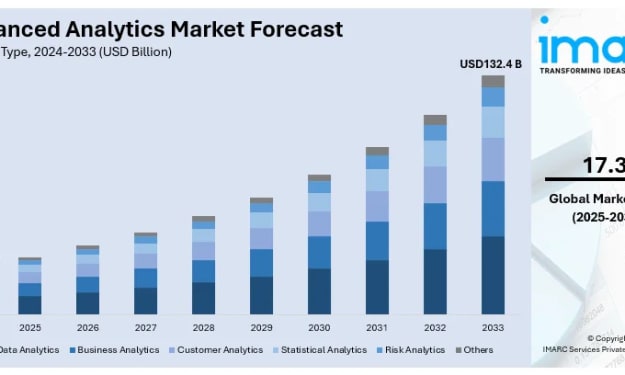
Rapid digital transformation, exponential data generation, cloud adoption, AI and machine learning integration, and rising demand for real-time, data-driven decision-making are accelerating advanced analytics adoption across industries. According to IMARC Group's latest research publication, global advanced analytics market size reached USD 26.9 Billion in 2024. Looking forward, IMARC Group expects the market to reach USD 132.4 Billion by 2033, exhibiting a growth rate (CAGR) of 17.3% during 2025-2033.
By Andrew Sullivan2 days ago in Futurism
Autonomy Is The Real Privilege
Good morning, freedom-seekers! Today we’re gonna be looking at autonomy. A strange word, I know; one many would probably look at blankly and run away from on sight. We’re gonna figure out what it actually means, consider how it’s achieved, and decipher just how deeply most of us are tangled up in dependence without realising it.
By That ‘Freedom’ Guy3 days ago in Humans



Comments
There are no comments for this story
Be the first to respond and start the conversation.