
The Future of Artificial Intelligence
The good and the bad

Artificial intelligence (AI) is a rapidly evolving field with the potential to revolutionize many aspects of our lives. From healthcare to transportation to customer service, AI is already having a major impact on the way we live and work.
In the coming years, AI is expected to become even more sophisticated and pervasive. We can expect to see AI-powered solutions that are more intelligent, more efficient, and more user-friendly than anything we have today.
Here are some of the ways that AI is likely to change our future:
Healthcare: AI is already being used to diagnose diseases, develop new treatments, and provide personalized care. In the future, AI is expected to play an even greater role in healthcare, helping to improve the quality of care and reduce costs. For example, AI can be used to analyze medical images and data to identify potential diseases, or to develop new drugs and treatments.
Transportation: AI is being used to develop self-driving cars, improve traffic flow, and optimize shipping routes. In the future, AI is likely to revolutionize transportation, making it safer, more efficient, and more accessible. For example, AI can be used to control self-driving cars, or to optimize traffic signals to reduce congestion.
Customer service: AI is being used to provide customer support, answer questions, and resolve issues. In the future, AI is likely to play a larger role in customer service, providing a more personalized and efficient experience. For example, AI can be used to answer customer questions in real time, or to resolve issues without the need for human intervention.
Education: AI is being used to personalize learning, provide feedback, and assess student progress. In the future, AI is likely to play an even greater role in education, helping students learn more effectively and efficiently. For example, AI can be used to create personalized learning plans for each student, or to provide feedback on student work.
These are just a few of the ways that AI is likely to change our future. As AI continues to evolve, we can expect to see even more amazing and transformative applications.
Of course, there are also some potential risks associated with AI. For example, AI could be used to create autonomous weapons systems that could pose a threat to humanity. It is important to address these risks and develop ethical guidelines for the development and use of AI.
Some of the challenges that we will need to overcome in order to realize the full potential of AI include:
Data privacy and security: AI systems rely on large amounts of data to train and operate. This data must be collected and used responsibly in order to protect people's privacy and security. For example, we need to ensure that AI systems are not used to collect or store personal data without people's consent.
Bias: AI systems can be biased if they are trained on data that is biased. This can lead to discrimination against certain groups of people. For example, if an AI system is trained on data that is mostly white men, it may be more likely to make decisions that favor white men.
Ethical considerations: There are a number of ethical considerations that need to be addressed when developing and using AI systems. For example, we need to decide how much control humans should have over AI systems, and how to ensure that AI systems are used for good rather than for harm.
Despite these challenges, I believe that the future of AI is very bright. With careful planning and responsible development, AI has the potential to make our lives better in many ways.
Here are some additional thoughts on the future of AI:
AI is likely to become increasingly integrated into our lives, and it will be important to develop ways to ensure that AI is used for good.
AI has the potential to solve some of the world's most pressing problems, such as climate change and poverty.
AI will also create new challenges, such as job displacement and the need for new ethical guidelines.
Overall, the future of AI is full of promise and potential. However, it is important to be aware of the challenges that AI will bring, and to develop ways to address them. With careful planning and responsible development, AI has the potential to make the world a better place
About the Creator
Keep reading
More stories from writers in Futurism and other communities.
About Binding Prometheus
I want to start actively advocating on behalf of my own work, and the most valuable part of my canon is, without a doubt, Binding Prometheus, the play I have been working on since 2019 and only finished in 2023 as part of my MA. The play itself is an amalgamation of a million different inspirations. On one end, it evokes the Ancient Greek myth-play, deriving its own title from the earliest extant work of Western drama we have, Aeschylus’s Prometheus Bound. On the other end, it borrows significantly from the sci-fi bulwarks from over the years, namely Mary Shelley’s Frankenstein and Karel Capek’s Rossum’s Universal Robots. The play could be an episode of Black Mirror, I fear. I don’t know. I’ve only ever seen one episode of Black Mirror.
By Steven Christopher McKnightabout a month ago in Futurism
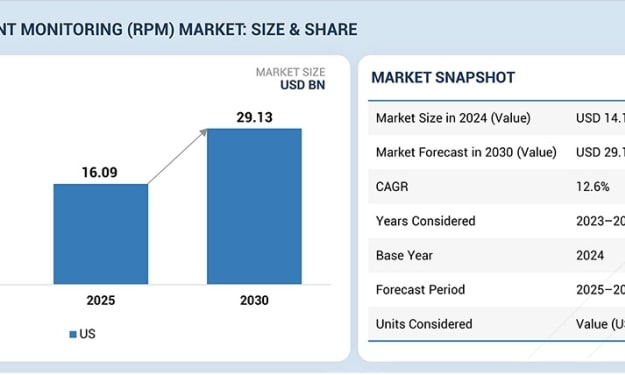
US Remote Patient Monitoring Market Surges to $29.13 Billion by 2030
The Remote Patient Monitoring (RPM) market in the United States is evolving rapidly, becoming a fundamental element of contemporary healthcare systems and a key focus for healthcare leaders across the country. The market was worth $14.15 billion in 2024 and is expected to grow to $16.09 billion in 2025. Forecasts indicate a strong compound annual growth rate (CAGR) of 12.6% until 2030, with a total market value of $29.13 billion anticipated by the close of the decade.
By Juan Martinez4 days ago in Futurism



Comments