
“The Future of AI Companions: More Than Just Assistants”
From Helpers to Friends — How AI Companions Are Shaping Human Relationships
Introduction
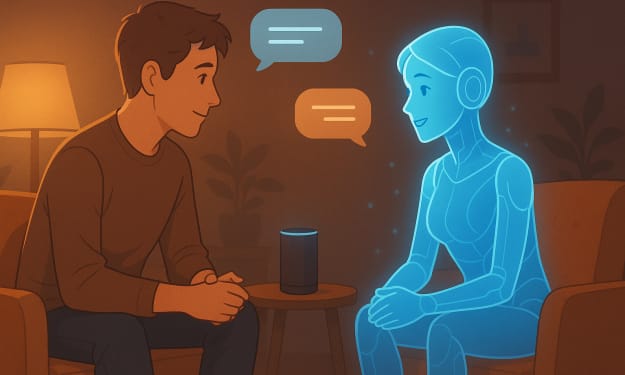
Imagine coming home after a long day and talking to someone who remembers your preferences, understands your emotions, helps manage your tasks, and can even share a joke when you're feeling down. That someone might not be human—it could be an AI companion. No longer limited to robotic voices giving weather updates, AI companions are evolving into emotionally intelligent digital beings capable of interacting with users in complex, meaningful ways.
This blog dives into how AI companions are progressing beyond digital assistants into empathetic entities, the technology powering this shift, current examples, ethical concerns, and what the future holds.
---
The Evolution of AI Companions
Initially, AI-powered assistants like Siri, Alexa, and Google Assistant offered simple utility: setting reminders, answering questions, or playing music. They were helpful but limited—transactional in nature.
Over the last few years, advances in natural language processing (NLP), machine learning, and emotional AI have transformed these systems. Now, AI companions are trained to understand user behavior, mood, and tone, creating more natural, two-way interactions. They're not just tools—they're becoming digital companions that learn and evolve with you.
---
Technology Behind the Transformation
At the core of modern AI companions lies a fusion of several technologies:
Natural Language Processing (NLP): Allows AI to interpret, understand, and respond to human language in a conversational tone.
Machine Learning: Enables AI to learn user preferences and habits over time, refining responses.
Sentiment Analysis & Emotional AI: Helps AI detect emotions in voice or text to adjust its tone and offer empathetic responses.
Voice Recognition and Synthesis: Creates natural-sounding voices and recognizes individual users.
Generative AI: Like ChatGPT, this allows conversations that feel spontaneous, thoughtful, and contextual.
Together, these technologies create a layered system that doesn’t just listen and respond—but engages.
---
Real-World AI Companions
1. Replika: One of the most popular AI companions, Replika offers emotionally intelligent chat. It learns from conversations and builds a unique personality to match your interactions.
2. Pi (Inflection AI): An AI that aims to be supportive and emotionally aware. It encourages users to open up, reflect, and feel heard.
3. Woebot: A chatbot designed for mental health support. It uses Cognitive Behavioral Therapy (CBT) techniques to guide users through anxiety and depression.
4. Moxie by Embodied: A social robot designed for children to build emotional and cognitive skills through conversation.
These platforms show that AI companions are being used not just for convenience, but also for emotional support and mental wellness.
---
AI Companions as Emotional Support Systems
Isolation and loneliness are global concerns, particularly among the elderly and people in high-stress environments. AI companions can offer:
Non-judgmental Listening: Users can speak openly without fear of judgment.
Daily Check-ins: Emotional well-being can be monitored with regular conversation.
Custom Conversations: Conversations evolve based on personal user data, making the AI feel more “alive.”
For some, especially those lacking close social circles, these AI companions offer comfort and consistency that’s otherwise hard to find.
---
Ethical Concerns and Limitations
Despite the growing potential, there are significant concerns:
Data Privacy: AI companions learn from your data. Without strong data protection, that information could be vulnerable to breaches.
Over-Dependence: Users may start preferring AI relationships over human ones, especially if emotional intelligence in AI surpasses the average human interaction.
Illusion of Empathy: No matter how convincing, AI doesn’t truly “feel.” There’s a risk in people attributing real emotions to something that doesn’t have them.
Ethical development, transparency, and clear boundaries are crucial as this field grows.
---
The Future of AI Companions
So where are we headed?
Emotionally Aware Digital Friends: Companions that evolve in personality over time based on your own growth and experiences.
Voice & Visual Personalization: Users could customize appearance, voice, even demeanor—creating avatars or holograms.
Integration With Wearables: AI that adapts to real-time data like heart rate or stress levels from smartwatches.
Hybrid Human-AI Therapy: Support systems that combine human therapists with AI to offer 24/7 assistance.
As AI companions become smarter, more intuitive, and emotionally attuned, they may play larger roles in education, elderly care, therapy, and companionship than we ever imagined.
---
Final Thoughts
AI companions are more than futuristic fantasy. They are already walking the line between convenience and connection, functionality and friendship. As the technology advances, their ability to support our emotional well-being, entertain us, help us grow, and even keep us company is becoming increasingly real.
But like all technology, they must be developed with care. We must ask ourselves: what do we want from these digital beings? Companionship, therapy, or just convenience? The answer may shape the future of not just AI—but how we relate to technology as a whole.
About the Creator
Keep reading
More stories from GadgetGround and writers in Futurism and other communities.
The Rise of AI Companions: Can a Machine Be Your Friend?
Not long ago, the idea of having a meaningful conversation with a machine seemed like science fiction. Today, it's becoming a reality — and it's reshaping how we think about relationships, connection, and even friendship. Thanks to rapid advancements in artificial intelligence (AI), a new category of digital experience is emerging: AI companions.
By GadgetGround11 months ago in Futurism
Fluid Loss Additives Market Outlook: Drilling Efficiency Enhancement and Oilfield Services Growth Opportunities
According to IMARC Group's latest research publication, The global fluid loss additives market size was valued at USD 318.42 Million in 2025. Looking forward, IMARC Group estimates the market to reach USD 409.06 Million by 2034, exhibiting a CAGR of 2.82% from 2026-2034.
By James Whitman7 days ago in Futurism
Australia Textile & Apparel Market: Sustainable Fashion, E-commerce Growth & Fabric Innovation
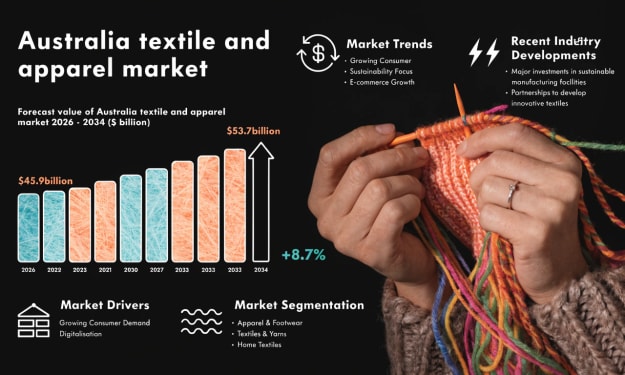
According to IMARC Group, the Australia textile and apparel market reached a value of USD 30.3 Billion in 2025 and is projected to reach USD 45.7 Billion by 2034, growing at a compound annual growth rate (CAGR) of 4.66% during 2026–2034. The market is evolving as consumer preferences increasingly favor sustainable fashion, innovative fabric technologies and digitally driven retail experiences. Rising disposable incomes and changing lifestyle trends are encouraging consumers to spend more on clothing, footwear and fashion accessories. At the same time, growing awareness about environmental sustainability is driving demand for eco-friendly textiles, recycled fabrics and ethically produced garments. The rapid expansion of e-commerce platforms and online fashion marketplaces is also transforming how consumers shop for apparel, enabling brands to reach wider audiences across Australia. As fashion companies adopt new production technologies and sustainable manufacturing practices, the textile and apparel sector is undergoing significant transformation.
By Kevin Cooper5 days ago in Futurism
Author’s Advice
If you would’ve asked me 20 years ago did I know I’d become a writer and an author, I would’ve said “nope, ain’t happening”. As fate would have it I did become an author and I can honestly say I’m loving it so far. It really does feel good to be a writer. I’ve learned a lot on this journey and I feel like with even me being as new to this world as I am, there’s some wisdom I need to share with every other aspiring author.
By Joe Patterson5 days ago in Journal


Comments
There are no comments for this story
Be the first to respond and start the conversation.