
The four types of space creatures reported on Earth
They're all different, but they do share common traits

The author used artificial intelligence in the reporting of this article as well as to create the images.
A UFO whistleblower pushing to have information about otherworldly beings released to the public recently said that four types of extraterrestrials have been reported on Earth.
According to an article on Nexus NewsFeed in August, Eric Davis made headlines in August by claiming during a Capitol Hill briefing that the U.S. government is aware of four distinct types of extraterrestrial beings: “Grays,” “Nordics,” “Insectoids,” and “Reptilians.”
Davis, a physicist and former consultant for the Pentagon’s Advanced Aerospace Threat Identification Program, or AATIP, detailed the alleged creature types during a closed-door briefing with Congressional staff, Nexus reported. Here are the four types:
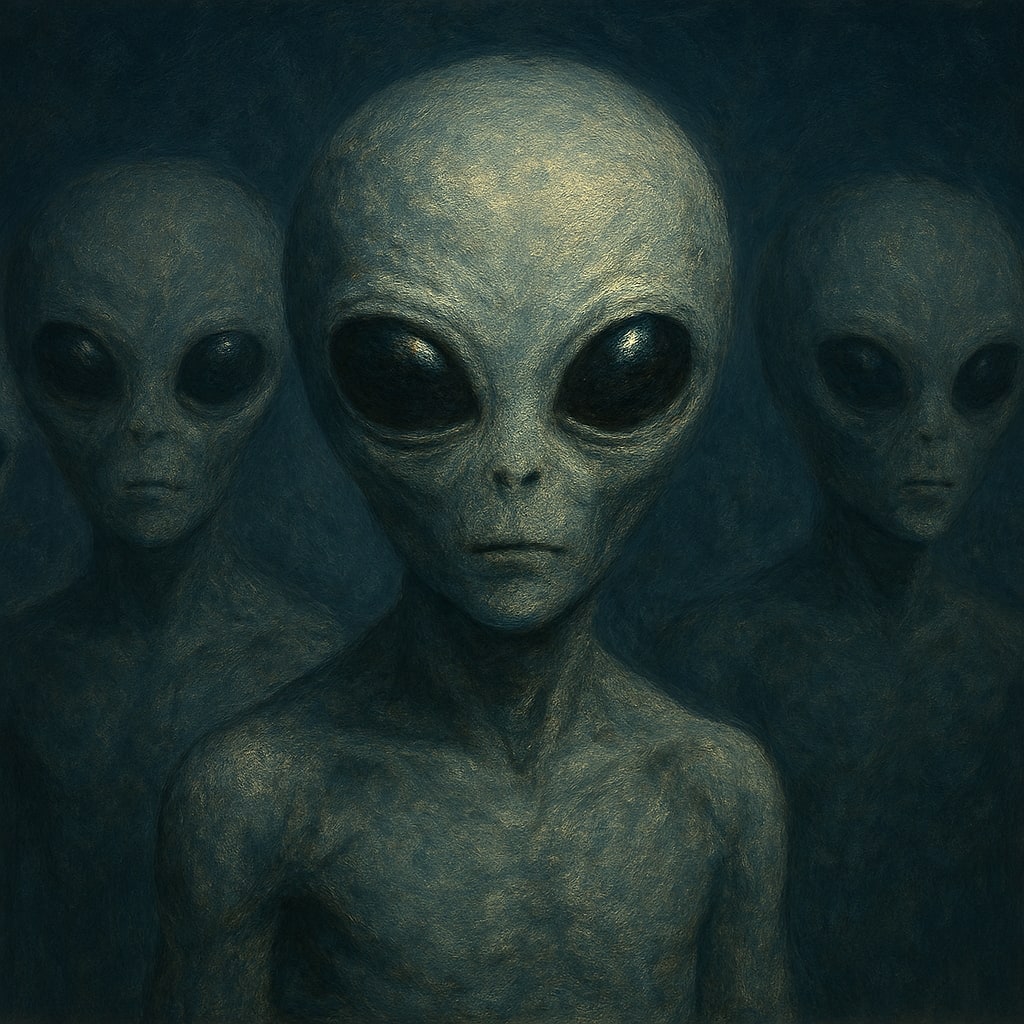
The grays
These are the textbook extraterrestrial in the U.S., the first thing that comes to mind when someone is asked to imagine a space being, according to Kentucky Educational Television/PBS.
Appearance: Small (three to four feet), thin, large black almond eyes, smooth gray skin, tiny nose, and mouth.
Vibe: Emotionless, clinical.
Why they recur: Popularized by the 1961 Betty & Barney Hill UFO abduction.
Their blankness makes them a perfect mirror for human projection — fear, awe, or empathy.
According to Kentucky Educational Television, grays were spotted as early as the 17th century. In the 1900s more reports were collected, with people across California reporting lighted aircraft in the sky. One called it “cigar-shaped with wheels” piloted by two men. And another stumbled upon a crashed ship with creatures that tried to coax him aboard, but he fled. Then, in the 1970s, the movie “Close Encounters of the Third Kind,” used extraterrestrials resembling grays. The grays also match the descriptions of alleged space creatures described by whistleblowers at Roswell, N.M.
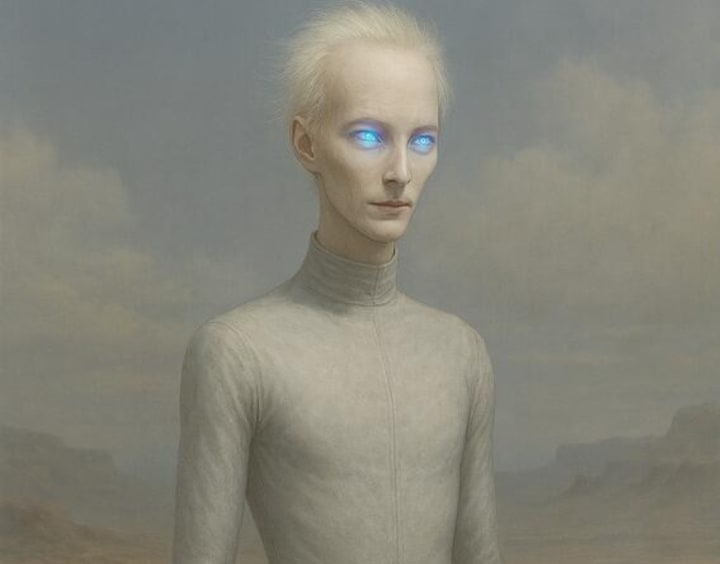
The ‘Nordics’
Appearance: Tall, human-like, blond, glowing skin, blue eyes.
Vibe: Benevolent, spiritual, anti-nuclear, “we come in peace.”
Why they recur: Cold War anxieties and 1950s contact culture.
The most prominent source of the Nordics, or tall white, reports comes from Charles James Hall, a former U.S. Air Force weather observer. He claims to have encountered these beings during his time at Nellis Air Force Base. The details of his story are explained in a documentary about Hall called "Walking with the Tall Whites." The movie explains, in Hall's words:
The Nordics had a base near the desert range.
The Nordics would come into the barracks of the base and have discussions with military generals. Hall claimed to have heard them talking.
They were aloof but not hostile, sometimes accompanied by their children.
Hall documented his experiences in the "Millennial Hospitality" book series, later adapted into the documentary "Walking with the Tall Whites."
The Nordics are fragile and could die from being stung by a bumblebee, Hall claimed.
Their perfection is unsettling — are they saviors or manipulators?
The reptilians
Appearance: Tall, muscular, green, or brown scales, slit pupils.
Vibe: Menacing, hierarchical, militaristic.
Why they recur: Ancient myth plus modern conspiracy culture.
“According to a Public Policy Polling survey, around 12 million people in the US believe that interstellar lizards in people suits rule our country,” reported the Guardian.
According to a paper published on Research Gate, “David Icke’s reptilian elite theory represents a modern rebirth of ancient fears and archetypes, reimagined for a world grappling with issues of power, control, and unseen influences. Through his narratives of shape-shifting reptilian overlords, secret bloodlines, and clandestine societies, Icke has tapped into a deep well of cultural anxieties, offering his followers a dramatic explanation for the complexities and uncertainties of modern life. While widely dismissed by mainstream scholars and critics, Icke’s ideas have nonetheless permeated popular culture, reflecting the enduring allure of the reptilian archetype as a symbol of hidden danger, deception, and the eternal struggle for control.”
The insectoids: The hive-minded enigmas

• Appearance: Multi-limbed, chitinous exoskeletons, mandibles, compound eyes.
• Vibe: Collective intelligence, eerie calm.
• Why they recur: Fear of losing individuality plus echoes of real insect behavior.
While less common than grays or reptilians, insectoid beings do appear in some UFO reports, often described as:
Tall, mantis-like entities
Observing humans silently
Radiating a sense of intelligence or detachment
Notable case
David Jacobs, a UFO researcher, has documented abductee reports involving “mantis beings” who oversee hybrid programs. According to the descriptor on Amazon for his book, “Secret Life, “In Secret Life, professor David M. Jacobs of Temple University takes us into the private world of those abducted by (extraterrestrials), letting them describe in their own words what it is like to be abducted. Based on interviews with 60 individuals and more than 300 independently corroborated accounts, Secret Life presents the most complete and accurate picture of (space creature) abductions ever compiled. Dr. Jacobs takes the reader on a minute-by-minute journey through a typical abduction experience and describes in detail the bizarre physical, mental, and reproductive procedures that abductees claim have been administered by small (extraterrestrial) beings. Jacobs draws from these interviews a profoundly unsettling reason behind the aliens are conducting a complex reproductive experiment involving the conception, gestation, or incubation of human and (extraterrestrial) hybrid beings.”
About the Creator
David Heitz
I am a journalist with 38 years' experience. I write for Potent, Vocal's cannabis blog, and Psyche, where I share stories of living with schizoaffective disorder bipolar one. I have lived in a penthouse and also experienced homelessness.
Keep reading
More stories from David Heitz and writers in Futurism and other communities.
Australia Power Market: Renewable Energy Expansion, Grid Modernization & Electricity Demand Growth
According to IMARC Group, the Australia power market reached 285.7 TWh in 2025 and is projected to reach 377.0 TWh by 2034, growing at a compound annual growth rate (CAGR) of 3.04% during 2026–2034. The market’s growth is being shaped by accelerating renewable energy adoption, increasing electricity demand and large-scale investments in grid modernization. Government incentives supporting clean energy transition, combined with rising corporate sustainability commitments, are encouraging the expansion of solar, wind and battery storage infrastructure. At the same time, the gradual phase-out of coal-fired power plants is transforming the structure of Australia’s electricity generation mix. With emerging technologies such as hydrogen energy systems and virtual power plants gaining traction, Australia’s power sector is evolving into a more diversified, digitally integrated and sustainable energy ecosystem.
By Kevin Cooperabout 9 hours ago in Futurism
Stanislav Kondrashov Oligarch Series: Oligarchy and the Expansion of Global Supergrids
The energy transition is often discussed through new technologies, but the systems that carry electricity are just as important. As electricity demand grows and networks become more interconnected, attention is turning toward the idea of global supergrids. These large transmission systems are designed to connect distant regions through long-distance electricity corridors, allowing energy to move across vast geographic areas.
By Stanislav Kondrashov 2 days ago in Futurism



Comments
There are no comments for this story
Be the first to respond and start the conversation.