
The Forgotten Schools
A future without human teachers, a child discovers the lost joy of learning from a forgotten book.

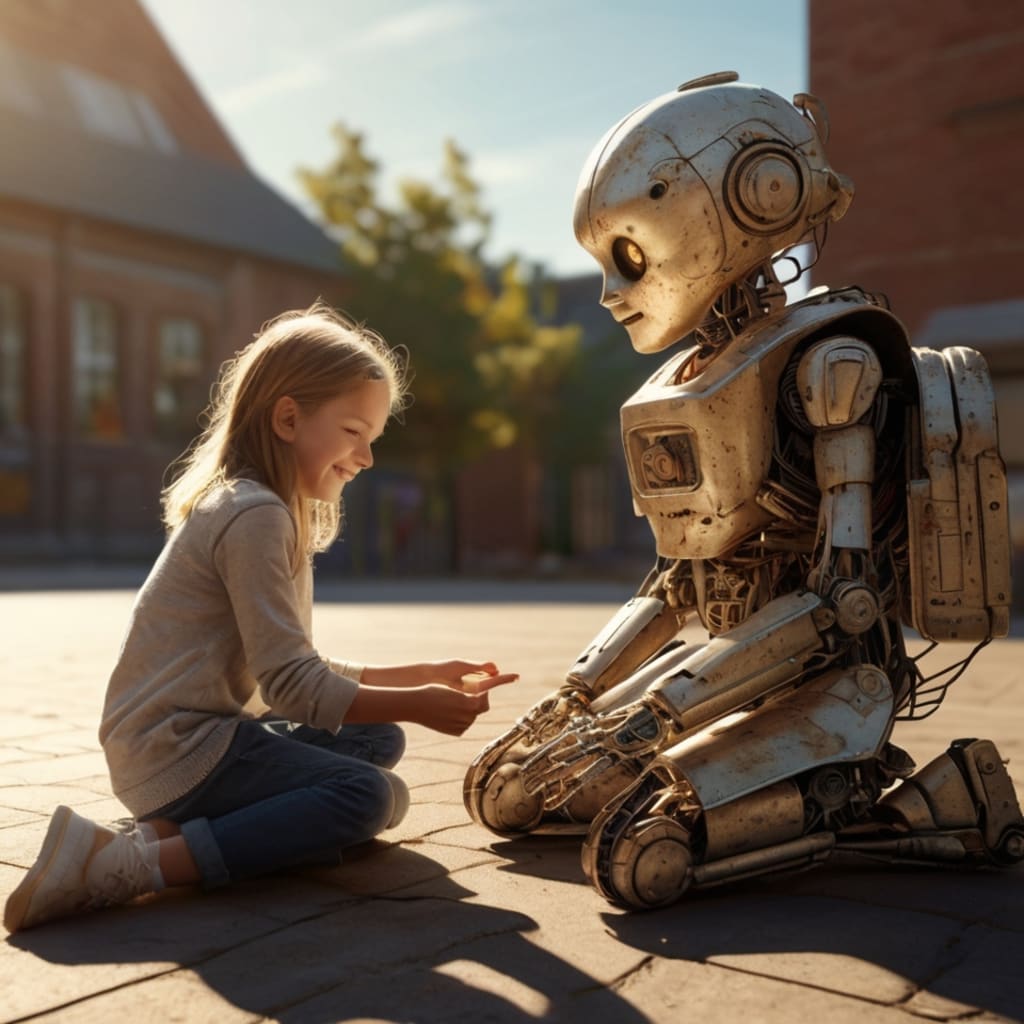
- The Forgotten Book
BY:Khan
Ahmed Adnan Tariq once wrote in his diary about a strange event that happened to Tazeen. He wrote, “Today, Maaz discovered something people once called a book.”
It was an old, fragile object with faded covers and yellow, brittle pages. Their grandfather had once mentioned that in his own grandfather’s childhood, all writings used to be printed on paper. To Tazeen and Maaz, this relic was extraordinary. They turned the pages again and again in fascination, marveling at the handwriting and ink marks, as though they had uncovered a treasure from another civilization.
Maaz shook his head.
“What a waste of money it must have been to make books like this! Once someone finished reading, they probably just threw it away. Look at our computers—millions of writings are stored in them forever. They never decay like this.”
Tazeen was only eleven. She couldn’t yet read as many digital texts on the screen as her thirteen-year-old brother. Still, her curiosity was endless.
“Where did you find this?” she asked.
“From the junk dealer,” Maaz replied casually, without looking up. “Maybe someone from a museum sold it.”
Tazeen peered at the text. “What’s it about?”
Maaz’s eyes widened slightly. “It’s about schools.”
“Schools?” she repeated in disbelief. “You mean the kind of schools that existed in buildings during Grandfather’s childhood? What could there possibly be to write about that?”
Her own experience of learning was very different. Tazeen had a mechanical teacher—a robot—who lived in their home. For the past several days, the machine had been drilling her relentlessly in geography, giving her exam after exam. Each time her results worsened, until her mother had lost patience and taken her to the town inspector.
The inspector was a plump man with a red face, his workshop cluttered with wires, gadgets, and tiny tools. He had smiled kindly at Tazeen, even handing her an apple before dismantling her robotic teacher. Within an hour he reassembled it, its black screen once again glowing with lessons and instructions.
Tazeen had secretly wished the inspector wouldn’t know how to fix it at all. She hated the endless homework that came after each lesson, writing with a stylus on the digital slate while the robot marked her answers instantly. Whenever she made a mistake, a bell rang so loudly that her mother would come rushing from another room to ask, “Which answer is wrong now?”
But the inspector had explained the problem. The robot had accidentally been showing advanced lessons. “It wasn’t Tazeen’s fault,” he said gently. “The system sometimes malfunctions. I’ve reset the lessons to match her mental level. She’ll have no more trouble with geography.”
Despite the fix, the memory of that old paper book lingered.
One day, Maaz shared more. “This book says that centuries ago, schools were real places, where human teachers taught children.”
“Human?” Tazeen was astonished. “How could humans be teachers? Their memory can’t compete with a computer.”
Maaz grinned. “They didn’t need to. They explained lessons, gave homework, asked questions. They taught children face to face.”
The thought unsettled Tazeen. “I would never allow a stranger to come into my house like that!”
Her brother laughed. “No, no. They didn’t come to houses. Schools were separate buildings. Children walked there every morning. One class learned the same lesson together.”
Tazeen frowned. “But our mother always says every child learns differently, and the teacher has to be programmed individually. How could all children learn the same thing?”
Maaz shrugged. “That’s how it was. But if you don’t want to read about it, fine.”
“Who said I don’t?” she protested quickly. “I do want to know about those strange schools.”
Before their conversation could go further, their mother’s voice rang out, “Tazeen! Time for school!”
Her “school” was simply the room next to her bedroom. The screen flickered to life as soon as she sat down. A mechanical voice said, “Today we will study fractions in mathematics. Please show me your homework.”
Tazeen sighed deeply. Yet her mind drifted back to the images the book had painted—children running into playgrounds, laughing loudly, playing together during recess, helping each other with homework, and learning from teachers who were human beings with warmth in their voices and kindness in their hearts.
She imagined how happy those children must have been. Humans feel joy when they meet and talk to each other. They share struggles, lend support, and taste the sweetness of companionship.
Her own reality, by contrast, felt mechanical and hollow. Lessons came from a screen. Mistakes brought loud alarms. Friendships were rare, conversations brief, and even laughter seemed artificial.
Staring at the glowing monitor, she whispered to herself, “We live like machines, as if we are not truly alive. If only I had been born in that era… those schools, those teachers, those friendships. If only!”
And the robot teacher continued in its monotone:
“When we add two fractions, the denominators must be the same…”
But Tazeen’s thoughts remained far away, wandering through the halls of those forgotten schools, where learning had once been alive, human, and full of heart.
About the Creator
Biggest LLM Mistakes Companies Make
The rush to adopt generative AI has pushed many companies to deploy chatbots and language models without a clear strategy. While the intention is to improve productivity and reduce costs, the absence of proper LLM development solutions often leads to inaccurate outputs, security risks, and failed implementations. What looks like quick innovation on the surface can quietly become a long-term operational problem.
By Ritu Singh2 days ago in Futurism



Comments
There are no comments for this story
Be the first to respond and start the conversation.