
The Fascinating Story of Human Evolution
From Survival to Supremacy — How Our Ancient Past Shapes Who We Are Today


Have you ever looked in the mirror and wondered—how did we get here? Not just you or me, but us, as a species? The way we walk, think, love, fight, explore—none of it happened by chance. It's the result of a long, painful, beautiful journey that started millions of years ago. A journey that isn’t just about science. It’s about identity.
This is the story of how we became human. Not a fantasy, not a myth—but a real, breathtaking saga of survival, struggle, and change. A story that, if you read it right, can teach you more about yourself than any self-help book ever could.
Chapter 1: Our Wild Beginnings
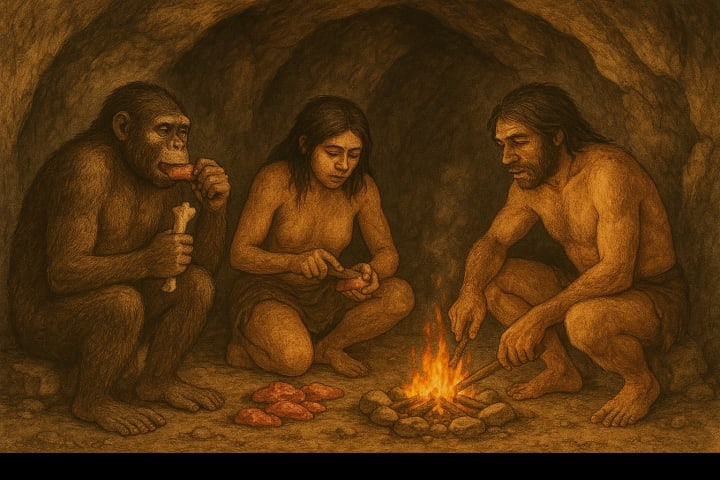
Let’s rewind the clock—way back. About 6 to 7 million years ago, somewhere in the heart of Africa, a small group of ape-like creatures did something extraordinary. They stood up.
Not all the time. Not at first. But it was the beginning of something that would define us: walking on two legs. This wasn’t just a physical shift—it changed everything. It freed our hands to carry food, cradle babies, and eventually hold tools.
These early ancestors, like Sahelanthropus tchadensis or Australopithecus afarensis (think “Lucy”), were still more ape than human. But they had sparked the first flame of change. They didn’t know it—but evolution had just set us on a path that would eventually lead to smartphones and space travel.
Chapter 2: Fire, Family, and the First Tools
Fast forward a couple million years, and we meet Homo habilis, the “handy man.” These early humans started using stone tools—breaking bones to get to the marrow, cutting meat, and crafting survival strategies. Then came Homo erectus, taller, smarter, and full of potential.
But the real game-changer? Fire.
When humans learned to control fire, it wasn’t just about warmth or cooking. Fire brought people together. Around the flames, they shared food, stories, safety. It was the birthplace of something even more important than tools—community.
We didn’t just evolve biologically—we began evolving socially and emotionally. We started depending on each other, not just for survival, but for meaning.
Chapter 3: Out of Africa, Into the World
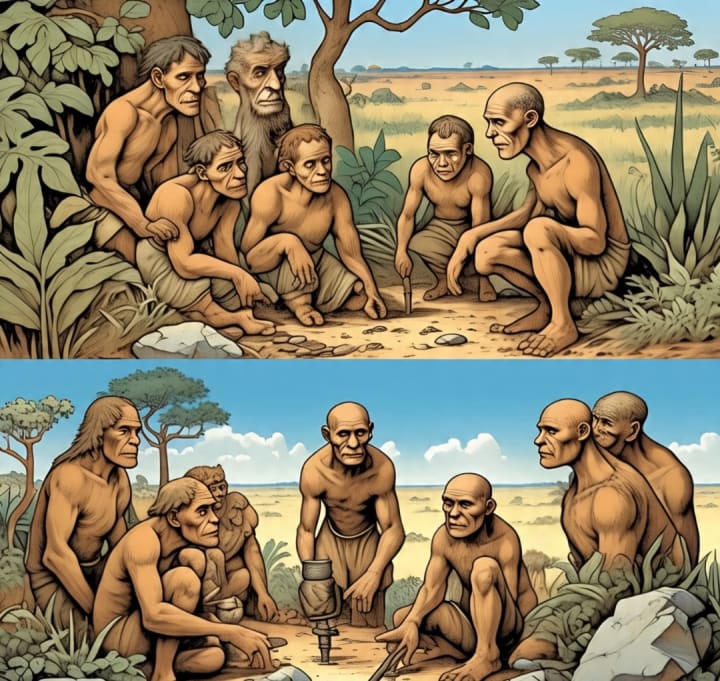
Roughly 60,000 to 70,000 years ago, humans began leaving Africa, spreading across Asia, Europe, and eventually the Americas. It wasn’t an easy journey—ice ages, predators, unfamiliar climates. Yet, we adapted.
Along the way, we met other human species: the Neanderthals in Europe, the Denisovans in Asia. We didn’t just fight them—we interbred with them. In fact, if you’re reading this today, you probably carry a small percentage of Neanderthal DNA.
What made us different wasn’t strength—it was creativity. We made better tools. We learned to fish, sew clothes, build shelter. We told stories. We painted on cave walls to remember, to express, and perhaps, to dream.
We didn’t just survive. We started to thrive.
Chapter 4: The Birth of Belief and Civilization
With stability came growth. Around 10,000 years ago, we began farming—staying in one place, domesticating animals, growing food. Villages turned into towns, towns into cities. We built temples, pyramids, palaces.
And we began asking deeper questions.
Who are we?
Where do we come from?
Why are we here?
That’s when we started creating religions, myths, rituals. We wanted to understand the stars, the seasons, death, and love. Evolution had shaped our brains not just to survive, but to wonder.
But it wasn’t all progress. We also invented war, hierarchy, greed. Civilizations rose and fell—Mesopotamia, Egypt, Greece, Rome. We built empires, enslaved others, and nearly destroyed ourselves.
Still, through all the destruction, our minds kept evolving.
Chapter 5: The Modern Miracle
Fast forward to the last few hundred years, and our evolution accelerated like never before. We invented machines, electricity, medicine, airplanes, the internet. We began unlocking the secrets of DNA—the very code of life.
But here’s the twist: while our technology leapt forward, our emotions and instincts still carry the ancient code of survival.
That’s why we sometimes feel fear when there’s no threat. Why we crave sugar or fat. Why tribalism, anxiety, and anger still haunt us—they were once useful. But now, they’re leftovers from a different world.
Understanding human evolution isn’t just academic. It’s personal. It helps us recognize our struggles and strengths. It reminds us that the flaws we carry aren’t signs of weakness—they’re signs of history.
So… Why Does This Matter?
You might be wondering: What does this have to do with my life today?
The answer is: everything.
When you feel lost, remember: your ancestors crossed deserts and glaciers with nothing but stone tools and determination.
When you feel afraid of change, remember: change is literally what made you human.
When you doubt your worth, remember: you are the product of millions of years of unbroken survival.
You’re not weak. You’re a living miracle.

Moral of the Story
Human evolution teaches us that growth is messy, but it’s always possible.
We went from prey to predator, from hunter to thinker, from firelight to satellite. And yet, we’re still evolving—not just physically, but emotionally, morally, spiritually.
Yes, we still fight. We still make mistakes. But we also love, create, heal, and imagine.
So the next time you feel small in this vast world, remember: the story of evolution isn’t over.
You’re still writing it.
About the Creator
From Dust to Stars
From struggle to starlight — I write for the soul.
Through words, I trace the quiet power of growth, healing, and becoming.
Here you'll find reflections that rise from the dust — raw, honest, and full of light.
Keep reading
More stories from From Dust to Stars and writers in Futurism and other communities.
THE SOUL: A CONCEPT OF DEFINED
Chapter 1: The Hollow Chase Ravi Sharma was the kind of man every parent pointed at with pride and envy. At just 34, he was the regional director of a renowned tech company in Bengaluru. His LinkedIn was a tapestry of milestones — promotions, awards, international conferences. His Instagram showed luxury vacations, gourmet meals, and curated smiles. To the outside world, Ravi had it all.
By From Dust to Stars9 months ago in Humans
Aircraft Lighting Market: Why the Lights on Your Plane Matter More Than You Think
Next time you board a flight, take a moment before you settle into your seat to look around. The soft glow overhead as you shuffle down the aisle. The reading light above your headrest. The subtle blue wash that fills the cabin during a red-eye as most passengers drift off to sleep. And if you've ever watched a plane approach through the dark from the ground, you've seen those rhythmic strobes and steady navigation lights that make aircraft visible across miles of sky.
By Frank Morgan6 days ago in Futurism
Seeing Is No Longer Believing
It started with a frantic FaceTime call at 2:00 AM. A mother in Arizona picked up her phone to see her teenage daughter crying, surrounded by dark shadows. The girl begged for help, saying she had been in an accident and the other driver was threatening her. The mother saw her daughter’s face—the specific way her lip quivers when she’s terrified—and heard the exact pitch of her scream. She was ready to pay any ransom, to do anything.
By Alex Sterling about 7 hours ago in Futurism



Comments (1)
This story of our evolution is fascinating. It makes me think about how far we've come from those early ape-like creatures.