
The Ethics of Body Modifications in a Post-Human World
Playing God or Playing Smart?


We’re no longer just flesh and bone—we’re becoming something more. In a world where technology blurs the line between human and machine, body modifications aren’t just tattoos or piercings anymore. They’re neural implants that sharpen memory, robotic limbs that outmuscle nature, and gene edits that promise eternal youth. Transhumanism—the belief that we can and should transcend our biological limits—isn’t science fiction; it’s here, reshaping bodies and minds. But as we sprint toward a post-human future, a question looms: where’s the ethical line when altering what it means to be human?
The New Normal of Enhancement
Body modifications have evolved from cultural rites to radical upgrades. Today, you can get a chip under your skin to unlock doors or monitor vitals—Sweden’s already got thousands doing it. Tomorrow, Elon Musk’s Neuralink might wire your brain to the internet, letting you think in gigabytes. CRISPR’s gene-editing scissors are snipping away at disease, but also at aging, eye color, even intelligence. Prosthetics aren’t just replacements; they’re enhancements—think Oscar Pistorius, whose blades sparked debates about fairness in sports.
This isn’t fringe anymore. A 2024 survey found 30% of Americans would consider non-medical enhancements if safe and affordable. We’re not talking vanity—these are tools to outpace evolution, to hack mortality itself. Transhumanists argue it’s our destiny: why settle for a frail, fleeting body when tech can make us stronger, smarter, longer-lived? It’s a seductive pitch, but the ethical cracks start showing when you dig deeper.
come cheap, and gene editing isn’t covered by insurance. Imagine a world where the wealthy wire their kids for genius while the rest scrape by on factory-default brains. Inequality’s already a chasm; post-human tech could turn it into a canyon. The psychology of this is brutal—envy, inferiority, resentment simmering in those left upgraded.
Fairness isn’t just economic—it’s existential. If some can buy immortality while others decay, do we still share a common humanity? Philosophers like Nick Bostrom warn of a "genetic aristocracy," where modified elites dominate. History backs this fear: every leap—industrial, digital—has widened gaps before narrowing them. The future might democratize these tools, but the transition could be a mess of haves and have-nots.
The Mind’s Uncharted Territory
en there’s the psyche. Body mods don’t just tweak the chassis—they mess with the driver. A 2023 study on cochlear implants showed recipients grappling with identity—am I still me with a machine in my head? Scale that to brain chips or mood-altering nanobots, and the questions get thornier. If I boost my IQ or erase my anxiety, am I enhancing myself or erasing who I was? Transhumanism celebrates self-design, but psychology warns of a slippery slope—too much tweaking, and you might lose the raw, messy essence that makes you human.
Consent’s another minefield. Parents already pierce their kids’ ears—what’s stopping them from editing embryos for "better" traits? A Chinese scientist’s 2018 gene-edited babies sparked global outrage, yet the tech’s still advancing. In a post-human world, will opting out be a choice, or will societal pressure—like today’s vaccine debates—force us all to plug in? The line between autonomy and coercion blurs when the stakes are survival or obsolescence.
Playing God or Playing Smart?
Critics call it hubris—playing God with our own bodies. Religious voices decry modifications as defiance of divine design, while secular skeptics fear we’re outpacing our wisdom. What if a neural implant malfunctions, turning your mind into a glitchy mess? What if gene edits cascade into unforeseen mutations? The future’s littered with cautionary tales—Thalidomide, anyone?—and rushing into post-humanity risks catastrophe.
Yet, the counterargument bites back: isn’t all progress a gamble? Vaccines, electricity, flight—all were "unnatural" once. Transhumanists say ethics evolve with capability—denying enhancement is like denying penicillin to the sick. If we can fix blindness with retinal implants, why not sharpen sight beyond 20/20? If we can mend a broken leg, why not craft one that never tires? The line’s arbitrary, they argue—it’s about potential, not purity.
A Mirror to Our Values
Here’s my take: body modifications aren’t inherently wrong, but they’re a mirror. They reflect what we value—power, longevity, equality—and what we’re willing to sacrifice. A post-human world could be a utopia of shared potential or a dystopia of engineered privilege. The ethics hinge on execution: make it universal, transparent, and consensual, and it’s a leap worth taking. Botch the rollout, and it’s a fall we won’t recover from.
We’re at the cusp. Governments are scrambling—France banned non-therapeutic gene editing in 2024, while Japan greenlit neural trials. Individuals are guinea pigs, from biohackers injecting DIY mods to patients testing bionic arms. The future’s not a monolith—it’s a choice. Do we mod ourselves into something greater, or lose ourselves trying? In this post-human dawn, the only certainty is that staying human might soon be the boldest modification of all.
About the Creator
Pure Crown
I am a storyteller blending creativity with analytical thinking to craft compelling narratives. I write about personal development, motivation, science, and technology to inspire, educate, and entertain.
Keep reading
More stories from Pure Crown and writers in Futurism and other communities.
Immortality 2.0: Can Science Defy Death in Our Lifetime?
What if death wasn’t the endgame? Imagine a world where wrinkles fade, organs regrow, and birthdays pile up without the ticking clock of mortality. Science fiction, right? Not quite. Today, February 20, 2025, researchers are chipping away at aging’s foundations with tools like gene editing, organ regeneration, and biotech breakthroughs. The dream of “Immortality 2.0” isn’t just a sci-fi trope—it’s a tantalizing possibility. But can science really defy death in our lifetime, or are we chasing a mirage? Let’s unpack the quest to outrun the reaper.
By Pure Crownabout a year ago in Futurism
Fluid Loss Additives Market Outlook: Drilling Efficiency Enhancement and Oilfield Services Growth Opportunities
According to IMARC Group's latest research publication, The global fluid loss additives market size was valued at USD 318.42 Million in 2025. Looking forward, IMARC Group estimates the market to reach USD 409.06 Million by 2034, exhibiting a CAGR of 2.82% from 2026-2034.
By James Whitman4 days ago in Futurism
Australia Textile & Apparel Market: Sustainable Fashion, E-commerce Growth & Fabric Innovation
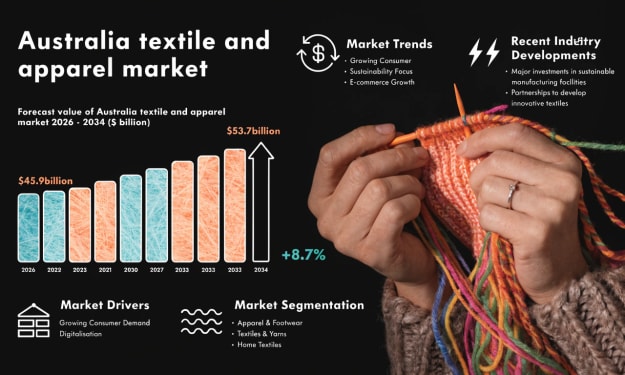
According to IMARC Group, the Australia textile and apparel market reached a value of USD 30.3 Billion in 2025 and is projected to reach USD 45.7 Billion by 2034, growing at a compound annual growth rate (CAGR) of 4.66% during 2026–2034. The market is evolving as consumer preferences increasingly favor sustainable fashion, innovative fabric technologies and digitally driven retail experiences. Rising disposable incomes and changing lifestyle trends are encouraging consumers to spend more on clothing, footwear and fashion accessories. At the same time, growing awareness about environmental sustainability is driving demand for eco-friendly textiles, recycled fabrics and ethically produced garments. The rapid expansion of e-commerce platforms and online fashion marketplaces is also transforming how consumers shop for apparel, enabling brands to reach wider audiences across Australia. As fashion companies adopt new production technologies and sustainable manufacturing practices, the textile and apparel sector is undergoing significant transformation.
By Kevin Cooper3 days ago in Futurism
The First Rainbow Baby
Pitter-patter, pitter-patter. The rain fell in rhythmic splatters, slowly slowing, but still constant. Mira rolled onto her side pulling the blanket tight against her ears, but still she could hear chitter-chatter and scurrying feet of the creatures that refused to sleep in the lower decks.
By A. J. Schoenfeldabout 19 hours ago in Fiction



Comments (1)
Totally enjoyed reading this Thank you 🙏✍️⭐️⭐️⭐️