
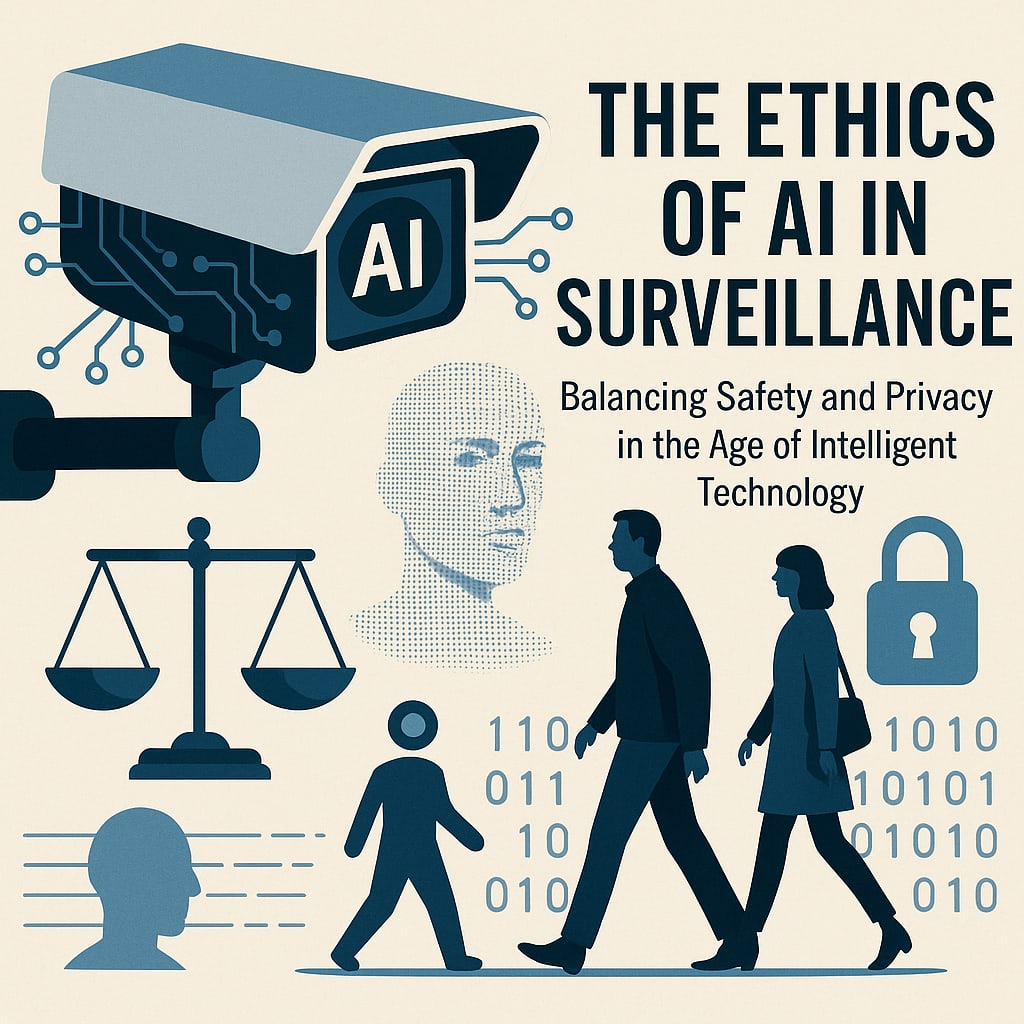
The Ethics of AI in Surveillance
Balancing Safety and Privacy in the Age of Intelligent Technology
Introduction
In today’s digital world, Artificial Intelligence (AI) is transforming the way we live, work, and interact. One area where AI is rapidly growing is surveillance — the monitoring of people and activities, often through cameras, sensors, and data analysis. AI makes surveillance more powerful and efficient, allowing systems to track movements, recognize faces, and even predict behavior.
While this may sound helpful, especially for law enforcement or national security, it also raises serious ethical concerns. What happens to our privacy when we are constantly being watched? Can AI make fair decisions, or does it carry bias? How much control should governments or companies have over this technology?
In this article, we will explore the ethical questions surrounding AI in surveillance, its benefits, and how we can find a balance between public safety and personal freedom.
What is AI Surveillance?
AI surveillance refers to the use of artificial intelligence to monitor, record, and analyze human activity. Common tools used include:
Facial recognition systems that can identify people by scanning their faces.
Motion detectors that can recognize unusual or suspicious behavior.
Predictive algorithms that guess where and when crimes may happen based on past data.
License plate readers and other tracking systems used to follow vehicles or individuals.
These technologies are used in public spaces, shopping malls, airports, schools, and even workplaces. They are meant to improve security and help authorities respond faster to threats.
The Ethical Concerns of AI in Surveillance
While the purpose of AI surveillance may seem good, its use brings up important ethical issues that need serious attention.
1. Loss of Privacy
One of the main concerns is the loss of privacy. AI can collect and analyze data about where you go, who you meet, and what you do — often without your knowledge or permission. This can make people feel uncomfortable, as if they are being watched all the time.
In a democratic society, individuals have the right to live without constant monitoring. If AI surveillance goes unchecked, it could lead to a world where privacy no longer exists.
2. Bias and Injustice
AI systems learn from data. If that data contains bias, the AI may repeat or even worsen it. For example, many facial recognition systems have been shown to be less accurate when identifying people of color or women. This can lead to false arrests or discrimination, especially in communities that are already vulnerable.
This raises the question: Can we trust AI to treat everyone fairly?
3. Lack of Consent and Transparency
Most people are unaware of where AI surveillance is being used and how their data is collected or stored. They often do not get a chance to give consent or opt out. This is a major ethical issue — people should have the right to control their own information and decide whether it can be used.
4. Abuse by Governments or Corporations
In some countries, governments have used AI surveillance to monitor citizens’ behavior, suppress protests, and silence critics. Without proper limits, AI can become a tool for authoritarian control. Similarly, private companies might use surveillance for marketing or profit, without thinking about ethics or human rights.
Benefits of AI Surveillance
It’s important to understand that AI surveillance is not all bad. When used correctly and responsibly, it offers many advantages:
Crime prevention: Cameras with facial recognition can help identify criminals quickly.
Public safety: AI can detect threats in crowded places like airports, concerts, or large events.
Emergency response: AI systems can help find missing persons or assist during natural disasters.
Efficiency: AI can analyze massive amounts of data faster than humans.
These benefits show that AI surveillance can help society — but only if we use it ethically.
How Can We Use AI Surveillance Ethically?
The key challenge is to find a balance between using AI for safety while protecting human rights. Here are some ways to do that:
1. Set Clear Rules and Regulations
Governments must create strong laws that define how AI surveillance can be used, who can use it, and for what purposes. These laws should also include rules about data protection, retention, and deletion.
2. Ensure Transparency
People have a right to know when and where they are being monitored. All surveillance systems should be clearly marked, and users should be informed about what data is being collected and why.
3. Establish Accountability
If AI systems make wrong decisions or cause harm, there must be a way to hold someone accountable — whether it's a government agency, a company, or the system developers.
4. Reduce Bias
AI systems should be tested and improved regularly to eliminate bias. More diverse training data and independent audits can help ensure fairness.
5. Allow Public Participation
Citizens should be involved in decisions about surveillance in their communities. Public discussions, voting, or local boards can help decide what level of surveillance is acceptable.
Conclusion
AI surveillance is a powerful tool that can make the world safer, but it comes with serious ethical challenges. As technology grows, so must our responsibility to use it wisely.
If we fail to control how AI is used in surveillance, we risk creating a society where freedom and privacy no longer exist. But if we set clear rules, stay transparent, and protect human rights, we can use AI to help — not harm — society.
The future of AI in surveillance depends on the choices we make today. Let’s choose ethics, fairness, and respect for all.
About the Creator
Idea hive
Article writer and enthusiast sharing insight and knowledge on nature, human behavior, technology, health and wellness, business, culture and society and personal development.
About Binding Prometheus
I want to start actively advocating on behalf of my own work, and the most valuable part of my canon is, without a doubt, Binding Prometheus, the play I have been working on since 2019 and only finished in 2023 as part of my MA. The play itself is an amalgamation of a million different inspirations. On one end, it evokes the Ancient Greek myth-play, deriving its own title from the earliest extant work of Western drama we have, Aeschylus’s Prometheus Bound. On the other end, it borrows significantly from the sci-fi bulwarks from over the years, namely Mary Shelley’s Frankenstein and Karel Capek’s Rossum’s Universal Robots. The play could be an episode of Black Mirror, I fear. I don’t know. I’ve only ever seen one episode of Black Mirror.
By Steven Christopher McKnight19 days ago in Futurism
White Box Server Market: Hyperscale Adoption, Cost-Efficient Infrastructure & Open Architecture Trends
According to IMARC Group's latest research publication, global white box server market size reached USD 17.0 Billion in 2024. Looking forward, IMARC Group expects the market to reach USD 67.7 Billion by 2033, exhibiting a growth rate (CAGR) of 15.43% during 2025-2033.
By sujeet. imarcgroup6 days ago in Futurism




Comments
There are no comments for this story
Be the first to respond and start the conversation.