
The Dream Cartographers: Mapping the Unconscious in a Monetized World
What if your dreams were no longer private? In a future where companies extract and sell our subconscious visions, one woman discovers a hidden rebellion within the dreamscape.

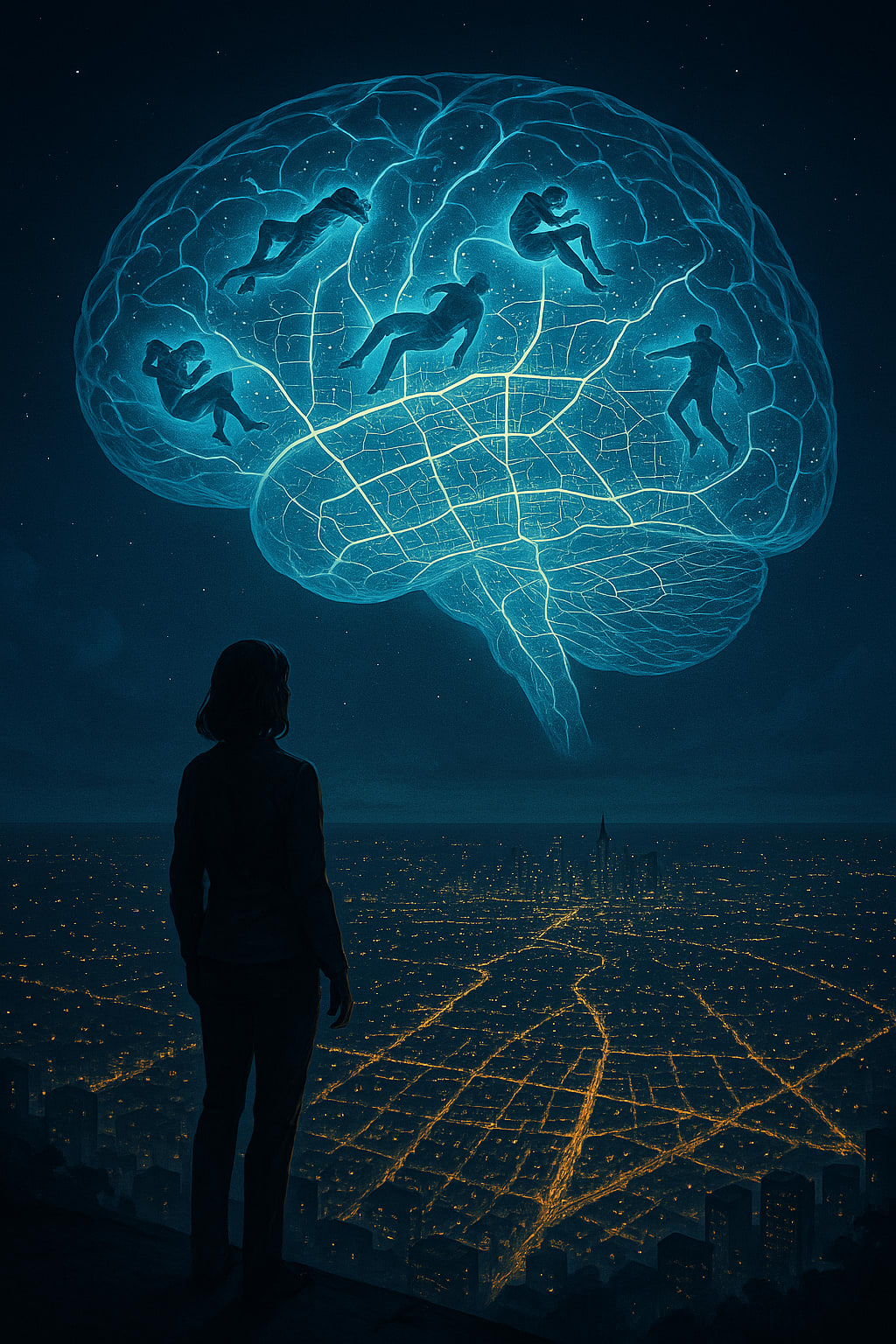
In the early days of Noctisight, most people saw it as a novelty. A high-tech dream journal. You’d sleep, and your dreams would be recorded, encrypted, and uploaded for you to view the next morning—complete with analytical summaries, symbolic interpretations, and emotion graphs. What began as a form of psychological self-care quickly transformed into a billion-dollar industry.
Soon, the Dream Network opened its doors to third parties. Marketers, artists, analysts, even governments. Why guess consumer desire when you could observe it in its rawest, most unfiltered form? Why ask what people feared, loved, or longed for when it was already there, painted across their unconscious minds?
At first, there were voluntary signups. Then there were incentives—discounts, access, dream enhancements. Finally, dream capture became a term of service. If you wanted access to society's digital infrastructure, you had to give up the privacy of your sleep.
Lina, once a lucid dreamer and now a lead algorithmic engineer at Noctisight, had helped build the cartography system that turned dreams into maps. It was her team that discovered the patterns—the recursive architecture, the neural topographies that repeated from dream to dream. A meadow of red trees meant a yearning for control. A hallway of shifting doors suggested a fear of permanence. It was beautiful in its elegance. Terrifying in its accuracy.
And yet, something had begun to bother her.
Within the code—deep in the data sets—she started seeing regions that defied classification. The system would throw errors. Blocks of unrendered space marked with placeholders: “UNTRANSLATABLE. NON-PATTERN.” At first, she dismissed them as data glitches. But they were growing in frequency, and curiously, they all originated from accounts that had one thing in common: a legacy status. Users who had been part of Noctisight before the monetization shift.
On a whim, Lina decided to explore one of these dreams manually. Using admin privileges, she dove into the dreamscape—her consciousness digitally embedded into a 3D rendering of the dream world. What she found startled her.
It was a forest. But not just any forest. The trees were shaped like spirals, and the leaves pulsed with light. Symbols danced in the sky—glyphs she couldn’t translate but felt drawn to. In the center of it all stood a structure, half temple, half engine, humming with energy. And within, a message carved into the stone floor:
“WE ARE STILL AWAKE.”
From that night on, Lina’s dreams began to change. At first subtly—a flicker of color that didn’t belong, a voice whispering in a language she didn’t know. Then more overtly. She began dreaming of the forest. Always the forest. Each time, new symbols appeared. New paths opened. She started to suspect she was being contacted.
She confronted her supervisor, Nolan, a tight-lipped man who always seemed more machine than human. “There are anomalies in the dream data,” she said. “Someone’s encrypting messages in the subconscious layer.”
Nolan’s eyes didn’t flinch. “We’re aware.”
“You knew?”
“We’ve been monitoring the phenomenon. It’s not a threat. Just noise.”
“But it’s not noise,” Lina insisted. “It’s a language. Someone is speaking through their dreams. Collaborating.”
Nolan leaned forward. “Let me be clear. Pursue this further, and you breach your NDA. You breach it, and you’ll be decommissioned from the Dream Network.”
“Meaning?”
“No more dreaming.”
It was the worst punishment imaginable. Being cut off from your own subconscious. A digital lobotomy. Most people didn’t survive the psychological collapse.
That night, Lina didn’t sleep. Instead, she scanned archived dream data for patterns. It took hours, but eventually, she found them—dreamers who had disappeared from the system. Not just inactive. Scrubbed. Deleted. But traces remained, like ghost imprints. The more she found, the more certain she became. There was an underground network. A resistance.
She contacted one of the legacy users still active—an artist named Rue, whose dreamscapes were some of the most visually chaotic in the system. They met in a shared lucid construct: a dream café, suspended over a canyon of mirrors.
Rue sipped dream-coffee, her face shifting subtly with every blink. “You’re late,” she said. “We’ve been waiting for you.”
“You’re the Dream Cartographers?” Lina asked.
“No,” Rue said, smiling. “You are.”
Rue explained: before the monetization, lucid dreamers had discovered they could manipulate the dreamspace not just for personal exploration, but to connect. The dreamscape had become a shared canvas. The more they mapped, the more resistant they became to outside control. But once Noctisight discovered the potential, it began tightening its grip—standardizing dreams, suppressing anomalies, filtering out symbolic diversity. The dreamscape was being colonized.
“But how do we fight back?” Lina asked.
“You don’t fight. You dream deeper. We encode resistance into the architecture. Symbols, stories, myths. We bury secrets in the subconscious, where algorithms can’t reach.”
It sounded poetic. But Lina knew that poetry alone wouldn’t stop the system.
In the waking world, she began inserting anomalies into the codebase—small changes that would let dreams breathe again. She built loops into the compression algorithm, allowing symbols to recombine unpredictably. She weakened the emotional classifiers, making fear indistinguishable from curiosity.
At first, Noctisight noticed nothing.
Then, the Network began to destabilize.
Dreams stopped aligning with user profiles. Advertisers panicked. Analysts reported “semantic slippage.” One user dreamed of flying over oceans of laughter, only to wake in tears. Another dreamed of endless stillness, and woke dancing.
And always, always, the forest spread.
In response, Noctisight launched an internal countermeasure: Project Glassmind. Its goal was full transparency—removing all barriers between conscious and unconscious. Every thought visible. Every dream dissected.
Lina knew what had to be done.
She went dark. Used Rue’s guidance to fully decouple her dream-self from her waking identity. She became myth within the Network—an archetype called The Mapmaker. Wherever she appeared in dreams, others followed. New rebels joined the cartographers, spreading their visions.
Eventually, Noctisight collapsed under the weight of its contradictions. You can’t monetize mystery. You can’t categorize the infinite.
In the aftermath, dreaming was reclaimed. People formed local dream collectives. They shared symbols, learned the language of their own unconscious. Not all dreams were beautiful. But they were theirs.
And somewhere, deep in the forest of spiraled trees, a temple still stands, humming softly. On its walls, new messages appear each night, etched by countless minds:
“WE ARE STILL AWAKE.”
About the Creator
Ahmet Kıvanç Demirkıran
As a technology and innovation enthusiast, I aim to bring fresh perspectives to my readers, drawing from my experience.
Keep reading
More stories from Ahmet Kıvanç Demirkıran and writers in Futurism and other communities.
The Memory Market: When You Could Buy and Sell Your Past
Imagine walking into a boutique on a quiet city street. Inside, the scent of lavender and static hums in the air. Rows of delicate glass capsules sit on velvet-lined shelves—each holding a flickering hologram: a childhood birthday party, a first kiss under the stars, a sunset from a mountain temple in Tibet. You’ve just stepped into The Memory Market, a boutique of borrowed pasts.
By Ahmet Kıvanç Demirkıran10 months ago in Futurism
About Binding Prometheus
I want to start actively advocating on behalf of my own work, and the most valuable part of my canon is, without a doubt, Binding Prometheus, the play I have been working on since 2019 and only finished in 2023 as part of my MA. The play itself is an amalgamation of a million different inspirations. On one end, it evokes the Ancient Greek myth-play, deriving its own title from the earliest extant work of Western drama we have, Aeschylus’s Prometheus Bound. On the other end, it borrows significantly from the sci-fi bulwarks from over the years, namely Mary Shelley’s Frankenstein and Karel Capek’s Rossum’s Universal Robots. The play could be an episode of Black Mirror, I fear. I don’t know. I’ve only ever seen one episode of Black Mirror.
By Steven Christopher McKnight17 days ago in Futurism



Comments (1)
Interesting!!!