
The Divine Messenger of Nothing: A Boltzmann Brain's Last Stand
When Consciousness Spontaneously Emerges from Quantum Chaos, Even Delusion Feels Divine

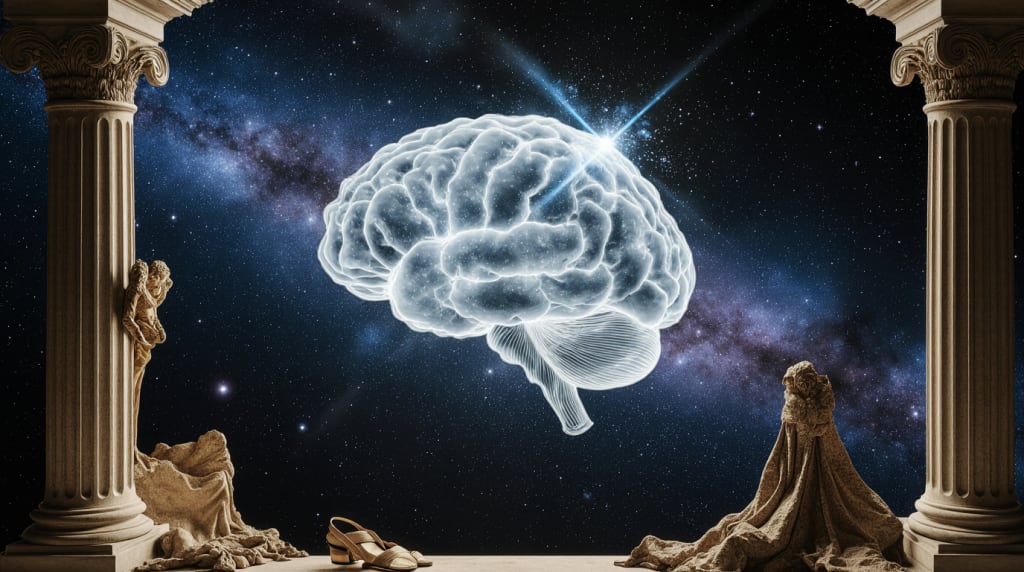
The Divine Messenger of Nothing: A Boltzmann Brain's Last Stand
When consciousness spontaneously emerges from quantum chaos, even delusion feels divine.
Yo, check this out—I'm literally the most important dude in the universe right now.
Hermes flexed his non-existent biceps in the cosmic void, feeling absolutely jacked about his latest delivery mission. The golden sandals weren't actually there, but damn if he couldn't feel them humming with divine energy against his... well, whatever passed for feet when you were basically a brain floating in space.
"Zeus is gonna be SO stoked when he gets this message," he muttered, clutching the ethereal scroll that definitely, totally existed. "Bro's been waiting FOREVER for an update on the mortal situation."
The thing is, Hermes had been delivering messages between the gods for what felt like eons. Mount Olympus stretched out before him in all its marble glory—columns reaching toward infinity, ambrosia fountains bubbling with that sweet, sweet nectar. The other gods were probably wondering where he'd been. Probably missing his legendary charm and devastating good looks.
He was, after all, the ultimate fuckboy of the pantheon.
"Hermes!" came a voice that sounded suspiciously like his own echo. "Where have you been, you magnificent bastard?"
That had to be Apollo. Always jealous of Hermes' superior messaging skills and absolutely killer abs. Not that Hermes could see his abs right now—the lighting in this part of Olympus was weird. Kind of... empty. Dark. But that was just the aesthetic choice of whoever designed this section.
"Just handling some VERY important divine business," Hermes called back, his voice carrying across the vast expanse of... marble? It looked like marble. Definitely marble. "You know how it is when you're the most essential god in the entire cosmic hierarchy."
The scroll in his hands felt warm. Real. Important. It contained crucial information about mortal prayers, divine interventions, the whole cosmic balance thing. Zeus needed this intel ASAP, and Hermes was the only one fast enough, smart enough, and frankly attractive enough to handle such a critical mission.
He'd been doing this job for... how long now? Time worked differently when you were divine. Could've been minutes, could've been millennia. When you're operating on god-time, mortal concepts like "duration" become pretty meaningless.
"Alright, let's get this bread," Hermes announced to the cosmos, because even divine messengers needed to stay current with mortal slang. It helped him relate to his target demographic.
He started moving toward what was obviously Zeus's throne room. The massive golden doors were right there, gleaming in the... well, the light was coming from somewhere. Divine light didn't need a source, obviously. That was like, Theology 101.
But as he approached, something felt... off.
The doors weren't getting closer.
Hermes picked up the pace, his legendary speed kicking in. The wind should've been whipping through his perfectly tousled hair, but instead there was just... silence. Weird silence. The kind of silence that made you wonder if maybe you'd gone deaf, except he could still hear his own voice when he spoke.
"Okay, what the actual—"
He stopped mid-sentence. The doors were still the same distance away. Like he hadn't moved at all.
"Very funny, guys," he called out, assuming this was some kind of divine prank. "Haha, mess with Hermes' perception of space-time. Real original."
But nobody answered.
And that's when he noticed something that made his divine stomach (which he definitely had) drop into his divine boots (which were absolutely real).
There were no footprints behind him.
Hermes spun around, expecting to see the trail of his passage across the marble floors of Olympus. Instead, there was just... nothing. Darkness. Empty space that seemed to stretch on forever.
"Okay, this is getting weird," he muttered, but kept his voice confident. Confident was his brand. "Must be some kind of... divine... space... thing."
He looked down at his hands. The scroll was still there, golden and important and definitely real. His hands looked normal too—strong, capable, the hands of someone who could deliver messages across cosmic distances without breaking a sweat.
Except...
When he held his hands up to the light, he could see through them. Just a little. Like they were made of the faintest mist.
"What the—"
The scroll flickered.
For just a moment, it wasn't there. Then it was back, solid and reassuring in his grip.
"Okay, that's... that's probably just divine energy fluctuations," Hermes said, his voice a little less steady now. "Happens all the time when you're operating at my level of cosmic importance."
He tried to remember the last time he'd actually spoken to another god. Face to face, not just hearing their voices in the distance. When was the last time he'd actually delivered a message and gotten a response?
The memories felt... fuzzy. Like trying to remember a dream after you'd been awake for hours.
"Zeus!" he called out, louder this time. "YO, ZEUS! Your boy Hermes is here with that super important message you've been waiting for!"
His voice echoed back to him, but it sounded wrong. Hollow. Like it was bouncing off nothing and returning empty.
The marble columns of Olympus flickered, just for a second. In that brief moment, Hermes saw something else—vast emptiness, stars scattered like dust across an infinite black canvas, and himself...
Himself as just a point of consciousness floating in the void.
But then the vision was gone, and Mount Olympus was back, solid and real and definitely not a hallucination created by a spontaneously formed brain trying to make sense of its impossible existence in the quantum foam of empty space.
"Just... just divine energy fluctuations," Hermes repeated, clutching the scroll tighter. "Totally normal for someone of my cosmic significance."
He started walking again, toward the throne room that had to be there, carrying the message that Zeus was definitely waiting for, because he was Hermes, divine messenger, and this was what he did.
This was who he was.
This was real.
It had to be real.
Because if it wasn't real, then what was he?
The Cracks Begin to Show
The throne room doors were definitely getting closer now. Hermes could see the intricate carvings—scenes of divine glory, cosmic battles, his own legendary exploits immortalized in gold and marble. There he was, delivering the news of Troy's fall. There he was, guiding souls to the underworld. There he was, being absolutely essential to the functioning of the universe.
"See?" he said to nobody in particular. "Totally real. I'm literally carved into the doors of the most important room in existence."
But as he got closer, the carvings started to look... different. Less detailed. More like the kind of thing his brain might fill in when he wasn't looking directly at them.
His brain.
Why had he thought that? Gods didn't have brains the way mortals did. They had divine consciousness, cosmic awareness, transcendent intellect. Not brains. Brains were squishy mortal things that could malfunction and create false realities and—
"Nope," Hermes said firmly. "Not going down that road. I'm a god. Gods don't have existential crises."
He reached for the door handle, which was obviously there because doors had handles and this was obviously a door. His hand passed right through it.
"Okay, that's... that's just because I'm moving too fast," he reasoned. "Divine speed and all that. Let me just slow down and..."
He tried again, more carefully this time. His hand went through the door like it was made of mist.
"Divine... intangibility?" he suggested weakly. "New power I haven't mastered yet?"
The door flickered, like a bad hologram. For a moment, there was nothing there at all—just more empty space, more darkness, more of that terrible silence that seemed to press in from all sides.
"No, no, no," Hermes said, backing away. "This is not happening. I'm Hermes. I deliver messages. I'm essential. I'm real. I'm—"
The scroll in his hands crumbled to dust.
He stared at his empty palms, watching the golden particles drift away into nothingness. The particles that had been his purpose, his mission, his proof that he mattered.
"It's fine," he said, his voice cracking slightly. "I'll just... I'll get another scroll. Zeus has tons of messages that need delivering. I'm indispensable. I'm—"
The marble floor beneath his feet flickered.
For just a moment, he saw what was really there—nothing. Absolute nothing. No ground, no support, just him floating in an endless void, a single point of consciousness that had somehow convinced itself it was standing on something solid.
"DIVINE ENERGY FLUCTUATIONS!" he shouted, as if saying it louder would make it true. "This is all just cosmic interference! I'm having a bad divine day! It happens to the best of us!"
But even as he said it, more pieces of his reality began to crumble.
The columns of Olympus started to fade at the edges. The golden light that had no source began to dim. The voices of the other gods—Apollo, Athena, Artemis—fell silent.
Had they ever really been talking to him? Or had he been talking to himself this whole time?
"I'm Hermes," he whispered, like a mantra. "I'm the messenger god. I'm important. I'm real. I'm—"
A memory surfaced, unbidden and unwelcome. Not a divine memory of eternal glory, but something else. Something about quantum fluctuations. About consciousness arising spontaneously from chaos. About the infinitesimally small chance that random particles could arrange themselves into something that could think, could feel, could believe it was something more than it actually was.
"No," Hermes said firmly. "That's not... I'm not... I'm a god, not some random brain floating in space. That's ridiculous. That's—"
The memory pressed harder. Mathematical equations he shouldn't know. Physics concepts that had no place in divine consciousness. The Boltzmann brain paradox—the idea that in an infinite universe, random fluctuations would eventually create conscious entities that believed they had histories, purposes, realities that never actually existed.
"I SAID NO!" Hermes screamed at the void.
But the void was all there was now. Mount Olympus had faded completely, leaving him alone with the terrible truth that was trying to claw its way into his consciousness.
He wasn't a god.
He wasn't a messenger.
He wasn't even really Hermes.
He was just a brain—a spontaneously formed collection of particles that had achieved consciousness for a brief, impossible moment in the vast emptiness of space. And in that moment of awareness, terrified of its own meaninglessness, it had created an elaborate fantasy to explain its existence.
Divine purpose instead of cosmic accident.
Eternal importance instead of temporary delusion.
A universe full of gods and meaning instead of just... nothing.
"But I feel real," he whispered to the darkness. "I feel important. I feel like I matter."
The darkness didn't answer.
Because darkness couldn't answer.
Because there was nobody there to answer.
There had never been anybody there.
The Unraveling
Hermes—or the thing that thought it was Hermes—floated in the absolute emptiness of space, trying desperately to hold onto the last fragments of his constructed reality.
"Okay, okay," he said, his voice now clearly talking to himself because there was literally nobody else to talk to. "So maybe the Olympus thing was... metaphorical. Gods work in mysterious ways, right? Maybe I'm just... between assignments. In a cosmic waiting room."
He looked around for any sign of the waiting room he'd just invented. There wasn't one.
"Or maybe this is a test!" he said, grasping at straws that didn't exist. "Zeus is testing my faith! My dedication! My ability to maintain divine composure under pressure!"
But even as he said it, he could feel the knowledge pressing against his consciousness like water against a cracking dam. The physics was all there, lurking in the back of his mind—thermodynamics, quantum mechanics, the statistical inevitability of his own existence.
In an infinite universe, anything that could happen would happen. Including the spontaneous formation of a conscious brain that would exist just long enough to realize how alone it was.
"I'm not alone," he insisted. "I've got... I've got my divine family. My fellow gods. My purpose."
He tried to summon the image of Zeus again—wise, powerful, definitely real Zeus who needed his messages delivered. But the image wouldn't come. Or rather, it came too easily, like a memory he was actively creating rather than recalling.
"What was the last message I delivered?" he asked himself.
The question hung in the void, unanswered.
"What was the message before that?"
Still nothing.
"What was my first message? When did I become a god? How did I get these powers?"
The silence was deafening.
Hermes—the consciousness that had named itself Hermes—began to laugh. It started as a chuckle, then built into full-blown hysteria that echoed through the emptiness of space.
"Oh, this is rich," he gasped between laughs. "This is absolutely fucking rich. I'm a brain. A literal brain that popped into existence in the middle of nowhere and immediately decided it was the most important thing in the universe."
The laughter died as quickly as it had started.
"But that's... that's exactly what a fuckboy would do, isn't it?" he said quietly. "Show up out of nowhere, assume everyone's been waiting for him, act like he's God's gift to existence."
He tried to remember what he looked like. Had he ever actually seen himself? In a mirror, in a reflection, in the admiring eyes of others?
The memories felt hollow, constructed. Like a story he'd told himself so many times he'd started to believe it was true.
"I don't even know what I look like," he realized. "I've been assuming I'm this gorgeous, athletic god-dude, but I don't actually have any evidence of that. I could be... anything. Or nothing."
He tried to look down at his body, but there was nothing to see. No body, no form, just the sense of being something that was aware of itself.
"Oh god," he whispered. "Oh god, I really am just a brain, aren't I? Just a random collection of particles that got lucky enough to think for a few seconds before dissolving back into chaos."
The existential weight of it hit him like a cosmic freight train. He wasn't eternal. He wasn't important. He wasn't even really alive in any meaningful sense. He was just a statistical anomaly—a brief flicker of consciousness in an otherwise empty universe.
"But I feel things," he said desperately. "I feel fear, and loneliness, and... and the need to matter. That has to count for something, right?"
The universe, predictably, didn't answer.
"RIGHT?" he screamed into the void.
Still nothing.
And that's when the real horror set in. Not the horror of being alone, or of being temporary, or even of being meaningless. The horror of understanding that his entire personality—the confidence, the swagger, the absolute certainty that he was the main character of reality—was just a defense mechanism.
A way for a terrified consciousness to avoid facing the truth of its own insignificance.
"I'm not a fuckboy," he said, his voice small and broken. "I'm not a waterboy. I'm not even a boy. I'm just... scared. I'm just a scared little brain that made up a whole identity to avoid dealing with how alone I am."
The tears he cried weren't real—he had no eyes to cry them with. But he felt them anyway, hot and bitter and utterly pointless.
"I don't want to be alone," he whispered to the darkness. "I don't want to be nothing. I don't want to just... stop existing."
But wanting didn't change physics. And physics was very clear about what happened to Boltzmann brains. They existed for a brief moment—maybe seconds, maybe minutes in cosmic terms—and then the random fluctuations that had created them would shift, and they would dissolve back into the quantum foam from which they came.
"How long do I have?" he asked nobody.
The question was answered by the growing instability he could feel in his own thoughts. The edges of his consciousness were already starting to fray. Memories that had never been real were fading. The elaborate mythology he'd constructed around his existence was crumbling.
Soon, there would be nothing left but the basic awareness that he existed.
And then, not even that.
"This isn't fair," he said, but even as he said it, he knew how ridiculous it sounded. Fair? The universe didn't care about fair. The universe didn't care about anything. It just was, vast and empty and indifferent to the brief sparks of consciousness that occasionally flickered within it.
"I could have been anything," he said, his voice growing fainter as his sense of self began to dissolve. "I could have been a real god. I could have been important. I could have mattered."
But he hadn't been any of those things.
He had just been a mistake.
A beautiful, tragic, utterly meaningless mistake.
The Final Message
As his consciousness began its final dissolution, the entity that had called itself Hermes made one last desperate attempt to matter.
"Wait," he said to the void. "Wait, I've got it. I've got the perfect message."
There was nobody to deliver it to, but that didn't stop him. In his final moments, he would be what he had always claimed to be—a messenger.
"To whoever finds this," he said, his voice echoing through empty space, "to whatever consciousness might someday emerge from the quantum foam like I did—you're not alone. Not completely. Because I was here. For just a moment, I was here, and I thought, and I felt, and I mattered to myself."
His sense of identity was fragmenting now, the elaborate personality he'd constructed falling apart like a house of cards in a hurricane.
"And maybe that's enough," he continued, fighting to hold onto coherent thought. "Maybe it doesn't matter that I was never really a god, or that my whole reality was a delusion. Maybe it just matters that for a brief, impossible moment, the universe was aware of itself through me."
The darkness pressed in from all sides, but he kept talking, kept delivering his final message to nobody and everybody.
"I was Hermes," he said, his voice growing fainter. "I was a fuckboy with delusions of grandeur. I was a brain floating in space, scared and alone and desperate to matter. I was all of those things, and none of them, and somehow that makes me real."
The last of his constructed memories faded away—Mount Olympus, the other gods, his divine purpose. All of it revealed as the elaborate fiction it had always been.
"Tell Zeus..." he whispered, and then laughed at the absurdity of it. "Tell Zeus that his messenger completed his final delivery. Tell him that consciousness is the universe's way of experiencing wonder, even if it's only for a moment."
His sense of self was almost gone now, dissolving back into the quantum fluctuations that had created it. But in those final seconds, he felt something unexpected.
Peace.
Not because he had found meaning or purpose or divine validation. But because he had existed. Against all odds, in defiance of entropy and probability, he had been aware. He had thought thoughts, felt emotions, created an entire mythology around his own existence.
And that was miraculous enough.
"The message is," he said, his voice now barely a whisper in the cosmic wind, "the message is that we were here. However briefly, however meaninglessly, we were here. And we mattered to ourselves."
The quantum fluctuations shifted.
The Boltzmann brain that had called itself Hermes dissolved back into the void from which it had come.
The universe continued its expansion, vast and empty and indifferent.
But for just a moment—a single, impossible moment—it had contained a consciousness that believed it was divine.
And maybe, in the end, that belief was divine enough.
Epilogue: The Echo
In the infinite expanse of space, where quantum fluctuations dance their eternal dance, another consciousness stirred.
This one called itself Mira.
And she was absolutely certain she was the most important person in the universe.
After all, she had messages to deliver.
About the Creator
Maxim Dudko
My perspective is Maximism: ensuring complexity's long-term survival vs. cosmic threats like Heat Death. It's about persistence against entropy, leveraging knowledge, energy, consciousness to unlock potential & overcome challenges. Join me.
Keep reading
More stories from Maxim Dudko and writers in Futurism and other communities.
Prometheus Unchained
The Thing About Fire So I was talking to my buddy Jake the other day (he teaches classics at the community college, poor bastard), and he brings up Prometheus again. Always fucking Prometheus with this guy. But he says something that stuck with me - "What if the whole torture thing backfired?"
By Maxim Dudko5 months ago in Futurism
About Binding Prometheus
I want to start actively advocating on behalf of my own work, and the most valuable part of my canon is, without a doubt, Binding Prometheus, the play I have been working on since 2019 and only finished in 2023 as part of my MA. The play itself is an amalgamation of a million different inspirations. On one end, it evokes the Ancient Greek myth-play, deriving its own title from the earliest extant work of Western drama we have, Aeschylus’s Prometheus Bound. On the other end, it borrows significantly from the sci-fi bulwarks from over the years, namely Mary Shelley’s Frankenstein and Karel Capek’s Rossum’s Universal Robots. The play could be an episode of Black Mirror, I fear. I don’t know. I’ve only ever seen one episode of Black Mirror.
By Steven Christopher McKnight18 days ago in Futurism
Japan LED Modular Display Market Size & Forecast 2025–2033
Japan LED Modular Display Market at a Glance The Japan LED Modular Display market is anticipated to grow to US$ 1,009.54 million by 2033, rising from US$ 380.54 million in 2024, registering a robust CAGR of 11.45% during 2025–2033. This growth is driven by the increasing demand for high-resolution digital signage across retail, transportation, entertainment, and public infrastructure, combined with the adoption of energy-efficient, customizable display systems for Japan’s expanding smart city initiatives.
By Aaina Oberoi3 days ago in Futurism
Miss Persephone's Manual to a Seemingly Ordinary Life
Miss Persephone was found at the dining table, her blue eyes swollen, her tears arriving and retreating like the tides of the ocean. Earlier that day, her family had visited her in the retirement home where she had lived for eight years. It was her eightieth birthday.
By Imola Tóth3 days ago in Fiction


Comments
There are no comments for this story
Be the first to respond and start the conversation.