
The Digital Evolution: Are Smartphones Reshaping Our Skeletons?
Unraveling the Controversial Link Between Modern Technology and Human Anatomy


In an era dominated by digital devices, a startling question has emerged: Could our beloved smartphones be powerful enough to alter the very structure of our bones? This intriguing topic has recently captured the attention of media outlets worldwide, stemming from a scientific report that suggests our constant interaction with phones and tablets might be inducing significant and lasting changes to our physical anatomy - in ways we never anticipated.
At the heart of this research are David Shahar and Mark Sayers, biomechanics specialists from the University of the Sunshine Coast in Australia. Their groundbreaking study delves into the fascinating field of biomechanics, a discipline that applies mechanical principles to living organisms, exploring everything from human locomotion to insect flight patterns. The researchers have also incorporated elements of osteobiography - a technique used to decipher an individual's lifestyle from their skeletal remains.
It's long been established that our skeletons are not static structures but rather adaptive frameworks that respond to our lifestyle choices. Each set of bones tells a unique story of its owner's life experiences. A historical example of this adaptability was discovered in 1924 on the Pacific island of Tinian, where unusually large skeletons were unearthed. The presence of massive stone structures in the vicinity provided a logical explanation for the islanders' robust bone development - their daily work with heavy stones had naturally led to enlarged arms, legs, and collarbones.
Drawing parallels to this historical evidence, Shahar and Sayers posit that modern technology might be leaving its mark on the skeletons of today's youth. Their research focuses on a particular anatomical feature known as the external occipital protuberance (EOP), colloquially dubbed by some as a "phone bone" or even a "devil's horn." In reality, the EOP is a bony growth located at the base of the skull, serving as an anchor point for the nuchal ligament - a crucial connective tissue linking neck muscles to the skull.
To investigate their hypothesis, the researchers analyzed X-rays of individuals aged 18 to 86, sourced from chiropractic clinics. Their goal was to gain fresh insights into skeletal changes and potential health implications. What they discovered was striking: young people seemed to exhibit a more pronounced EOP compared to their older counterparts.
Shahar and Sayers theorize that this increased prevalence of enlarged EOPs in younger individuals could be attributed to poor posture during prolonged screen time. When we use our smartphones or tablets, we tend to crane our necks forward, placing additional stress on the area where the skull meets the neck muscles. To compensate for this strain, the body may respond by gradually elongating the EOP, sometimes extending it by several millimeters. This phenomenon has been dubbed "text neck" in popular discourse.
Interestingly, the study revealed a significant gender disparity in the occurrence of enlarged EOPs. In their 2016 report, based on a sample of 218 individuals, Shahar and Sayers found that 67% of men exhibited larger EOPs compared to only 20% of women. By 2018, after expanding their research to include 1,200 participants, they concluded that males were five times more likely to develop these pronounced "text necks."
The potential implications of these findings are profound and raise questions about the long-term impact of technology on human physiology. While concerns about phone radiation and its possible links to cancer have long been debated, this study represents one of the first instances where experts have explicitly highlighted how our devices might be reshaping our physical bodies.
Shahar and Sayers describe the elongation of EOPs as a "degenerative process," suggesting that the situation may worsen for younger generations if current device usage patterns persist. They also draw attention to other technology-related physical ailments, such as "text thumb" or thumb arthritis, which can lead to complications similar to carpal tunnel syndrome.
However, it's crucial to note that this research has not been without its critics. Some experts in the field argue that the study's conclusions are not definitive and that, like any scientific paper, it relies on certain assumptions. Archaeologists point out that elongated skull bones are not a new phenomenon and have been particularly common in males throughout history. Skeptics contend that there simply isn't enough concrete evidence to support the claim that our cell phone usage is transforming us into horn-bearing creatures.
Regardless of where one stands on the validity of Shahar and Sayers' findings, there's no denying the profound impact that technology has on our daily lives. The notion that upcoming generations might be physically changing due to their constant interaction with digital devices is a serious issue that warrants further investigation and discussion.
Ultimately, it may be the archaeologists and anthropologists of the future who will make the final determination on how our digital age has shaped human evolution. Perhaps they'll uncover skeletons with pronounced bony protrusions at the base of the skull, serving as a lasting testament to our era's obsession with handheld technology.
As we grapple with these thought-provoking possibilities, it might be wise to consider a more balanced approach to our daily routines. While completely abandoning our beloved devices is unrealistic in today's interconnected world, perhaps incorporating more physical activity and mindful posture practices could help mitigate potential negative effects.
In conclusion, whether or not we're on the verge of developing "phone bones," this research serves as a poignant reminder of technology's pervasive influence on our lives. As we continue to push the boundaries of innovation, it's crucial that we remain aware of how these advancements might be reshaping not just our world, but our very bodies. The next time you find yourself hunched over your smartphone, remember - you might be participating in the next chapter of human evolution. So why not take a break, stretch your neck, and ponder the fascinating interplay between biology and technology that defines our modern existence?
About the Creator
Daisy Kebaso
Hi there! I'm Daisy Kebaso, a passionate storyteller. I recently joined Vocal Media to share my love for crafting engaging stories with a broader audience. Join me on this exciting journey as I explore the magic of storytelling.
Keep reading
More stories from Daisy Kebaso and writers in Futurism and other communities.
Celestial Kisses: When Stars Lock Lips in the Cosmic Ballet
In the vast expanse of our universe, a cosmic drama unfolds that rivals the most passionate love stories ever told. Recent astronomical discoveries have revealed that stars, those twinkling beacons of the night sky, lead lives far more complex and intriguing than we ever imagined. From intimate stellar embraces to vampiric relationships, the cosmos is teeming with celestial spectacles that challenge our understanding of the universe.
By Daisy Kebaso2 years ago in Futurism
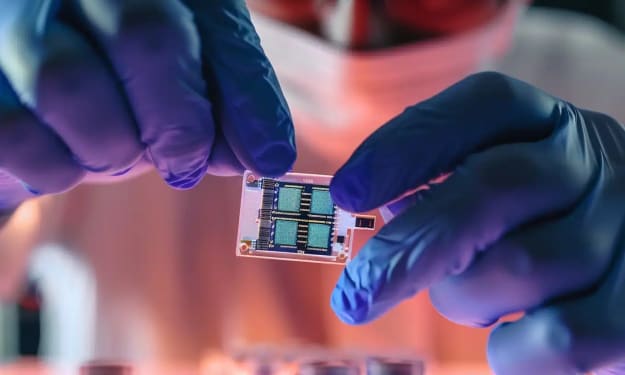
Biochips Market Outlook: Precision Diagnostics Innovation and Biotechnology Growth Opportunities
According to IMARC Group's latest research publication, The global biochips market size reached USD 22.3 Billion in 2024. Looking forward, IMARC Group expects the market to reach USD 76.0 Billion by 2033, exhibiting a growth rate (CAGR) of 13.02% during 2025-2033
By James Whitman5 days ago in Futurism



Comments
There are no comments for this story
Be the first to respond and start the conversation.