
The Darkest Renewable Energy
Can Mini black holes be used as gravity drives?


A black hole is a place in space where gravity pulls so much that even light can not get out. The gravity is so strong because matter has been squeezed into a tiny space. This can happen when a star is dying. NASA.gov
Standing at the fuel pump at your nearest Gas station, you might not predict a point in time where you pick up the nozzle labelled "Black Holes". We are still in the infancy of understanding Black Holes and their place in the Universe, but could we eventually find a way to harness them, in order to create a form of renewable energy?
As NASA suggests, the singularity within a Black Hole contains an unfathomable amount of gravitational force, meaning we are unlikely to be throwing a lasso around one to get about space any time soon.
But what if we were able to harness the power of miniature Black Holes, to create enough force to drive our cars; using gravitational batteries?
Gravitational Batteries aren't a new concept
According to BBC, a company in Edinburgh, in the UK was the first to work on a patent for batteries which produce power using gravity.
Gravitricity - generating electricity from gravity - is getting noticed by investors, as an effective alternative to large batteries, so that renewable energy supply can be stored until there is demand. No need to go to the Congolese jungle to get hold of the raw materials for batteries.
All you need is a lot of concrete, some very strong cables, and winding gear.
The issue with any concept involving renewable energy is in scale. If you're able to generate any power using natural forces, it's an excellent start, but for the world to adopt the idea, it needs to be immensely scalable, which is why wind and solar energies have become increasingly popular over the years.
Mini Black Holes may be the answer
Suspended in space and considered, by many, to be the graveyard of the Universe, Black Holes have grown a bad name for themselves. Everyone who pictures a Black Hole considers the point of no return, at which we "spaghettify" and get pulled into the centre, never to be seen again.
An annihilation of planets and stars alike, black holes are where every particle in the known universe goes to die. But, let's put a little spin on the mysterious objects and look at how they might be more friendly than we might think.
If you picture one black hole in space, you would think about how the forces of gravity "pull" all particles within its event horizon towards its singularity.
What, then, would happen if you were to picture two black holes, in the same space, with the identical mass? Presuming the gravitational forces from each singularity was identical, perhaps the two black holes would remain in perpetual motion, orbiting one another.
You'd therefore assume that the force of gravity on the particles between the black holes would either remain motionless, or, hopefully, would move between the black holes in the same perpetual motion as the black holes themselves.
If you could create two black holes and keep them in this motion, you would therefore have an eternal source of energy.
Growing a Mini Black Hole
Are you holding onto your Phone whilst reading this? Or are you scrolling through the page with your Mouse? Whichever of those objects you're holding, you can, theoretically, create a black hole with.
If you were able to continuously fold any object enough, it would become so small and so energy dense, that even light couldn't escape it, therefore creating a black hole.
Unfortunately, the density you would need to create a black hole is unfathomably high. In fact, according to theconversation.com, the matter density would need to be 2x10¹⁹, which is more dense than an atomic nucleus.
Effectively, unless you had some super folding strength, you'd never condense an every day object down enough for it to be dense enough to create a black hole.
If you're interested in some more real world examples of growing your own black hole, check out this video by Dr Becky Smethurst
About the Creator
Ben Parry
Creator and Blogger.
Fuelled by Espresso
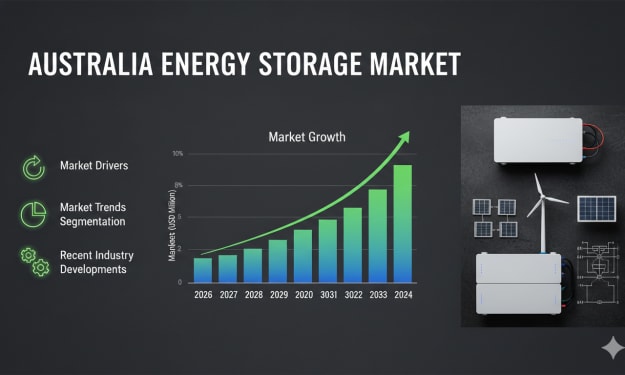
Australia Energy Storage Market: Renewable Integration, Battery Deployment & Grid Stability
According to IMARC Group, the Australia energy storage market reached 4.72 GW in 2025 and is projected to expand significantly to 19.81 GW by 2034, exhibiting a compound annual growth rate (CAGR) of 17.28% during 2026–2034. The rapid growth of the sector reflects the country’s accelerating transition toward renewable energy and the increasing need for reliable electricity systems across Australia. As solar and wind power generation expands, energy storage technologies such as battery energy storage systems (BESS) are becoming essential for maintaining grid reliability and balancing electricity supply and demand. Government policies supporting clean energy adoption, declining battery costs, and investments in grid modernization are significantly strengthening Australia energy storage market share while enabling the integration of renewable power into the national electricity network.
By Shrestha Roy2 days ago in Futurism
Cooking Oil Market: AI-Driven Innovation Transforming Global Edible Oil Demand
AI Overview of the Cooking Oil Market The cooking oil market includes a wide range of edible oils derived from plant and seed sources such as soybean, palm, sunflower, olive, coconut, and canola. These oils are essential ingredients in households, restaurants, food processing industries, and the HoReCa (Hotel, Restaurant, and Catering) sector.
By James Smith4 days ago in Futurism
Review of 'Man on the Run'
My wife and I saw Man on the Run, a nearly 2-hour documentary on Amazon Prime, about Wings, Paul McCartney's group that flew around the world from shortly after The Beatles broke up in early 1970 to shortly after John Lennon was murdered at the end of 1980, making a Beatles reunion forever impossible.
By Paul Levinson6 days ago in Beat



Comments
There are no comments for this story
Be the first to respond and start the conversation.