
The Butterfly Effect of Civilization: How a Few Key Moments Led Us Into a World of Greed and Consumerism
A Look at the Choices and Consequences that Defined Civilization

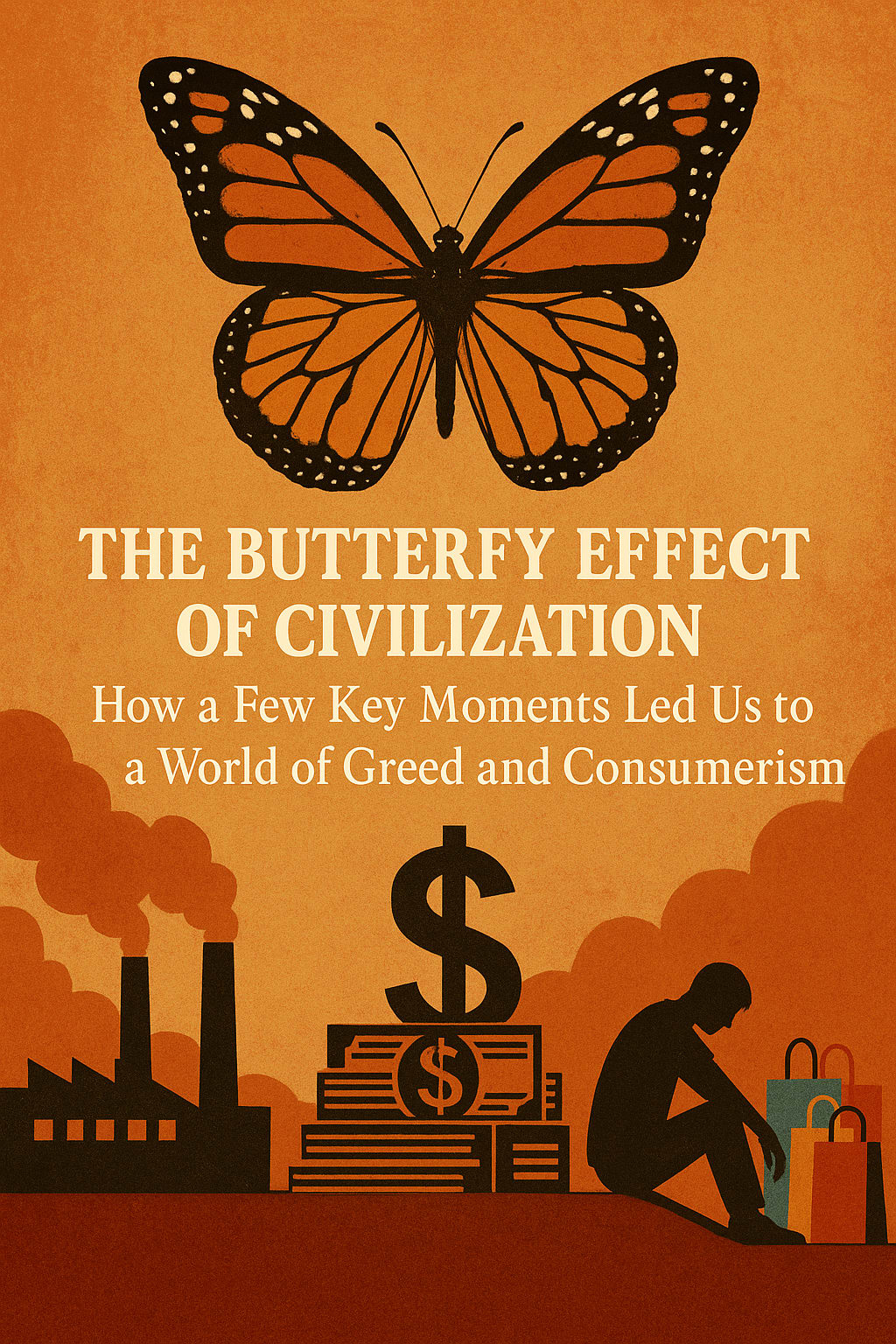
It’s easy to look at the modern world and feel a sense of disconnection, overwhelm, or even quiet despair. We live in a society that often feels driven by greed, dulled by sloth, and consumed by… well, consumption.
But how did we get here?
If you zoom out far enough, history begins to look like a series of pivotal moments—small decisions, inventions, or shifts in thinking—that snowballed into the world we now live in. Like butterfly wings stirring storms across time, these moments reshaped how we relate to nature, to each other, and to ourselves.
Below are some of the key turning points that brought humanity to this moment of hyper-consumption, inequality, and ecological crisis.
1. The Agricultural Revolution (~10,000 BCE)
What happened: Humans transitioned from hunting and gathering to farming.
Why it matters:
- Introduced the concept of private property, surplus, and hierarchy.
- Enabled cities, organized states, and deep inequality.
- Set us on a path of controlling nature instead of coexisting with it.
The butterfly effect: Greed began as a survival instinct, but quickly became structural.
2. The Industrial Revolution (1760s–1800s)
What happened: Machines and fossil fuels replaced human and animal labor.
Why it matters:
- Fueled urbanization, mass production, and relentless resource extraction.
- Progress became defined by speed and scale, not harmony.
- Alienated humans from nature and their own labor.
The butterfly effect: We traded community and craft for convenience and capital.
3. The Invention of Plastic (Early 1900s)
What happened: A synthetic, durable, cheap material changed everything.
Why it matters:
- Ushered in a culture of disposability.
- Plastic now pollutes nearly every ecosystem—and our own bodies.
- Convenience eclipsed long-term consequence.
The butterfly effect: A single invention amplified both greed (mass production) and sloth (throwaway habits).
4. Post-WWII Consumer Capitalism (1950s–Present)
What happened: Societies began defining success through consumption.
Why it matters:
- Advertising shifted identity from being to buying.
- Planned obsolescence became standard business practice.
- Citizens became consumers; happiness became a product.
The butterfly effect: The more we bought, the less satisfied we felt.
5. The Internet & the Attention Economy (1990s–Now)
What happened: Human attention became the most valuable commodity.
Why it matters:
- Algorithms manipulate desire and emotion to maximize engagement.
- Content is endless, but meaning is often absent.
- Truth became optional; stimulation became constant.
The butterfly effect: We started consuming not just products—but ourselves.
6. Neoliberal Globalization (1980s–Now)
What happened: Deregulated markets and global trade reshaped the world.
Why it matters:
- Corporate power exploded while environmental safeguards weakened.
- “Growth” became gospel—even at the cost of human and planetary health.
- Inequality reached new extremes.
The butterfly effect: Greed became systemic. Sloth became resignation.
What Could Have Been?
Imagine if, at any of these forks in history, we’d chosen differently:
- Economies based on enough, not more.
- Technology aligned with wisdom and wellbeing.
- Cultures rooted in stewardship, not extraction.
What kind of world would we have now?
Final Thought
The 7 deadly sins aren’t just moral warnings—they’re psychological patterns. Scaled across billions, they shape civilizations. But every system we built was invented—and what’s invented can be reinvented.
If this sparked something in you, share it. Conversations like this might be the first cracks in the consumerist spell we’re all under. And if this reflection resonated with you, please leave a heart, share it, or tip if you feel inspired. Every voice counts—and your support helps keep these ideas alive.
About the Creator
Corey
Curious thinker, observer of the human condition.
Agentic AI Workflows Market worth USD 227 Billion By 2034
Agentic AI Workflows Market Overview The Global Agentic AI Workflows Market is projected to reach approximately USD 227 Billion by 2034, increasing from USD 5.2 Billion in 2024, reflecting a strong CAGR of 45.8% during the forecast period from 2025 to 2034.
By Roberto Crum3 days ago in Futurism
Australia IoT Sensors Market: Industrial IoT Adoption, 5G Connectivity & Smart Automation
According to IMARC Group, the Australia IoT sensors market reached a value of USD 708.1 Million in 2025 and is projected to reach USD 12,853.9 Million by 2034, growing at a compound annual growth rate (CAGR) of 38.00% during 2026–2034. The market is witnessing remarkable growth as businesses increasingly adopt connected technologies to enhance operational efficiency and data-driven decision-making. IoT sensors play a crucial role in collecting real-time data across industrial equipment, infrastructure systems and consumer devices. Rapid advancements in sensor technology have improved performance while reducing manufacturing costs, enabling broader deployment across industries. Additionally, the expansion of 5G networks across Australia is strengthening IoT connectivity by enabling faster data transmission and lower latency.
By Shrestha Roy5 days ago in Futurism



Comments
There are no comments for this story
Be the first to respond and start the conversation.