
Agentic AI Workflows Market worth USD 227 Billion By 2034
Rising adoption of autonomous AI agents for task automation, decision-making, and workflow optimization is driving market growth.

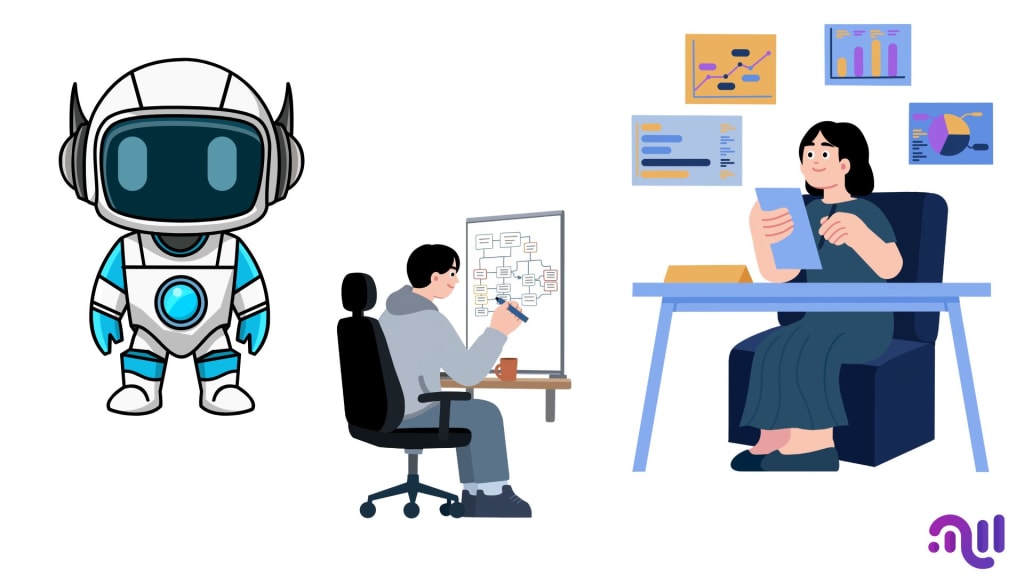
Agentic AI Workflows Market Overview
The Global Agentic AI Workflows Market is projected to reach approximately USD 227 Billion by 2034, increasing from USD 5.2 Billion in 2024, reflecting a strong CAGR of 45.8% during the forecast period from 2025 to 2034.
The rapid growth of this market is driven by the rising adoption of autonomous AI systems capable of managing complex business workflows, increasing demand for enterprise automation, and the expansion of generative AI technologies across industries. Agentic AI workflows enable intelligent software agents to perform tasks, make decisions, and coordinate multi-step processes with minimal human intervention.
Explore Detailed 2025-2035 Market Report Forecasts Today
In 2024, North America accounted for more than 32.8% of the global market, generating approximately USD 1.7 Billion in revenue. The region’s leadership is supported by strong investments in artificial intelligence infrastructure, widespread enterprise adoption of AI automation platforms, and the presence of advanced technology ecosystems. Businesses across the United States and Canada are increasingly deploying AI agents to automate internal processes such as customer service operations, IT management, and enterprise resource planning workflows.
How Agentic AI Workflows are Transforming Enterprise Automation?
Agentic AI workflows are transforming enterprise automation by enabling intelligent software agents to manage tasks independently across multiple systems. Traditional automation systems relied on predefined rules and manual programming to execute repetitive processes. In contrast, agentic AI systems can analyze contextual information, plan actions, and adapt workflows dynamically to changing conditions.
Another transformation involves the ability of AI agents to collaborate across digital platforms. Agentic AI workflows allow multiple AI agents to coordinate activities, share information, and execute complex tasks across enterprise systems. This capability improves operational efficiency and allows organizations to automate sophisticated processes such as supply chain management, financial reporting, and customer support operations.
Scope and Research Methodology
The scope of the agentic AI workflows market includes AI orchestration platforms, autonomous workflow automation software, intelligent digital agents, and enterprise process management systems integrated with artificial intelligence capabilities. These technologies are widely used across industries including finance, healthcare, technology, manufacturing, and telecommunications.
Research methodology typically combines primary insights from AI engineers, enterprise software developers, and digital transformation specialists alongside secondary information from technology reports, enterprise automation studies, and digital workflow analytics. Analytical frameworks evaluate adoption trends in AI-driven automation and enterprise productivity technologies.
Key Forces Driving Market Expansion
One of the strongest forces driving the growth of the agentic AI workflows market is the increasing demand for enterprise process automation. Organizations are seeking technologies that reduce manual workloads and improve operational efficiency across business departments.
Another major factor supporting market expansion is the rapid advancement of generative AI models capable of performing reasoning and task planning. These technologies allow AI agents to understand business objectives, interpret data inputs, and execute multi-step processes automatically.
Emerging Trends Analysis
One emerging trend in the agentic AI workflows market is the integration of AI orchestration platforms with enterprise software ecosystems. These platforms allow organizations to coordinate multiple AI agents that perform tasks across customer relationship management systems, finance platforms, and supply chain applications.
Another trend involves the growing use of autonomous AI assistants within workplace environments. Digital agents are increasingly being deployed to manage scheduling tasks, generate reports, analyze business data, and support decision-making processes.
Driver Analysis
A major driver of the agentic AI workflows market is the increasing complexity of modern business operations. Organizations often manage large volumes of data and complex operational workflows across multiple systems. AI agents can analyze these processes and automate tasks more efficiently than traditional software tools.
Another key driver is the rising adoption of cloud-based enterprise platforms. Cloud infrastructure provides scalable environments where AI agents can access data, execute workflows, and interact with multiple enterprise applications simultaneously.
Restraint Analysis
Despite strong growth potential, certain factors may limit the expansion of the agentic AI workflows market. One major restraint involves concerns related to data security and privacy when AI systems manage sensitive enterprise information.
Another limitation involves the complexity of integrating AI agents with existing enterprise software infrastructure. Many organizations operate legacy systems that require significant upgrades before advanced AI automation platforms can be implemented effectively.
Opportunity Analysis
Significant opportunities are emerging from the expansion of AI-driven enterprise productivity tools. Organizations are increasingly exploring AI agents capable of automating administrative tasks, managing documentation workflows, and improving internal communication processes.
Another opportunity lies in the integration of agentic AI systems within industry-specific digital platforms. For example, healthcare organizations can use AI agents to automate patient record management, while financial institutions can deploy AI agents for fraud detection and regulatory compliance monitoring.
Challenge Analysis
One of the key challenges facing the agentic AI workflows market is ensuring transparency and accountability in AI-driven decision-making processes. Organizations must ensure that AI agents operate according to defined policies and ethical guidelines.
Another challenge involves managing system reliability and monitoring the performance of autonomous AI agents. Businesses must implement governance frameworks to oversee AI operations and prevent unexpected workflow errors.
Top Use Cases
Agentic AI workflows are widely used in enterprise process automation, where intelligent agents manage repetitive business tasks such as document processing, report generation, and workflow coordination.
Another important use case appears in customer service automation and digital support platforms. AI agents handle customer inquiries, process service requests, and provide automated responses across digital communication channels.
Conclusion
The Agentic AI Workflows Market is experiencing rapid expansion as organizations increasingly adopt autonomous AI systems to streamline business operations. AI agents enable enterprises to automate complex workflows, reduce operational costs, and improve productivity across multiple departments.
Looking ahead, continued advancements in generative AI models, enterprise automation platforms, and cloud-based infrastructure are expected to strengthen the capabilities of agentic AI workflow systems. Although challenges related to system integration and governance remain, the long-term outlook for this market remains highly positive as businesses continue investing in intelligent automation technologies.
About the Creator
Roberto Crum
I am blogger, digital marketing pro since 4.5 years and writes for Market.us. Computer Engineer by profession. I love to find new ideas that improve websites' SEO. He enjoys sharing knowledge and information about many topics.
Keep reading
More stories from Roberto Crum and writers in Futurism and other communities.
AI in CAD Market to hit USD 6.7 Billion by 2033
AI in CAD Market Overview The Global AI in CAD Market is projected to reach approximately USD 12.6 Billion by 2033, increasing from USD 2.3 Billion in 2023, reflecting a CAGR of 18.5% during the forecast period from 2024 to 2033. The market expansion is driven by the growing adoption of artificial intelligence within design and engineering workflows, increasing demand for automated design processes, and the rising complexity of product development across industries.
By Roberto Crumabout 8 hours ago in Futurism
The Interactive Shift: Exploring the Future of Storytelling in Digital Age
For centuries, storytelling was a one-way street. We sat around campfires, listened to bards, turned the pages of novels, and watched silver screens. In these scenarios, the creator was the architect, and we—the audience—were the passive observers. We cried for characters we couldn't warn and cheered for heroes we couldn't help. But we are currently standing at a massive crossroads in cultural history.
By Muhammad Owais SEOa day ago in Futurism
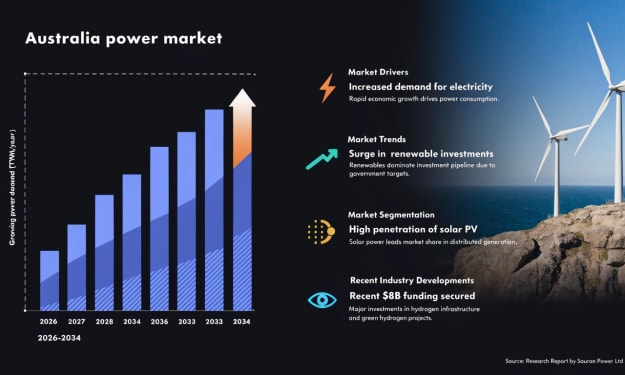
Australia Power Market: Renewable Energy Expansion, Grid Modernization & Electricity Demand Growth
According to IMARC Group, the Australia power market reached 285.7 TWh in 2025 and is projected to reach 377.0 TWh by 2034, growing at a compound annual growth rate (CAGR) of 3.04% during 2026–2034. The market’s growth is being shaped by accelerating renewable energy adoption, increasing electricity demand and large-scale investments in grid modernization. Government incentives supporting clean energy transition, combined with rising corporate sustainability commitments, are encouraging the expansion of solar, wind and battery storage infrastructure. At the same time, the gradual phase-out of coal-fired power plants is transforming the structure of Australia’s electricity generation mix. With emerging technologies such as hydrogen energy systems and virtual power plants gaining traction, Australia’s power sector is evolving into a more diversified, digitally integrated and sustainable energy ecosystem.
By Kevin Cooper5 days ago in Futurism



Comments
There are no comments for this story
Be the first to respond and start the conversation.