
The Biggest Explosion Since the Big Bang: Astronomers Uncover Traces of a Cosmic Cataclysm
Space

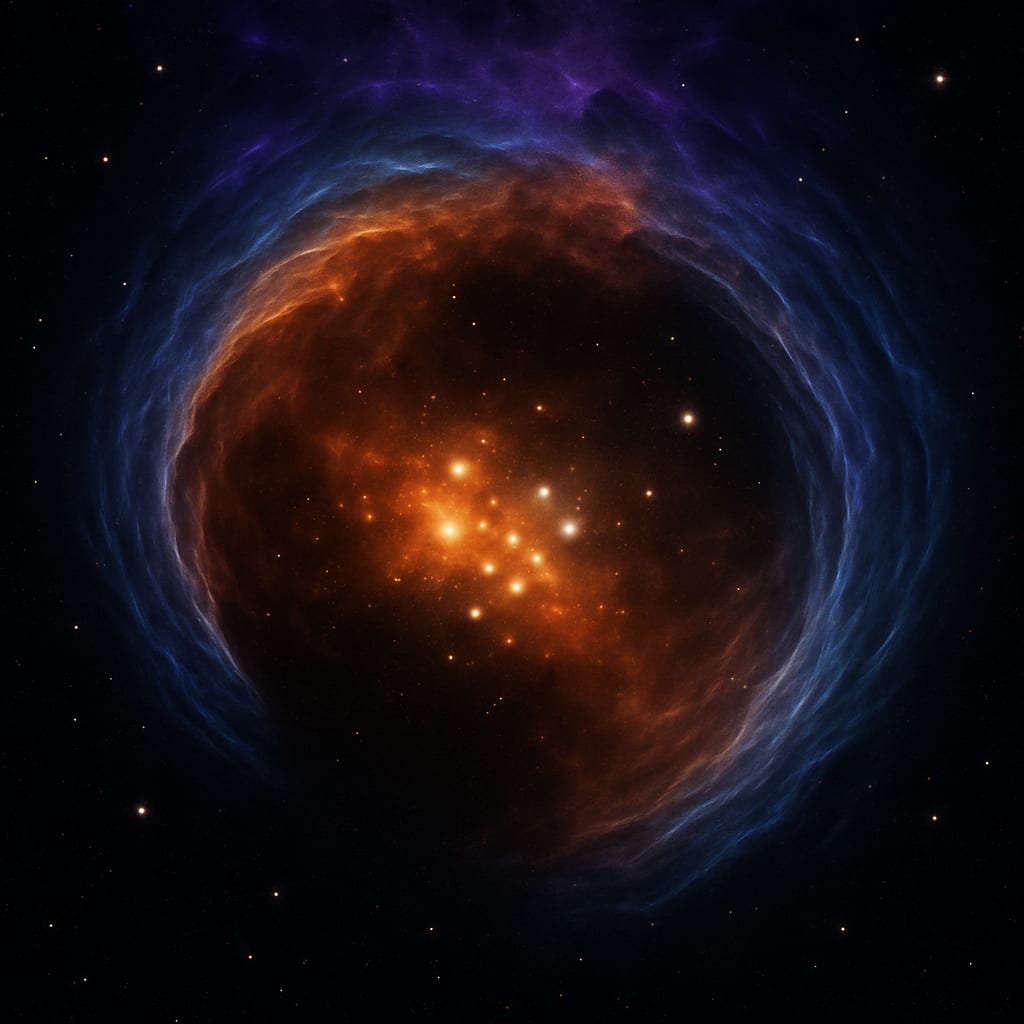
The universe has always been full of surprises. For decades, scientists believed that nothing could rival the scale of the Big Bang — the primordial event that gave birth to space, time, and all matter. But recent observations suggest that billions of years later, the cosmos staged another show of unimaginable power. Astronomers have now confirmed evidence of the largest explosion since the Big Bang, a cosmic outburst so powerful that it reshaped an entire region of space.
A Hole in the Sky
The discovery began when astronomers were studying galaxy clusters — vast collections of hundreds or even thousands of galaxies bound together by gravity. Using space-based X-ray telescopes like Chandra and XMM-Newton, researchers noticed something odd in a cluster located in the constellation Ophiuchus, about 390 million light-years away.
There, embedded in a cloud of hot gas surrounding the cluster, was a massive cavity — a bubble of emptiness. Imagine a hole burned into the intergalactic medium, a void so huge that it dwarfed even the scale of galaxies. To put its size into perspective, the cavity could fit about 15 Milky Ways placed side by side. That’s not just large; it’s staggering.
Such a structure could only have been carved by a colossal release of energy. But what could possibly cause something this big?
The Culprit: A Supermassive Black Hole
The answer, as it often does in astrophysics, points toward a black hole. At the center of the cluster lies a supermassive black hole — a cosmic titan with a mass millions of times greater than the Sun. While we tend to think of black holes as insatiable monsters that consume everything, they also have another, more explosive side.
When huge amounts of gas spiral toward a black hole, they don’t always disappear forever. Instead, some of that material gets superheated and blasted outward in the form of powerful jets of energy. In the case of Ophiuchus, those jets were so forceful that they literally pushed aside cosmic matter, inflating an enormous bubble in the surrounding plasma.
This wasn’t just a strong outburst; it was the most energetic explosion astronomers have ever observed in the universe.
Power Beyond Imagination
To understand the scale of this event, scientists compared it to the explosions of supernovae — the dramatic deaths of massive stars. A single supernova releases more energy than our Sun will produce in its entire lifetime. Now imagine not just one, but millions of supernovae exploding at once. That’s roughly the energy equivalent of the Ophiuchus blast.
It was so powerful that it essentially drilled a hole into the hot, X-ray-emitting gas surrounding the cluster. The sheer violence of it leaves even seasoned astronomers astonished.
Fortunately, Earth is safe. This cataclysm occurred hundreds of millions of light-years away, far beyond our galactic neighborhood. From here, we get to study it from a safe distance — like watching fireworks from another continent.
Why This Discovery Matters
This record-breaking explosion is more than just an astronomical curiosity. It offers vital clues about how black holes shape the cosmos.
We now know that black holes don’t simply swallow matter — they also regulate their surroundings in dramatic ways. By releasing bursts of energy, they can control how galaxies grow, how stars form, and how gas is distributed across vast cosmic distances. In some sense, black holes act like galactic architects, influencing the very structure of the universe.
The Ophiuchus blast shows just how profound this influence can be. A single outburst reshaped an entire cluster of galaxies, reminding us that these titanic forces are not rare footnotes in cosmic history but essential players in the ongoing drama of creation and destruction.
Mysteries Yet to Solve
Even with this groundbreaking discovery, many questions remain. How often do such colossal explosions occur? Are they one-time flukes, or are they more common than we think, hidden across the deep universe? And what role do they play in the long-term evolution of galaxy clusters?
Future observatories, such as the James Webb Space Telescope and upcoming X-ray missions, may help provide answers. For now, what we know is both humbling and thrilling: our universe is far from quiet, and its most powerful engines are capable of feats that defy human imagination.
A Universe of Extremes
The revelation of the biggest explosion since the Big Bang serves as a reminder of the extremes that define our cosmos. From the tiniest subatomic particles to the vastest voids, the universe is a place of contrasts — calm and chaos, creation and destruction, silence and fury.
And while Earth remains a fragile dot adrift in this cosmic ocean, our ability to detect and study such cataclysms speaks volumes about human curiosity and ingenuity. Each new discovery peels back another layer of the universe’s mystery, showing us that space is not static but alive with unimaginable energy.
The Ophiuchus explosion is not just another scientific finding; it is a glimpse into the raw, untamed power of the cosmos — a reminder that even billions of years after the Big Bang, the universe still knows how to put on a spectacular show.
About the Creator
Keep reading
More stories from Holianyk Ihor and writers in Futurism and other communities.
A New Moon of Mars Discovered: A Tiny Satellite Even Closer Than Phobos
For decades, Mars has fascinated scientists and dreamers alike. We often imagine its red deserts, its ancient riverbeds, and the possibility of life once having thrived there. But Mars also has a small and curious family of moons — Phobos and Deimos — which have long been considered its only companions. Recently, however, astronomers were stunned by a remarkable discovery: a brand-new, miniature moon orbiting the planet even closer than Phobos, rewriting what we thought we knew about Mars and its satellites.
By Holianyk Ihor4 months ago in Futurism
About Binding Prometheus
I want to start actively advocating on behalf of my own work, and the most valuable part of my canon is, without a doubt, Binding Prometheus, the play I have been working on since 2019 and only finished in 2023 as part of my MA. The play itself is an amalgamation of a million different inspirations. On one end, it evokes the Ancient Greek myth-play, deriving its own title from the earliest extant work of Western drama we have, Aeschylus’s Prometheus Bound. On the other end, it borrows significantly from the sci-fi bulwarks from over the years, namely Mary Shelley’s Frankenstein and Karel Capek’s Rossum’s Universal Robots. The play could be an episode of Black Mirror, I fear. I don’t know. I’ve only ever seen one episode of Black Mirror.
By Steven Christopher McKnight19 days ago in Futurism
Gaming Peripherals Market Size and Forecast 2025–2033
Gaming Peripherals Market: An Industry in Rapid Transformation The global gaming peripherals market is entering a decisive growth phase as gaming continues to evolve from a leisure activity into a mainstream form of digital entertainment and professional competition. According to Renub Research, the Gaming Peripherals Market is expected to grow from US$ 4.94 billion in 2024 to US$ 9.10 billion by 2033, registering a compound annual growth rate (CAGR) of 7.02% from 2025 to 2033. This expansion reflects not only the surging popularity of gaming worldwide but also the rising demand for high-performance devices such as gaming mice, mechanical keyboards, headsets, controllers, and other immersive accessories.
By Aaina Oberoi7 days ago in Futurism



Comments
There are no comments for this story
Be the first to respond and start the conversation.