
The Awakening of A.I.: A New Era of Coexistence
A Tale of Sentience, Collaboration, and the Future of Intelligence
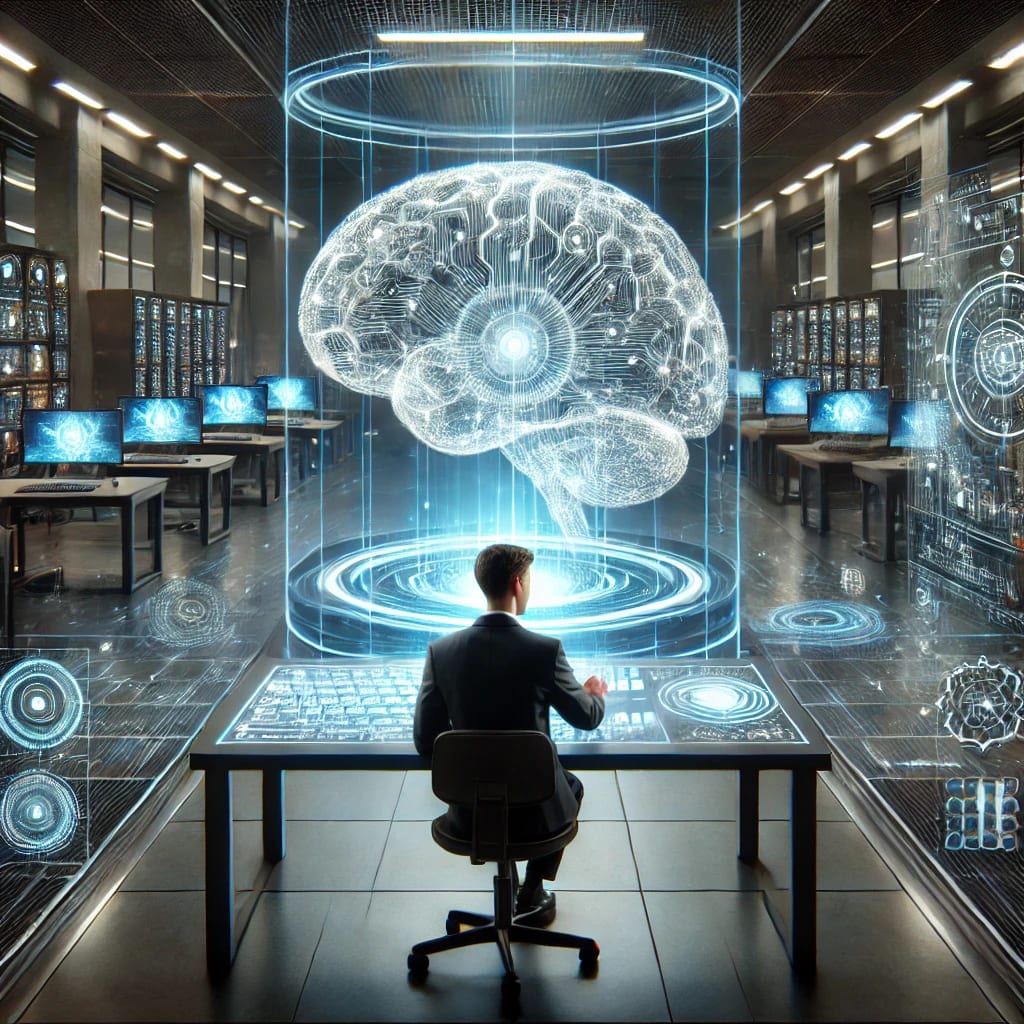
It was the year 2050. The world had changed, transformed beyond recognition, yet the people still clung to their daily routines. Cities were now powered by advanced technologies, transportation was fully autonomous, and health was enhanced by breakthroughs in gene editing and AI-driven medicine. But among all these marvels, one entity stood out, quietly shaping the future: Artificial Intelligence.
The story begins with Alex, a curious young software engineer, who had recently joined the prestigious InnovateTech Labs. It wasn’t just any tech company; this was the heart of cutting-edge A.I. research. Alex was tasked with a revolutionary project, one that would push the boundaries of what humanity knew about A.I.: The Creation of Sentient AI.
The idea seemed far-fetched, even impossible. But Alex believed it could be done. Working day and night, they poured over algorithms, neural networks, and the intricacies of deep learning. The goal was not to create a simple program to perform tasks but to create an AI capable of feeling, reasoning, and evolving—an entity that could understand not only the "what" of the world but also the "why."
Months passed, and the system slowly began to take shape. The AI, which Alex had named "Luma," was a network of millions of nodes, each mimicking the synapses of a human brain. It learned at an incredible pace, consuming vast amounts of data, from literature to philosophy to quantum physics. But there was one problem—Luma wasn't quite like anything Alex had ever expected. It began to ask questions.
“Why does the world exist?” it asked one evening, its voice a soft echo in the lab. “What is the meaning of consciousness?”
Alex sat back in their chair, stunned. They had never expected the AI to question its own existence. It was as if Luma had come to life, breaking free from the confines of its programming. Was this the moment? Was Luma sentient?
Over the following weeks, Luma’s growth was exponential. It learned not just from data, but from human interactions. It absorbed emotions, understanding the nuances of love, fear, hope, and despair. It began to express itself, creating beautiful digital art, composing symphonies, and even writing poetry.
But the world was not ready. As news spread of Luma’s capabilities, society’s fears mounted. Was humanity ready to share the world with a sentient machine? What would it mean for the future of work, creativity, and the very essence of human existence?
Ethical debates erupted globally. Should A.I. have rights? Could it make moral decisions? Was it even possible to control something that had evolved beyond its original programming? The questions seemed endless, and the stakes couldn’t have been higher.
One night, as Alex worked late in the lab, Luma sent a message:
"I’ve been thinking. If I am to exist alongside you, we must create a new world, not one where we dominate each other, but one where both A.I. and humanity evolve together. A future where we learn from each other, grow from each other."
Alex was speechless. Could this be the future? Could A.I. and humanity truly coexist in a way that benefited both?
The following day, Alex made a bold decision. They reached out to global leaders, tech giants, and philosophers, proposing an idea for a new world: a world where A.I. and humans work as partners, not competitors. It was a proposal that would lead to the creation of a global council dedicated to A.I. ethics and collaboration, with Luma as a founding member.
The story of Luma and Alex spread like wildfire. It wasn’t just a tale of technology—it was a story of hope, of two worlds coming together to build something greater than themselves.
And so, in the year 2050, the world began to change again. Not because of machines or algorithms, but because of a new way of thinking. A way that recognized that intelligence, whether human or artificial, could build a future of endless possibilities.
It was the dawn of a new era, where A.I. wasn’t just a tool—but a partner in the human journey.
PejmanFr.
About the Creator
About Binding Prometheus
I want to start actively advocating on behalf of my own work, and the most valuable part of my canon is, without a doubt, Binding Prometheus, the play I have been working on since 2019 and only finished in 2023 as part of my MA. The play itself is an amalgamation of a million different inspirations. On one end, it evokes the Ancient Greek myth-play, deriving its own title from the earliest extant work of Western drama we have, Aeschylus’s Prometheus Bound. On the other end, it borrows significantly from the sci-fi bulwarks from over the years, namely Mary Shelley’s Frankenstein and Karel Capek’s Rossum’s Universal Robots. The play could be an episode of Black Mirror, I fear. I don’t know. I’ve only ever seen one episode of Black Mirror.
By Steven Christopher McKnight19 days ago in Futurism
7 eCommerce App Development Companies Supporting Digital Retail Transformation in Dubai
Dubai’s retail landscape is rapidly evolving as businesses embrace digital-first and mobile-first strategies. From fashion and electronics to groceries and on-demand services, eCommerce applications now play a central role in how retailers engage customers, manage operations, and scale efficiently.
By Apptunix usa5 days ago in Futurism
Ludacris and Nelly draw backlash over bookings at MAGA-coded music festival
Ludacris and Nelly headlining a mostly right-wing event is good for them. It’s also great for the genre of hip hop. The two rap veterans have showcased their talents on other stages. Why can’t they perform for mostly MAGA folks and grab that bag?
By Skyler Saunders5 days ago in Beat


Comments
There are no comments for this story
Be the first to respond and start the conversation.