
The Arctic Time Vault: Secrets of a Civilization Frozen Beneath the Ice
As climate change melts glaciers, a hidden chapter of human history—and lost science—is being uncovered

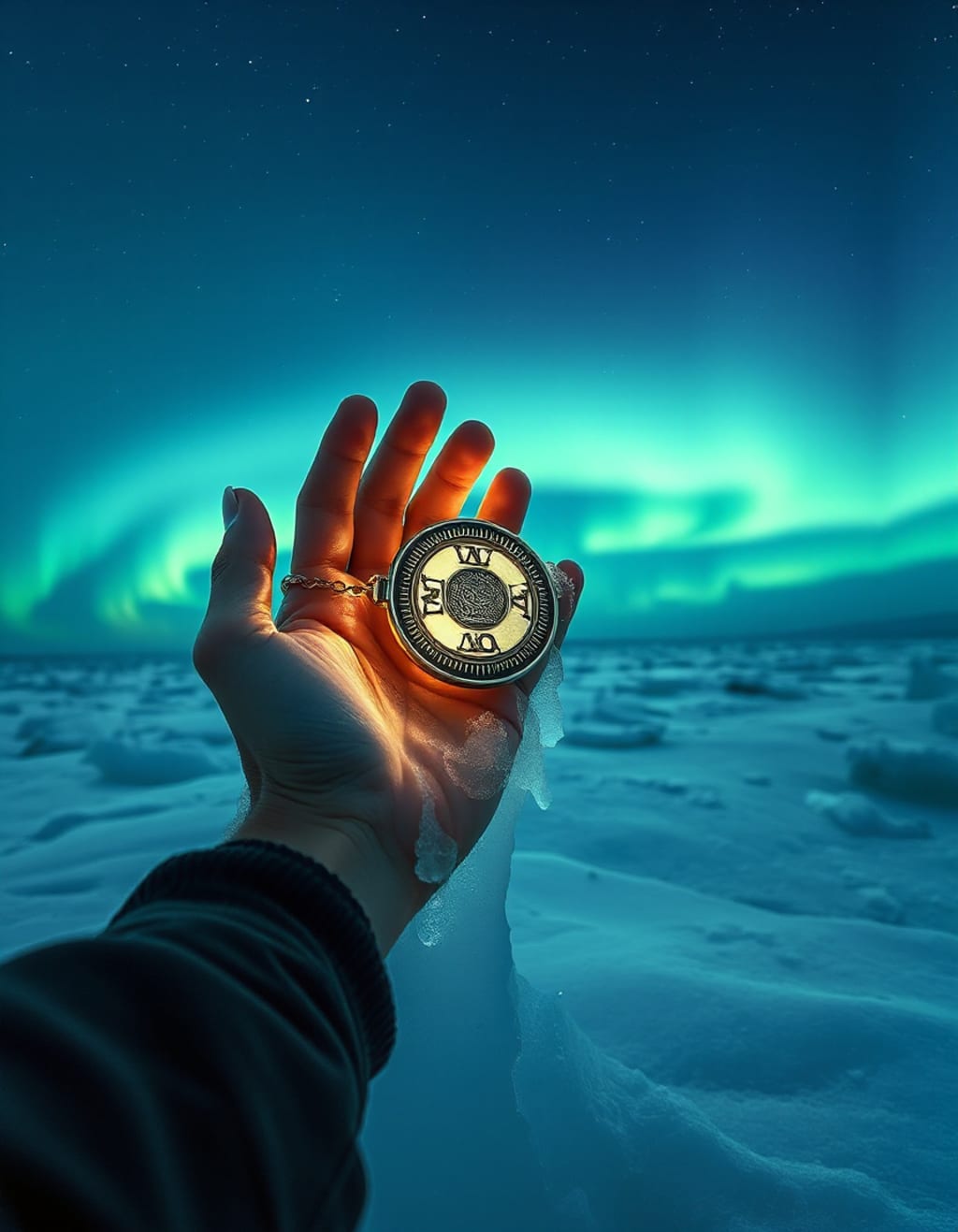
In the summer of 2028, a satellite flagged something unusual along the Greenlandic coast. A rapidly retreating glacier had exposed a symmetrical formation—too angular to be natural. The team at the British Geological Survey thought it was another rock anomaly.
But what lay beneath the ice would challenge everything we believed about early civilizations, and awaken one of the greatest scientific debates in the modern era.
The First Signal
It began with a sonar scan. Beneath 600 metres of compacted glacial ice, an underground cavity revealed geometric patterns: three concentric rings and a structure with proportions uncannily close to the Golden Ratio.
Climate change had made this moment possible. As permafrost retreated at unprecedented rates, ancient secrets long locked in ice were breaking through.
Dr. Miriam Leighton, a climatologist from the University of Edinburgh, led the first boots-on-ice expedition. “We expected fossils, maybe some preserved flora. We found architecture.”
It wasn’t until late August that a narrow entrance was fully exposed. Inside, under centuries of frozen silence, they discovered it: a subterranean chamber, preserved in ice, constructed from an alloy unknown to modern metallurgy, and inscribed with markings no linguist could translate.
The press called it the “Arctic Time Vault.” Scientists called it a paradox.
A Civilization That Shouldn’t Exist
Carbon dating was the first shock. The surrounding organic remains were over 100,000 years old—placing them tens of thousands of years before the known rise of Homo sapiens civilizations. No writing, no metallurgy, no monumental building should have existed then.
But the structure was there. It had survived glacial pressure. Inside were artifacts: spiral disks, spherical maps showing continental layouts startlingly similar to modern geography, and vials containing preserved botanical samples—some of which no longer existed on Earth.
One plant sample, dubbed Aethernis glacialis, revealed antimicrobial properties unseen in any modern medicine. British labs began synthetic trials by 2030.
If verified, it would mean that a civilization not only predated us—but had developed sophisticated medicinal knowledge before being swallowed by the Ice Age.
The Forgotten Genome
Among the most controversial discoveries was what became known as “Subject R-17”—a perfectly preserved humanoid figure encased in bio-glass. Genomic sequencing performed in Cambridge revealed a genome 97.6% identical to modern humans, but with several key differences related to neural structure and cellular aging.
R-17’s brain volume was marginally larger than ours. Its temporal lobes, responsible for memory and language, were unusually pronounced. And its mitochondrial efficiency—related to energy use and lifespan—was far beyond our own.
Was this a lost species of Homo? Or something else?
Dr. Alan Kersey, a neuroscientist at Oxford, stated: “If this being lived today, it would likely outlive us, outthink us, and possibly outheal us.”
Climate as the Great Eraser
By 2032, further Arctic digs had uncovered tools, writing tablets made of crystalized lignin, and water purification systems using layered quartz and copper—an ancient form of nanofiltration.
But as the ice melted further, many of these finds began degrading rapidly. The air—rich in microbes and pollutants—was hostile to preservation.
Climate change had exposed these secrets, but it was also erasing them.
To prevent total loss, a joint UK–UN effort began digitising every artifact, sample, and symbol in a project called "VaultEcho." A 3D map of the Arctic site was published globally. The UK Parliament debated funding a permanent cryo-research facility beneath Greenland—unprecedented in Arctic science.
Meanwhile, AI models began interpreting some of the carvings. One glyph, resembling the spiral of a galaxy, appeared alongside a star chart—pinpointing a location suspiciously close to the Taurus constellation.
Some claimed it hinted at an astronomical event. Others whispered of exodus.
A Warning from the Ice?
One decoded panel drew media frenzy. It showed what appeared to be a sequence: a lush green landscape, followed by storms, then floods, and finally—the symbol of ice locking everything in.
The team at the British Antarctic Survey, with help from linguists, interpreted it as a climate cycle map—perhaps a record of what led to this civilization’s extinction.
It eerily mirrored current Earth trends.
Could this lost Arctic culture have fallen victim to their own warming cycle? Could they have foreseen it and left behind a record—a warning?
Dr. Leighton returned to the site in 2034. “This isn’t just about archaeology anymore. It’s about survival. Their data may be the most valuable climate record we’ve ever found.”
The Technologies of Ice
Among the Vault’s artifacts were glass tablets embedded with microscopic symbols. Using quantum scanning, UK researchers uncovered that these symbols weren't decorative—they were data points.
Each tablet held compressed patterns of environmental records: pollen data, solar radiation levels, even tectonic activity.
It was a data vault frozen in ice—likely used to preserve their world’s knowledge for whatever—or whoever—came next.
One British physicist, Dr. Reina Malik, called it "an ancient black box recorder... left by a doomed flight called Civilization."
Inspired by this, in 2035, the UK and European partners began The Ice Memory Mirror, a contemporary Arctic vault designed to digitally store our own scientific and cultural records in glacial environments for future generations—should we fall like they did.
Public Response: Awe and Disbelief
Public fascination exploded. Museums in London and Edinburgh created “Ice Civilization” exhibits with holographic recreations. TikTok and Instagram flooded with speculative archaeology videos.
Some conspiracy theories spiraled: Were they aliens? Time travelers? Survivors of Atlantis?
But science held firm. “They were Earthlings. Just not our Earthlings,” Dr. Kersey reminded in a BBC interview.
Their rise, fall, and intelligence prove one chilling truth: Earth has housed advanced civilizations before—ones we’ve never known, and ones climate erased.
What We’re Learning—And Losing
By 2036, scientists had re-created three medicinal compounds, discovered a blueprint for ancient water harvesting, and begun modeling sustainable cities based on their architecture.
Their geometry used thermodynamics to naturally regulate heat and cold—no electricity needed. In a warming world, these principles are already being used in refugee shelter design in climate-hit regions.
But time is running out.
Permafrost decay accelerates each year. By 2040, much of the site could be lost.
A Final Message in Crystal
In late 2036, just before the site was sealed for preservation, a final chamber was opened. Inside: a translucent globe etched with microscopic text.
Its translated message haunts the scientific world:
"If you read this, you live. We once did too. We forgot our balance with the sky, the ice, and the fire beneath. We recorded what we learned, so you may not repeat our silence. Preserve it. Learn. Or vanish, as we did."
It was a plea. Not from gods, or aliens. From people.
People who may have once looked at the stars and wondered if anyone would ever find them.
Final Reflections
Today, classrooms across Britain teach the Arctic Time Vault as part of climate science and anthropology. Young minds are being raised with a new mantra: “Preserve knowledge, respect Earth, and listen to the past.”
And perhaps, for the first time in modern history, we understand that the future doesn’t only come from ahead of us.
Sometimes, it waits—buried beneath our feet.
About the Creator
rayyan
🌟 Love stories that stir the soul? ✨
Subscribe now for exclusive tales, early access, and hidden gems delivered straight to your inbox! 💌
Join the journey—one click, endless imagination. 🚀📚 #SubscribeNow
Your Face is Getting a Major Upgrade: 5 Game-Changing Features Coming to Meta Ray-Ban Display
When the $800 Meta Ray-Ban Display glasses hit the market in October, they felt like a prop pulled straight from a high-budget sci-fi thriller. For the early adopters who secured a pair, the experience of a heads-up display (HUD) glowing within their field of vision was nothing short of exhilarating. However, as with many first-generation devices, the initial thrill was tempered by a lingering sense that we were wearing a high-tech prototype—one that excelled at snapping photos and answering voice queries but remained largely tethered to a static, limited framework.
By Tech Horizonsa day ago in Futurism
Australia Pro AV Market: Hybrid Work Demand, Digital Signage & Smart AV Technologies
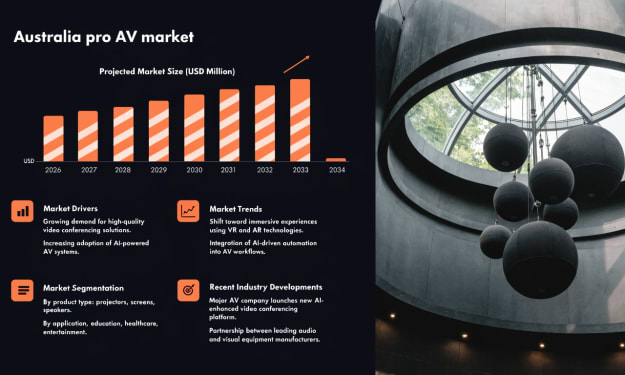
According to IMARC Group, the Australia pro AV market reached a value of USD 93.9 Million in 2025 and is projected to reach USD 133.6 Million by 2034, growing at a compound annual growth rate (CAGR) of 3.88% during 2026–2034. The market is expanding as organizations increasingly adopt advanced audiovisual solutions to support communication, collaboration and digital engagement. Hybrid work environments are encouraging businesses to invest in video conferencing systems, smart displays and integrated collaboration platforms that connect remote and in-office teams. At the same time, industries such as retail, hospitality and tourism are investing in digital signage to improve customer engagement and brand communication. As companies focus on creating interactive and technology-driven environments, professional AV solutions are becoming essential tools for modern workplaces, entertainment venues and commercial spaces across Australia.
By Kevin Cooper7 days ago in Futurism
My First Time Skiing and I Got Lost, Alone, in the French Alps
Looking back, I can trace some of my life’s biggest adventures to a simple action from my sister. She’d introduced me to Tommy (a very long time ago), a colleague of hers, who had overshared his penchant for Italian-looking women, and I ticked that box.
By Chantal Christie Weiss3 days ago in Humans



Comments (1)
This discovery is mind-blowing. The idea of a civilization existing so far back is crazy. I wonder how they managed to build such complex structures with unknown alloys. And those markings that no one can translate? That's a mystery waiting to be solved. Can't wait to hear more about what they find next.