
The Arctic Tensions: US Military Prepares as Russia and China Step Up Operations in the Region
A Cold Battle for Control: US Forces Face Rising Tensions as Russia and China Expand Arctic Presence

The Arctic Tensions: US Military Prepares as Russia and China Step Up Operations in the Region
As global temperatures rise and the Arctic ice sheet continues to recede, a new geopolitical hotspot has emerged in the resource-rich region: the Arctic. This once-forgotten expanse of icy terrain is becoming a focal point of global tension, with Russia and China increasingly positioning themselves for strategic advantage. The United States, closely monitoring these developments, is ramping up its military presence in the region, aware of the growing risks of conflict as the area becomes more accessible and contested.
The melting of the Arctic's ice has not only exposed new sea lanes and shipping routes but has also opened up vast, untapped natural resources, including oil and gas reserves. This has triggered a race between nations to establish control over the Arctic's resources, with Russia and China leading the charge. Over the past few months, military operations in the region have intensified, with both Russian and Chinese warships increasing their activity. In addition, bombers from both countries have been spotted patrolling the skies near Alaska, signaling a new chapter of military escalation in this cold, remote frontier.
The United States has been on high alert, especially as this new wave of military activity takes place in an area where tensions between global superpowers have historically been minimal. As Russia and China assert their influence, the Arctic has become a critical point of strategic interest, not just for its resources but for its growing importance in global military dynamics.
The U.S. Response: Special Operations in the Arctic
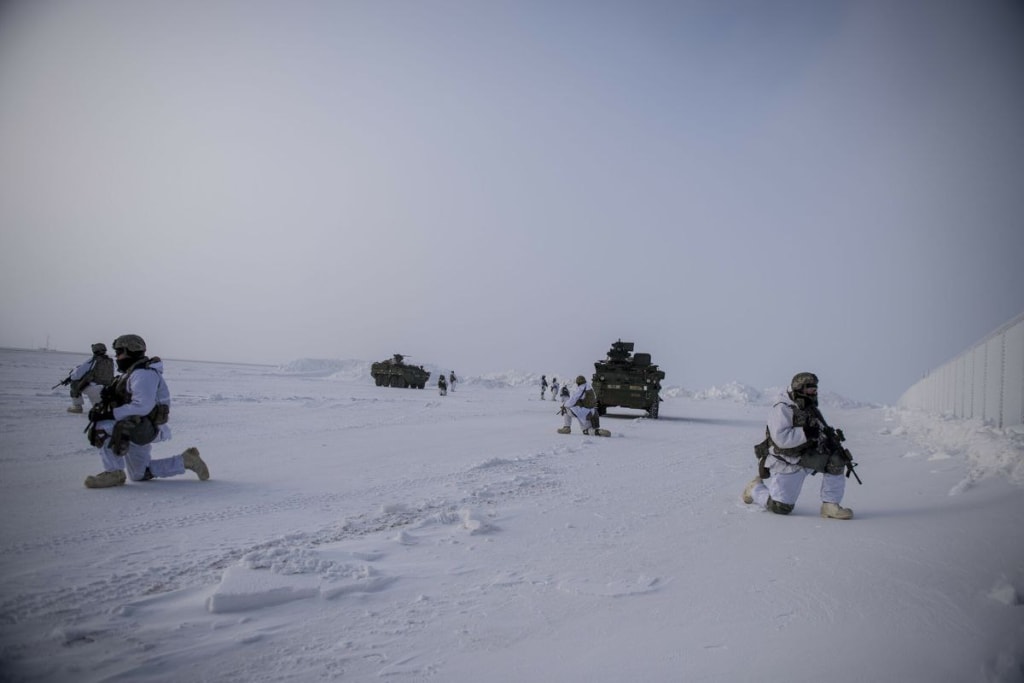
In response to the rising military activity in the region, the U.S. has ramped up its military preparedness, particularly through Special Operations forces. In an exclusive report, ABC’s Stephanie Ramos takes us to Alaska, where U.S. Green Berets are training to navigate the challenging Arctic environment and prepare for potential conflicts in the region. These Special Operations teams are stationed in some of the most remote, harsh, and dangerous areas of Alaska, making it the perfect training ground for Arctic warfare.
The Green Berets are stationed just miles from the Russian border, and their operations in these frozen territories are purposefully provocative. Their mission, known as Polar Dagger, is a strategic demonstration of the U.S. military’s ability to rapidly deploy forces in the Arctic, a message aimed at Russia’s leadership that highlights America’s readiness to respond to any military threat in the region. With Russia’s growing presence, including strategic bombers and icebreaker ships patrolling Arctic waters, this kind of readiness is becoming more critical than ever.
Colonel Matthew Tucker, one of the leaders of the operation, emphasizes that these military maneuvers are not designed to provoke conflict but to prevent it. “The goal of operations like Polar Dagger is not to create tensions but to deter them,” says Tucker. “We aim to demonstrate our capacity to project power quickly and maintain stability in a region that is becoming more volatile due to increasing Russian and Chinese military activity.”
A Fragile Balance: The Arctic’s Strategic Importance
The stakes in the Arctic are high, with both Russia and China eyeing the region for its strategic military and economic potential. As global temperatures rise, the once-impenetrable ice that has covered the Arctic for centuries is beginning to thin, opening up new shipping routes between Europe, Asia, and North America. These routes, which were once too hazardous to navigate, are now vital arteries for global trade. For countries like Russia, who have long viewed the Arctic as their backyard, this new access to the sea routes could provide a significant economic boost.
However, this opportunity also comes with immense risk. The Arctic is becoming a battleground for military dominance, with every move from Russia and China being carefully monitored by U.S. intelligence. The region’s proximity to the U.S., particularly Alaska, makes it an area of particular concern. The waters separating the U.S. from Russian territory are only a few miles wide at certain points, and when the ice freezes in the winter, the two nations are virtually a stone’s throw away from each other.
As tensions rise, the U.S. military has made it clear that the region’s stability is a priority. Through operations like Polar Dagger, U.S. forces demonstrate their ability to operate in these harsh conditions, counteracting any military build-up by adversaries. The goal is to maintain a strong presence to deter potential conflicts and ensure that no miscalculation occurs as Russia and China expand their operations.
A New Frontier for Global Tensions
The Arctic, once considered a remote and inhospitable wilderness, has now emerged as one of the most important fronts in global military strategy. As Russia and China increase their presence, and as the ice continues to melt, the U.S. military is bracing for a new era of competition in this frozen frontier. Special Operations forces are working day and night to monitor Russian and Chinese activities, ensuring that the U.S. maintains its edge in this new and rapidly evolving arena.
The outcome of this emerging Arctic conflict will have far-reaching implications, not just for military strategy, but for global trade, environmental policy, and national security. As the three superpowers jockey for position in this resource-rich region, the need for stability and cautious diplomacy has never been more critical. The Arctic is no longer just a land of ice and snow—it is a new theater of geopolitical tension, and the world is watching closely.
About the Creator
Keep reading
More stories from Cherub Kane and writers in Futurism and other communities.
Unidentified Drones Spotted Over US-UK Military Bases in England: Investigation Underway
Unidentified Drones Spotted Over US-UK Military Bases in England: Investigation Underway The US Air Force has confirmed multiple sightings of unidentified drones over four joint US-UK military bases located across England. These mysterious drone appearances have raised serious concerns, as they have been occurring repeatedly over the course of more than a week. The first sighting was reported on November 20th, and since then, military and government officials have been scrambling to investigate the nature and potential implications of these drone incursions.
By Cherub Kaneabout a year ago in Futurism
About Binding Prometheus
I want to start actively advocating on behalf of my own work, and the most valuable part of my canon is, without a doubt, Binding Prometheus, the play I have been working on since 2019 and only finished in 2023 as part of my MA. The play itself is an amalgamation of a million different inspirations. On one end, it evokes the Ancient Greek myth-play, deriving its own title from the earliest extant work of Western drama we have, Aeschylus’s Prometheus Bound. On the other end, it borrows significantly from the sci-fi bulwarks from over the years, namely Mary Shelley’s Frankenstein and Karel Capek’s Rossum’s Universal Robots. The play could be an episode of Black Mirror, I fear. I don’t know. I’ve only ever seen one episode of Black Mirror.
By Steven Christopher McKnight19 days ago in Futurism
Saudi Arabia Cancer Immunotherapy Market Advancing Treatment Adoption and Healthcare Innovation
According to IMARC Group's latest research publication, Saudi Arabia cancer immunotherapy market size reached USD 1,303.4 Million in 2025. The market is projected to reach USD 2,611.6 Million by 2034, exhibiting a growth rate (CAGR) of 8.03% during 2026-2034.
By Suhaira Yusuf4 days ago in Futurism




Comments
There are no comments for this story
Be the first to respond and start the conversation.