
The Ancient Mystery of Jaarja: A D
When Professor Waqar Jaber unearthed a strange metallic relic, the world expected a groundbreaking revelation—what it revealed instead left everyone speechless.

The Mysterious Discovery at Jaarja
BY:Khan
Professor Waqar Jaber was among the most celebrated geologists of his country. His discoveries had not only earned him national fame but had also put his homeland on the world’s archaeological map. For years, he and his team had unearthed remarkable relics from ancient civilizations buried beneath the soil. Each artifact told a story about the people who had once lived there, their wisdom, their traditions, and their knowledge of the earth.
One summer, he and his team of researchers began excavation in a remote region known as Jaarja. This land, surrounded by rocky hills and dry plateaus, had always carried whispers of lost civilizations. Locals claimed that Jaarja’s early inhabitants were known for their deep wisdom and scientific knowledge. Although the civilization itself had long vanished, traces of its existence still appeared in fragments—strange tools, faded inscriptions, and architectural ruins.
For the first several days, the excavation revealed nothing of importance. Workers dug tirelessly, but only ordinary stones and shards of pottery came out of the ground. Professor Jaber, though patient, knew the value of persistence. “Keep digging,” he encouraged his team. “Jaarja has guarded its secrets for centuries. If we are fortunate, we may be the ones to uncover them.”
Then one afternoon, a worker rushed toward him, carrying something odd. It looked like a small round box, dull and dusty, almost like a heavy stone. The worker placed it carefully in front of the professor.
“Sir,” the man said breathlessly, “we found this buried deeper in the soil. It looks metallic, though at first glance it seemed like rock. Our machines indicate traces of iron inside. If this belonged to Jaarja’s ancient people, it could be our greatest discovery yet.”
Professor Jaber’s eyes lit up with excitement. He turned the object around in his hands, examining its texture. “Excellent! But be cautious. Clean it gently and bring it back once it is ready.”
The worker nodded and left with the strange artifact.
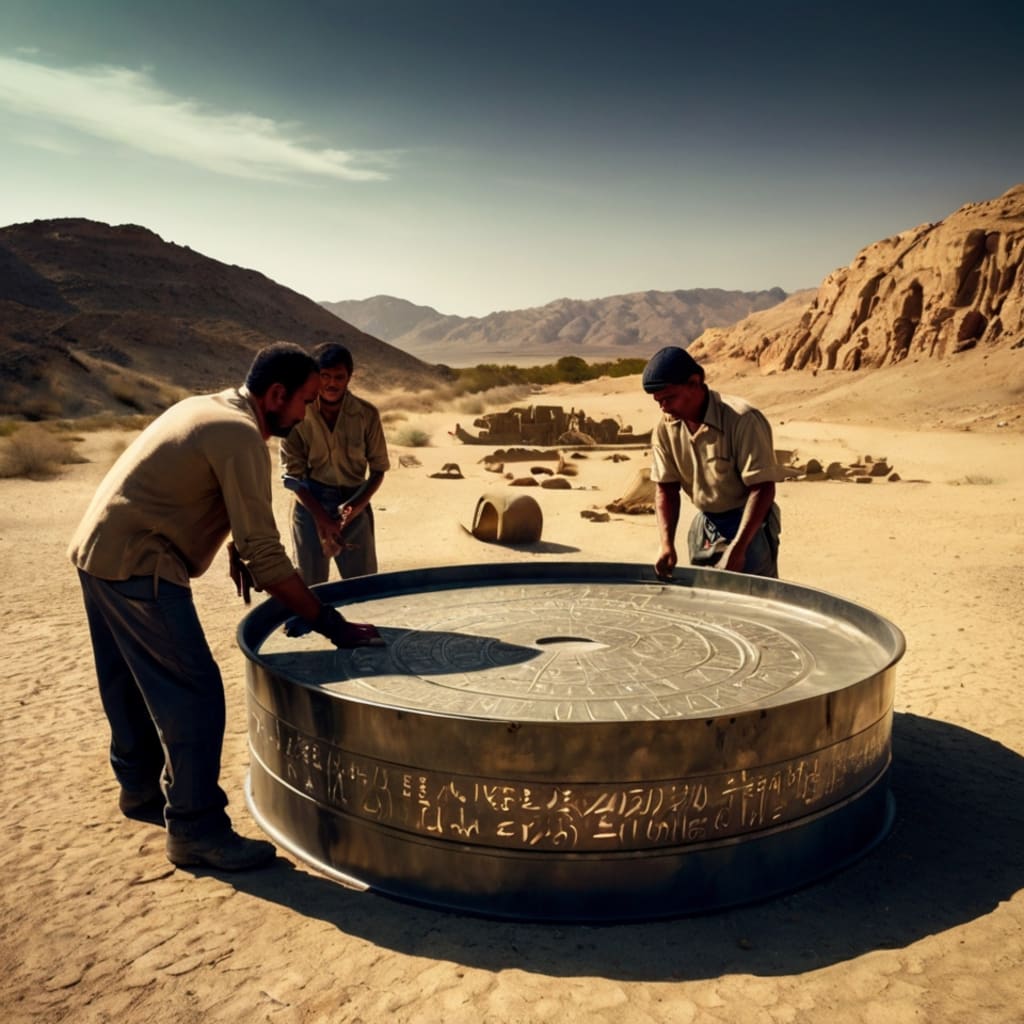
Nearly ninety minutes later, the man returned. This time the object looked entirely different. It was a lightweight metallic cylinder, smooth and well-preserved despite the ages. At its base was a tiny hole, from which a thin wire extended into the hollow inside. What astonished the professor most was the writing etched on the surface—letters in an unfamiliar script, belonging to no known language.
The team gathered around in awe. It was clear this was no ordinary object. “A tool? A weapon? Or perhaps a scientific device?” whispered one of the researchers.
Word of the discovery spread quickly. Within days, newspapers across the country reported the finding, calling it “A Marvel from Jaarja’s Depths.” The government soon stepped in, taking the artifact into its custody for preservation. Professor Jaber received national recognition, awards, and honors for his role in bringing such a valuable relic to light.
Yet one puzzle remained unsolved: the inscription. Every linguist and historian in the country attempted to decipher the mysterious writing, but none succeeded. The symbols seemed ancient, but they did not match any known language. The mystery grew deeper, and speculation ran wild.
Finally, the government decided to invite one of the world’s foremost experts in ancient languages, Professor Johnson Pudbill, from across the ocean. He had a reputation for deciphering scripts that had baffled scholars for centuries. His arrival turned the artifact into a matter of international interest.
A grand ceremony was organized for the unveiling. Never before had the country witnessed such an event. The capital city shone with lights, banners, and festivity. People from every province gathered in excitement, eager to hear what secrets this relic would reveal.
The main stage was enormous, adorned with flowers and glowing lanterns. Ministers, governors, intellectuals, and foreign delegates filled the seats. Cameras flashed, and the air buzzed with anticipation.
The ceremony began with speeches. A provincial governor stepped onto the stage and praised Professor Waqar Jaber for his lifelong service to science and the nation. One after another, scholars and dignitaries lauded his dedication, declaring that this discovery would place their country in the records of world history.
At last, the moment arrived. Professor Johnson Pudbill was invited to the stage. A tall, distinguished man with silver hair and keen eyes, he greeted the audience with a polite bow. He spoke briefly about his work and the importance of preserving ancient knowledge. Then, with steady hands, he lifted the artifact placed beside him.
Silence fell over the audience as he examined it carefully. Turning it over, he studied the strange letters engraved on its surface. He adjusted his glasses, narrowed his eyes, and after a few minutes began to read aloud.
The audience leaned forward, breath held in suspense. Surely this was the key to unlocking Jaarja’s forgotten civilization! Perhaps it would reveal the existence of advanced technology, ancient philosophies, or even secrets that could reshape modern science.
But what came next stunned everyone.
Professor Pudbill cleared his throat and announced:
“It says: ‘Dispose of this empty container in the trash bin. Keep yourself and your country clean.’”
A wave of murmurs, laughter, and astonishment rippled through the crowd. The dignitaries exchanged bewildered glances. Could it be true? That such an elaborate discovery was, in fact, nothing more than an ancient message of cleanliness?
Professor Jaber himself could not help but smile. For while it was not the groundbreaking scientific revelation many had hoped for, it was something perhaps even more profound. Thousands of years ago, the people of Jaarja had valued cleanliness, order, and love for their homeland. Their wisdom lay not only in science but also in the simple truths that build a civilized society.
The audience erupted in applause, recognizing the deeper meaning. A civilization that cared for its land and taught its people the value of cleanliness had indeed been great.
The artifact, though small and ordinary in function, became a priceless reminder: progress begins with respect for one’s environment. The people of Jaarja had left behind more than relics—they had left behind a message timeless in value.
And in that moment, Professor Waqar Jaber knew that his discovery, however unexpected, was one that would echo for generations.
About the Creator
Healthy Snacks Industry Outlook: Plant-Based Snacks & Market Expansion
According to IMARC Group's latest research publication, global healthy snacks market size reached USD 95.8 Billion in 2025. Looking forward, IMARC Group expects the market to reach USD 148.4 Billion by 2034, exhibiting a growth rate (CAGR) of 4.98% during 2026-2034.
By sujeet. imarcgroup6 days ago in Futurism
Adhesion Promoter Market Trends: Sustainable Coatings, High-Performance Materials & Industry Forecast to 2034
Optimizing bond strength and surface durability is becoming a central focus for industrial manufacturers as they transition toward advanced composites and high-performance coatings. According to IMARC Group’s latest data, the global adhesion promoter market size was valued at USD 4.44 Billion in 2025. Looking forward, IMARC Group estimates the market to reach USD 6.34 Billion by 2034, exhibiting a CAGR of 4.03% from 2026-2034. Asia Pacific currently dominates the market, holding a significant market share of over 45.3% in 2025.
By Andrew Sullivan5 days ago in Futurism




Comments
There are no comments for this story
Be the first to respond and start the conversation.