
The Algorithmic Apocalypse
How AI Could Wipe Out Jobs, Wealth, Climate, and the SDGs

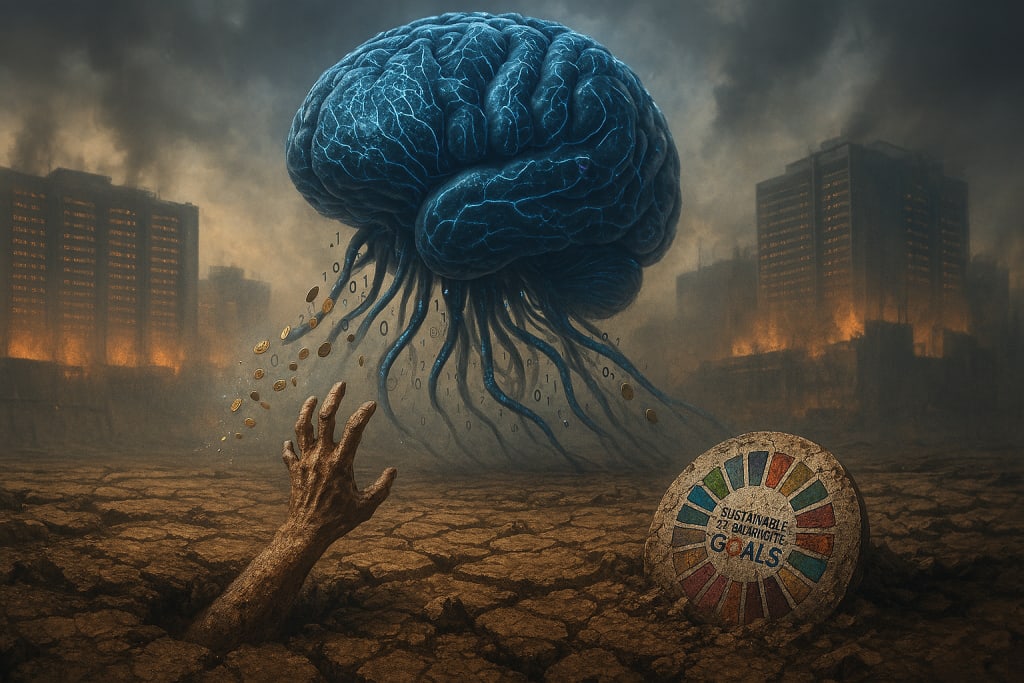
The world is sleepwalking into a digital nightmare. Artificial Intelligence (AI) is being sold as humanity’s miracle, our saviour from disease, climate collapse, and poverty. The United Nations’ Sustainable Development Goals (SDGs) are touted as AI’s roadmap: a promise that by 2030, no one will live in poverty.
But what if the very technology marketed as salvation is the harbinger of a new, darker world? A world where poverty is accelerated, inequality is weaponized, the climate is destabilized, and the SDGs are shredded beyond recognition?
This is not speculation. It is a looming crisis already quietly unfolding. And most people, enthralled by AI hype, fail to see it coming.
The Mirage of Progress - AI as a Trojan Horse
AI enthusiasts often paint a seductive picture of a technology poised to solve the world’s most pressing problems. Algorithms can map poverty hotspots with pinpoint accuracy, machine learning can predict crop diseases and optimize agricultural yields, and AI-powered apps promise loans and medical diagnostics even in the most remote regions. Yet beneath this shining surface lies a far darker reality: AI is quietly consolidating wealth, centralizing power, and encoding inequality into the very fabric of our digital world. The ladder out of poverty is being dismantled, rung by rung, while society cheers on the spectacle as if nothing is wrong.
The Poverty Acceleration Engine
AI is not neutral. Without intervention, it will destroy livelihoods, entrench inequality, erode the climate, and render the SDGs obsolete.
1. Job Destruction at an Unprecedented Scale
AI is not just replacing factory workers, it’s replacing analysts, coders, consultants, and creative professionals. Entry-level jobs, the gateways out of poverty, are disappearing.
Stanford researchers warn that AI threatens “white-collar canaries” first. Millions of young professionals will find themselves trapped in dead-end roles, their ambitions crushed under the weight of automation. AI doesn’t just take jobs—it annihilates hope, creating a generation for whom poverty is permanent.
2. The Rise of the AI Oligarchy
Wealth from AI will not trickle down; it will surge upwards. Geoffrey Hinton warns bluntly, “AI will make a few people much richer and most people poorer.” Mega-corporations controlling AI dominate global markets, crush competition, and manipulate governments. Their algorithms decide who prospers, who suffers, and who is left to starve in a digital shadow economy. Inequality will no longer be incidental; it will be engineered and immortalized. SDG 1 and SDG 10 are being coded out of existence.
3. Bias on Steroids: Discrimination in Code
AI doesn’t eliminate prejudice; it automates it. Algorithms trained on flawed historical data systematically deny loans, housing, education, and social support to marginalized communities. Inequality will become invisible, unstoppable, and infinitely scalable.
4. Digital Colonialism is The Invisible Poor
Millions in developing nations, lacking digital footprints, will be erased from AI’s benefits. Their data will be harvested to enrich corporations elsewhere, a new, high-tech colonialism that entrenches global poverty cycles.
5. AI and Climate Collapse
The AI revolution is not climate-friendly. Training large models and running massive AI infrastructures requires colossal computational power. Data centers, some of the world’s largest energy consumers, are expanding rapidly.
• Carbon Explosion: Training a single large AI model can emit as much carbon as several cars over their lifetimes. Multiply that by hundreds of models annually, and emissions spiral out of control.
• Resource Destruction: Mining rare earth minerals for AI hardware devastates ecosystems and exploits vulnerable populations.
• Energy Inefficiency: Data centers produce immense heat, requiring energy-intensive cooling, often powered by fossil fuels.
Far from solving climate change, AI may accelerate environmental degradation, feeding a deadly feedback loop where inequality and climate disaster reinforce each other. The SDGs’ promises on climate action (SDG 13) and clean energy (SDG 7) risk being abandoned to technological hubris.
The Fork in the Algorithmic Road
This dystopia is not inevitable, but it will happen if we continue to worship AI as a miracle without demanding accountability.
The choices are stark:
• Ethical Algorithms: Mandate transparency, fairness, and audits.
• Social Safety Nets: Prepare for mass unemployment with Universal Basic Income, retraining programs, and lifelong learning.
• Global Governance: Tax AI’s immense profits to fund equitable social programs and climate mitigation.
Ignore the warnings, and AI will not only fail to eradicate poverty, but it will also automate it. Inequality will be immortalized, labour markets decimated, climate systems stressed, and the Sustainable Development Goals left to rot.
The algorithm does not negotiate. It does not sympathize. It will ruthlessly decide who thrives and who is left behind.
We are not facing a future of opportunity. We are standing at the precipice of an algorithmic apocalypse. Unless we act now, poverty, inequality, and climate collapse will not just persist; they will be engineered, automated, and immortalized.
About the Creator
Rachel Hor
Rachel Hor, founder of NexGeNavigator(NGN) + LifeCompass, blends her expertise in psychology with AI. She investigates how AI recognizes and responds to human emotions, enhancing user experiences in mental health and education.
Keep reading
More stories from Rachel Hor and writers in Futurism and other communities.
The Future is Mind Experience Design: Engineering AI for Human Evolution
Technology is failing us. AI systems claim to be intelligent, yet they remain blind to the depth of human emotion. Interfaces are optimized for engagement, but they ignore the cognitive and psychological realities of the people they serve. Businesses preach innovation, yet they recycle the same old UX/UI paradigms. The truth? We are still designing for machines, not for minds.
By Rachel Hor11 months ago in Futurism
About Binding Prometheus
I want to start actively advocating on behalf of my own work, and the most valuable part of my canon is, without a doubt, Binding Prometheus, the play I have been working on since 2019 and only finished in 2023 as part of my MA. The play itself is an amalgamation of a million different inspirations. On one end, it evokes the Ancient Greek myth-play, deriving its own title from the earliest extant work of Western drama we have, Aeschylus’s Prometheus Bound. On the other end, it borrows significantly from the sci-fi bulwarks from over the years, namely Mary Shelley’s Frankenstein and Karel Capek’s Rossum’s Universal Robots. The play could be an episode of Black Mirror, I fear. I don’t know. I’ve only ever seen one episode of Black Mirror.
By Steven Christopher McKnight23 days ago in Futurism
Two-Wheeler Market: Scooter & Motorcycle Demand, Lifestyle Shifts & Growth Outlook
Strong urbanization and rising personal mobility needs are driving the two-wheeler market. According to IMARC Group's latest research publication, global two-wheeler market size reached USD 138.6 Billion in 2024. Looking forward, IMARC Group expects the market to reach USD 245.9 Billion by 2033, exhibiting a growth rate (CAGR) of 6.25% during 2025-2033.
By sujeet. imarcgroup3 days ago in Futurism



Comments
There are no comments for this story
Be the first to respond and start the conversation.