
The Algorithm That Couldn’t Grieve
What the age of perfect prediction forgot about being human


I. The Dashboard at 3:17 A.M.
At 3:17 a.m., the dashboard glowed like a small, contained sun in my apartment. Blue bars climbed and fell with obedient grace. Numbers refreshed themselves, indifferent to the hour, to my bare feet on cold tile, to the silence that had settled after the city exhaled. Somewhere inside those figures was a promise: clarity without cost. If I stared long enough, the mess of living would resolve into something legible.
Earlier that evening, a friend had called to tell me her father had died. The news arrived without drama, a sentence delivered cleanly, almost efficiently. I offered words that felt pre-approved, sympathy rendered in a standard font. When the call ended, I returned to the dashboard, as if it could absorb what I could not. The numbers did not change. They never do.
There is a peculiar comfort in systems that refuse to notice your sorrow. They keep working. They ask nothing. They make grief feel like an error state you can toggle off.
II. The Cathedral of Metrics
We have built a cathedral out of metrics. Its columns are conversion rates and engagement curves; its stained glass refracts reality into charts that glow with significance. Inside, we whisper prayers to prediction models and leave offerings of data, hoping for certainty in return. The faith is not irrational. The cathedral stands because it works. It keeps the rain off. It organizes crowds.
Data logic has given us extraordinary gifts. It maps epidemics before they bloom. It allocates resources with a fairness no single human could manage. It learns, relentlessly, from the past. Standing beneath its vaulted ceilings, it is easy to believe that meaning itself might be quantified, that the human story could be reverse-engineered into something clean and solvable.
Yet cathedrals are not homes. They inspire awe, not rest. Their beauty is vertical, their acoustics designed to amplify echoes rather than whispers. When you bring your small, private ache into such a space, it feels either irrelevant or uncomfortably loud.
III. Weather Inside the Chest
Human emotion does not behave like data. It behaves like weather.
Grief arrives as a pressure system, heavy and low, then lifts without warning. Joy is a sudden clearing, light breaking through at the wrong hour. Love can be a drought followed by a flood. None of it respects schedules. None of it submits to tidy causality. You cannot average a storm and call it a day.
I learned this the week after my friend’s call. I woke expecting the sharpness of sadness, only to find a strange neutrality instead. At noon, a song in a grocery store aisle cracked me open. By evening, I felt almost normal, which felt like a betrayal. The data-minded part of me wanted a curve, a predictable decay of pain. What I experienced instead was turbulence.
Nature does not apologize for its volatility. Mountains rise through violence. Forests burn to renew themselves. Rivers carve valleys by refusing to go straight. Emotion is not a bug in the system; it is the terrain.
IV. When Prediction Meets the Unmeasurable
Midway through my vigil with the dashboard, a realization intruded, uninvited and unwelcome. The models I admired were astonishing at telling me what would happen next—what people would click, buy, avoid. They were silent on the only question that mattered in that moment: how to sit with loss.
Prediction thrives on repetition. It feeds on what has already occurred. Grief, however, is always new to the person experiencing it. Even familiar losses feel unprecedented when they arrive. The mind searches its archives and finds them inadequate.
This is where the synthesis falters. We have asked cold logic to stand in for wisdom. We have confused foresight with understanding. An algorithm can tell you that people who lose parents often feel X at time Y. It cannot sit beside you when X refuses to appear, or when Y stretches into something shapeless.
The failure is not technological. It is philosophical. We have optimized for control and called it insight.
V. The Architecture of Listening
There is another structure worth studying: the house built to listen.
Unlike cathedrals, such houses are horizontal. They are made of rooms rather than naves, thresholds rather than towers. They creak. They absorb sound. They allow for silence without making it feel empty. In them, conversations wander. Time slows.
I found one of these houses in an unlikely place: a late-night kitchen, where my friend and I sat days after her loss. No dashboards. No advice. The refrigerator hummed like a patient animal. We spoke in fragments. Sometimes we did not speak at all. The architecture did the rest.
Listening is not passive. It is an active suspension of the urge to resolve. It is a refusal to turn a person into a problem statement. In a culture obsessed with outputs, listening feels inefficient, almost indulgent. Yet it is the only method that consistently yields something resembling truth.
VI. The Necessary Friction
There is a temptation to imagine a future where emotion is finally tamed—where sensors detect sadness early, where interventions are deployed before pain becomes unmanageable. The vision is seductive. It promises a world with fewer sharp edges.
But friction is how we know we are alive. It is how character forms, how empathy deepens. Remove it entirely and you do not get utopia; you get anesthesia.
Data logic excels at smoothing surfaces. Human emotion requires texture. The synthesis, if it exists, is not about elimination but accommodation. It is about designing systems that know when to step back, when to leave space for the unoptimized moment.
In nature, ecosystems thrive on diversity, on competing forces held in delicate balance. Monocultures are efficient until they collapse. The same is true of our inner lives. A single mode of understanding—no matter how powerful—cannot sustain us.
VII. What Remains After the Numbers Go Dark
Eventually, the dashboard dimmed. The night ended, as nights do, without ceremony. Morning brought its ordinary light, revealing dust on the shelves, a plant leaning toward the window. None of it was optimized. All of it was sufficient.
The global conclusion is quieter than the predictions that dominate our headlines. We will continue to build machines that see farther and faster than we can. We should. They will save lives and time and, occasionally, us from ourselves. But they cannot replace the human capacity to feel without immediately fixing, to endure ambiguity without demanding closure.
The future does not belong to logic or emotion alone. It belongs to those who can stand at their intersection, holding a map in one hand and a weathered heart in the other, accepting that some truths arrive as numbers and others as storms.
Long after the metrics have been archived, what will remain are the kitchens, the gardens, the moments that refused to be predicted. They will not trend. They will not scale. They will, quietly and stubbornly, continue to matter.
About the Creator
Alpha Cortex
As Alpha Cortex, I live for the rhythm of language and the magic of story. I chase tales that linger long after the last line, from raw emotion to boundless imagination. Let's get lost in stories worth remembering.
Keep reading
More stories from Alpha Cortex and writers in Futurism and other communities.
The Eye on the Digital Wall
Chapter 1: Calibration The Eye went online at 03:14 a.m. GMT. There was no announcement. No system-wide notification. Just a quiet boot sequence buried inside the protocol logs of the Global Digital Oversight Network. One blinking cursor. One new process.
By Alpha Cortex10 months ago in Futurism
The Future of Stucco: Market Dynamics and Sustainable Building Trends
According to IMARC Group's latest research publication, The global stucco market size reached USD 12.3 Billion in 2024. Looking forward, IMARC Group expects the market to reach USD 16.9 Billion by 2033, exhibiting a growth rate (CAGR) of 3.39% during 2025-2033.
By Michael Richard2 days ago in Futurism
Flow Chemistry Market Analysis: Process Automation, Safety Benefits & Forecast to 2033
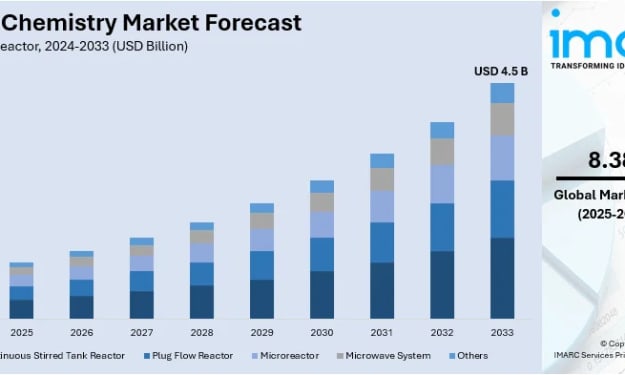
Growing demand for sustainable chemical processes, precise reaction control in pharmaceutical manufacturing, and the rise of continuous production methods are reshaping the flow chemistry landscape. Clean-label manufacturing trends, technological innovation in microreactor systems, and expanding adoption across pharmaceutical, chemical, and petrochemical sectors are further accelerating market momentum. According to IMARC Group's latest data, the global flow chemistry market size was valued at USD 2.0 Billion in 2024. Looking forward, IMARC Group estimates the market to reach USD 4.5 Billion by 2033, exhibiting a CAGR of 8.38% from 2025-2033. North America currently dominates the market, holding a market share of over 37.7% in 2024.
By Andrew Sullivan3 days ago in Futurism



Comments
There are no comments for this story
Be the first to respond and start the conversation.